Export commodity descriptions are the foundation of international trade documentation. The words you write on a commercial invoice, bill of lading, or packing list determine how the shipment is classified at customs, what duties apply, and whether the goods pass smoothly or get held for inspection. For polyurethane faux wood beams, writing an accurate description requires understanding the product, the classification system, and what customs authorities in the destination country are looking for.
A poorly written description can cause delays, unexpected duties, or even rejection of the shipment. An accurate description that follows international standards gets processed quickly and minimizes the friction between your factory and your buyer's receiving dock. The time spent getting the description right is an investment in smooth logistics.
The key is specificity. Generic descriptions like "decorative wood products" or "building materials" trigger further inquiry because they do not tell the customs officer what the product actually is. A description that names the product, its material, its function, and its non-structural nature answers the questions before they are asked.
Understanding HS code classification
The Harmonized Commodity Description and Coding System, commonly called the Harmonized System or HS, provides the framework for international trade classification. Nearly every country uses the HS system as the basis for their customs tariffs, though each country assigns its own duty rates and may add additional requirements beyond the international standard.
Polyurethane faux beams typically fall under Chapter 39, which covers plastics and articles thereof. The specific subheading depends on the exact nature of the product. Articles of polyurethane, not elsewhere specified or indicated, often fall under 3925 or 3926 subheadings, which cover various plastic articles for domestic or commercial use.
For faux wood beams specifically, the relevant classification is often 3925.90, covering "Builders' ware of plastics, not elsewhere specified or indicated." This subheading captures decorative plastic moldings and similar architectural elements that do not have a more specific classification elsewhere. Duty rates under this classification vary by destination country.
The buyer or their customs broker is ultimately responsible for confirming the correct classification for their specific country. Providing a suggested classification on commercial documents is helpful, but final classification decisions rest with the importing country's customs authority. Disputes over classification can be resolved through formal binding ruling processes in most major trading countries.
Essential elements of a complete description
A complete export commodity description for polyurethane faux beams should include several specific elements. The material must be named. "Polyurethane" or "polyurethane resin" is more accurate than "plastic" and provides customs authorities with the specific polymer type. Some countries have different duty rates or import restrictions for different plastics.
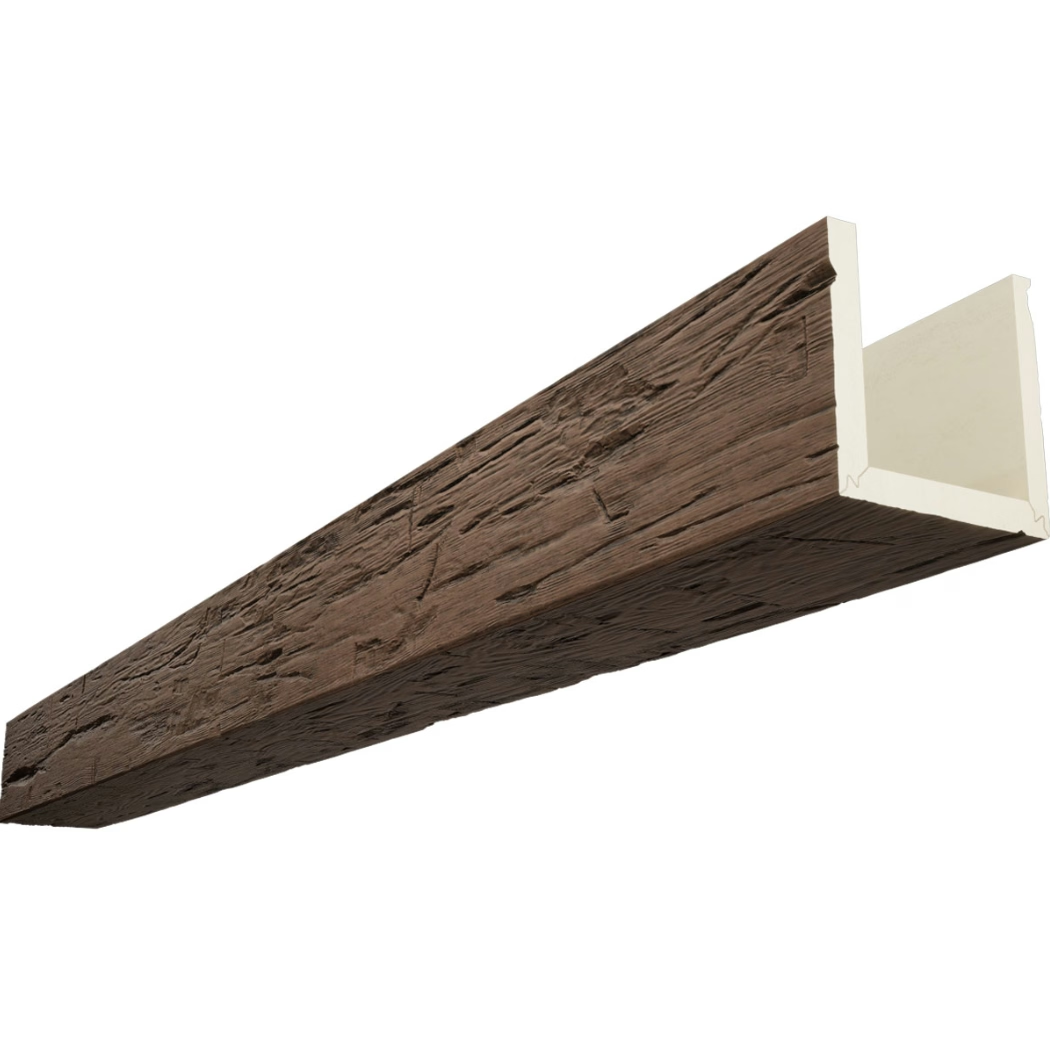
The physical form should be described. "Molded" or "injection molded" describes how the product is manufactured. "Hollow" or "semi-hollow" indicates the internal structure. "Decorative" or "non-structural" clarifies the function. Each of these descriptors narrows the classification and helps customs officers understand exactly what they are examining.
The intended use must be clear. "Ceiling decoration" or "architectural trim" tells customs that the product is for finishing work rather than structural use. This distinction matters for some classifications and helps the customs officer route the shipment to the correct processing pathway.
The dimensions are helpful if included. "Approximately" dimensions that give a sense of the product size help the customs officer verify that the shipment matches the documentation. A description that says "various sizes" followed by the actual range of dimensions in the shipment is acceptable, but exact dimensions are better.
A complete example description reads: "Non-load-bearing polyurethane molded decorative ceiling beam elements, hollow construction, approximately 100mm x 150mm cross-section, 2-4 meters in length, for architectural interior decoration." This description answers all the questions a customs officer would ask before asking them.
What goes on the commercial invoice
The commercial invoice is the primary document for customs purposes. Every country requires one, and they all have slightly different requirements for what it must contain. The commodity description on the commercial invoice should be the most complete version of all your shipping documents.
Include the full legal name of the product as recognized in international trade. "Polyurethane molded decorative ceiling beams, non-structural" is clearer than an abbreviated product name used in domestic marketing. The description should be one your buyer can use with their customs broker without needing additional explanation.
Quantity should be specified in both units and measurement. "50 pieces" or "100 linear meters" tells the customs officer the scale of the shipment. "50 pieces of polyurethane decorative ceiling beams, measuring approximately 6x8 inches in cross-section and 3-12 feet in length" gives complete information.
Value must be stated in the currency of sale and in a common international currency (usually USD or EUR). The Incoterm determines whether the stated value includes freight, insurance, and other costs. A CIF value in Rotterdam is different from an FOB value at origin. Specify which Incoterm applies and ensure the value reflects it.
Country of origin must be stated clearly. For polyurethane beams, this is typically China, Vietnam, or another manufacturing country. Some countries have different duty rates depending on the origin, and the customs officer will look for this information regardless of what the rest of the description says.
Additional shipping document requirements
The bill of lading summarizes the commercial transaction for the carrier and customs. The description on the bill of lading can be slightly abbreviated compared to the commercial invoice, but it must contain enough information to identify the shipment. An abbreviated description like "50 pcs polyurethane decorative ceiling beams" is acceptable if the full description appears on the commercial invoice.
The packing list itemizes the contents of each package. For shipments with multiple SKUs, sizes, or finishes, the packing list ensures customs can verify what is actually in each box or crate. The packing list description can match the commercial invoice description, or it can be more specific about package contents.
A certificate of origin may be required depending on the destination country and the trade agreements in place. For shipments to countries with free trade agreements with the manufacturing country, the certificate of origin enables preferential duty rates. The description on the certificate of origin should match the description on the commercial invoice exactly.
Dangerous goods documentation is not typically required for polyurethane faux beams, which are not classified as hazardous materials. However, some countries require MSDS documentation for polyurethane products due to concerns about isocyanates. Check the destination country's requirements before shipping.
Country-specific considerations
The United States uses the Harmonized System with its own additional digits for more specific classification. Polyurethane decorative beams may fall under US subheading 3925.90, which carries a duty rate of 3.3 percent for most countries. US customs also requires detailed country of origin labeling on the packaging.
The European Union classifies polyurethane decorative articles under CN code 3925 90 80, with a duty rate of 6.5 percent for most-favored-nation countries. The EU also requires REACH compliance documentation for polyurethane articles that may release regulated substances. VOC emissions documentation may be requested for interior decoration products.
Canada classifies polyurethane decorative items under HS code 3925.90, with duty rates varying by province and product type. Canadian customs may request documentation on whether the product is considered a "manufactured article" versus a "building material," which affects classification.
Australia and New Zealand have similar HS-based systems with their own duty schedules. Both countries have strict biosecurity requirements that may apply to wood-containing products, though polyurethane beams generally do not face the same restrictions as wood products. Check specific requirements before shipping to either market.
Asian markets including Japan, South Korea, and Singapore have their own customs processes. Japanese customs (Japan Customs) may request detailed Japanese-language documentation or certified translations. Korean customs has specific requirements for polymer product classifications that differ slightly from the international standard.
Common description errors to avoid
Vague descriptions like "faux wood beams" without specifying the material create confusion. Customs officers cannot classify a product without knowing what it is made of. Always specify "polyurethane" or "polyurethane resin" rather than leaving the material undefined.
Omitting the non-structural nature of the product can trigger structural review. If customs believes the beams might be load-bearing construction materials, they may request engineering certifications or apply different duty rates. Explicitly stating "non-load-bearing" or "decorative only" prevents this issue.
Incorrect unit of measure causes discrepancies between the documentation and the physical shipment. If the description says "50 linear meters" but the shipment contains 50 pieces of varying length, customs may question the accuracy. Use consistent units and verify that quantities match across all documents.
Failure to update descriptions for new products leads to misclassification. If you introduce a new profile or finish that does not match your standard description, update the documentation accordingly. Using a stale description for a new product type creates classification errors that can lead to duty assessments or penalties.
Working with customs brokers
A customs broker in the destination country is your best resource for accurate classification and documentation. Brokers have experience with local requirements and can identify issues before they cause delays. Many brokers offer classification review services where they check your documentation against local requirements before shipment.
Provide your broker with complete product information, including material composition, manufacturing process, intended use, and any certifications or test reports available. The more information the broker has, the more accurately they can classify the product and advise on documentation requirements.
Confirm classification with your broker before finalizing documentation. A quick email with the product description and asking for confirmation of the correct HS code and any additional requirements takes minutes but prevents problems at destination. Brokers appreciate being consulted early rather than being asked to fix problems after the shipment has been sent.
Maintain a file of approved descriptions and classifications for each market you serve. When you ship to the same country again, start with the previously approved description and update only if the product has changed. This consistency speeds up customs processing and reduces the risk of classification disputes on repeat shipments.
Technical References
ASTM standards cited in every specification
Test Data
Lab results from internal testing program
Updated 2026
Reviewed against current product specs