
Products that travel internationally face challenges that domestic shipments never encounter. Long ocean voyages expose cargo to salt air, humidity variations, and the physical stresses of container stacking. Multiple handling operations move the shipment from factory through ports, vessels, warehouses, and distribution centers before it reaches the final destination. Export-grade polyurethane faux beams are manufactured, packaged, and documented to survive these conditions without damage or degradation.
The term "export grade" signals that a product meets specific quality and packaging standards recognized in international trade. For polyurethane beams, this means dimensional accuracy sufficient to survive containerization, finish durability that tolerates ocean conditions, and packaging designed to protect the product through the logistics chain. It also means documentation that satisfies customs authorities and certifies compliance with relevant standards in the destination market.
Buyers sourcing internationally expect export-grade products because they know that buying from abroad introduces variables that domestic purchasing does not. A domestic shipment arrives in days. An international shipment takes weeks and passes through many hands. Export-grade certification gives buyers confidence that the product will arrive in the same condition it left the factory.
What export grade actually means
Export grade is not a standardized certification with a universal definition. Different industries and different products interpret it differently. For polyurethane faux beams, export grade means meeting a combination of manufacturing, packaging, and documentation requirements that international buyers and their logistics partners recognize as appropriate for ocean freight.
Manufacturing requirements for export grade focus on dimensional consistency and finish durability. Beams must be produced to close tolerances so that beams from different production runs will assemble and install correctly. Finish must be applied thickly and cured completely so that it does not crack, peel, or discolor during the humidity and temperature cycles of ocean transport.
Packaging requirements are the most visible aspect of export grade. Beams must be packaged to survive stacking, forklift handling, container loading, ocean motion, and warehouse storage without damage. This means stronger outer packaging, better internal protection, and clearer marking that helps handlers work safely with the product.
Documentation requirements ensure that export-grade products can be identified, classified, and cleared through customs at their destination. The documentation package includes commercial invoices, packing lists, certificates of origin, and any certifications required by the destination country. Complete documentation prevents delays that can cost more than the price difference between export-grade and standard packaging.
Manufacturing standards for export
Dimensional tolerances for export-grade beams are tighter than for domestic shipments. The extra tolerance accounts for the additional handling and the potential for minor dimensional shifts during transport. A beam that is 1mm out of spec when shipped domestically may be 2-3mm out of spec by the time it reaches its international destination due to the stresses of shipping.
Finish application for export-grade beams uses thicker coats and longer cure times than standard production. The additional finish thickness provides a buffer against the wear and minor damage that occur during handling. The extended cure ensures that the finish is fully polymerized and less susceptible to shipping damage.
Quality control inspection rates for export-grade beams are higher than for standard production. Rather than sampling one beam per twenty, export QC might inspect one per ten or even one per five. The tighter inspection catches defects that would otherwise reach the buyer, reducing costly returns and claims that are complicated by international logistics.
Material selection for export-grade production favors consistency over cost optimization. Raw material lots are tracked and matched to ensure color consistency across large orders. Finish components are selected for stability during temperature and humidity extremes. The polyurethane formulation is optimized for dimensional stability rather than fastest production time.
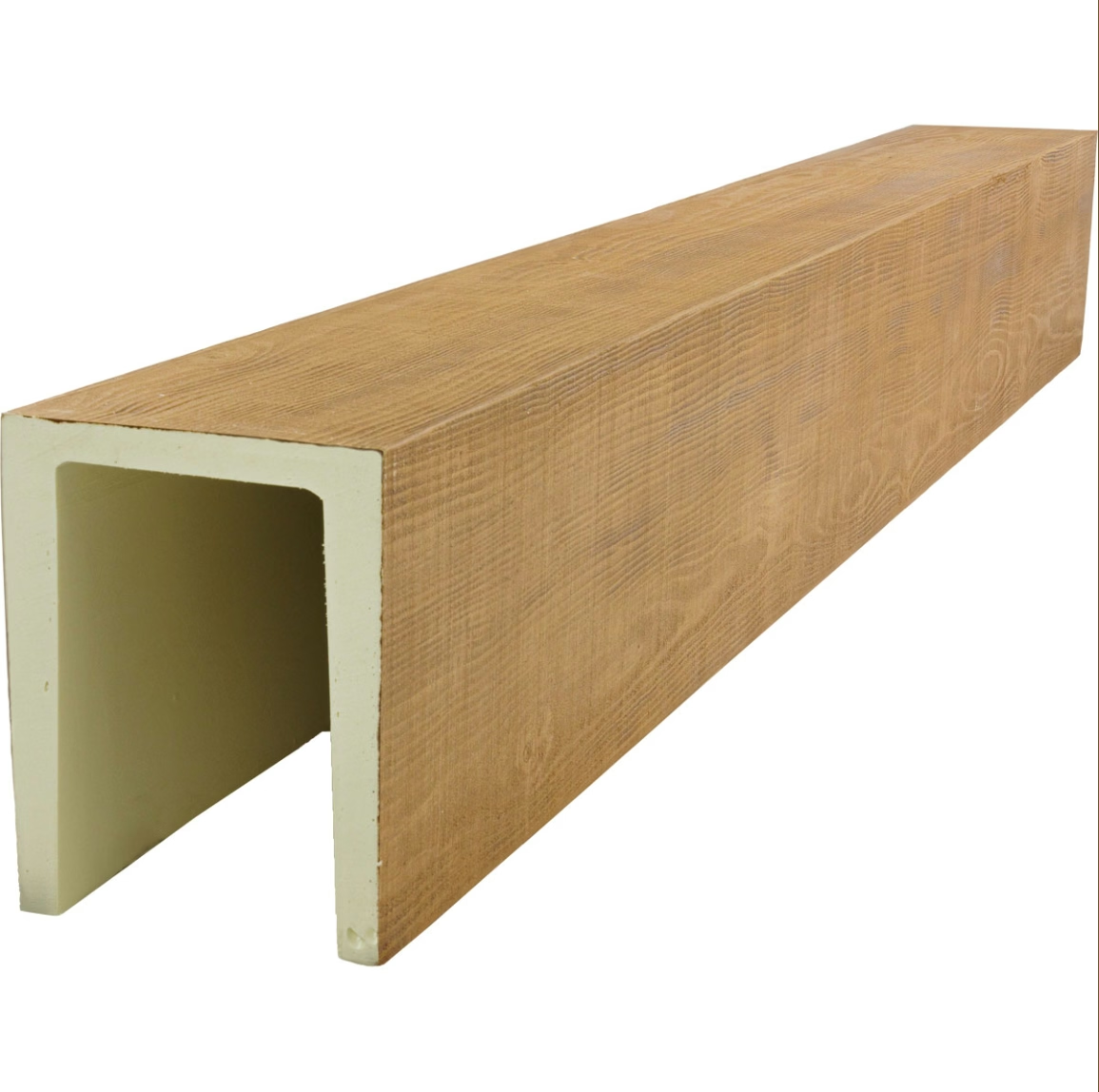
Packaging requirements for ocean freight
Outer packaging for export beams typically uses double-wall corrugated cartons or wooden crates depending on the beam dimensions and order size. The carton grade is specified by the manufacturer to handle the compression loads of container stacking. A beam packed in lightweight domestic packaging will be crushed under the weight of other containers stacked above it during ocean transit.
Internal packaging protects individual beams within the outer carton. Each beam is wrapped in foam or cardboard to prevent surface contact damage. Beams are separated by dividers that prevent impact between pieces during handling. The internal packaging absorbs the vibrations and minor impacts of the logistics chain.
Corner protection on carton edges prevents crushing damage at the most vulnerable points. Heavy cardboard corner boards or foam corner protectors extend along the length of the carton edge where handling forks and straps contact the package. This protection is inexpensive but critical to preventing the edge crushing that can damage beams near the carton perimeter.
Carton marking includes product identification, destination information, handling symbols, and weight specifications. International standards for carton marking (ISO 780) specify symbols for fragile, keep dry, and stack limits that guide handlers throughout the logistics chain. Clear marking reduces mishandling that leads to damage.
Certifications relevant to export
ISO 9001 certification indicates that the manufacturer operates a quality management system. While not specific to polyurethane beams, ISO 9001 registration demonstrates that the factory has documented processes for design, production, and inspection. Many international buyers consider ISO 9001 a minimum requirement for supplier qualification.
VOC emissions certifications apply to beams destined for European markets. The EU requires documentation that interior decoration products meet emission limits. Export-grade beams for Europe should be tested and certified under the appropriate standard (ISO 16000 or the French A+ system) before shipping. Sending uncertified product to Europe creates the risk of rejection at customs.
Fire performance certifications are required in many commercial construction contexts. Export beams for markets with strict fire codes should carry the appropriate classification from certified testing laboratories. Tests like EN 13501 in Europe or ASTM E84 in the US provide classification that destination authorities recognize.
Phytosanitary certificates are generally not required for polyurethane beams because they are not wood products. However, some countries have restrictions on polymer products that require documentation of the material composition. Checking destination requirements before shipping prevents surprises at customs.
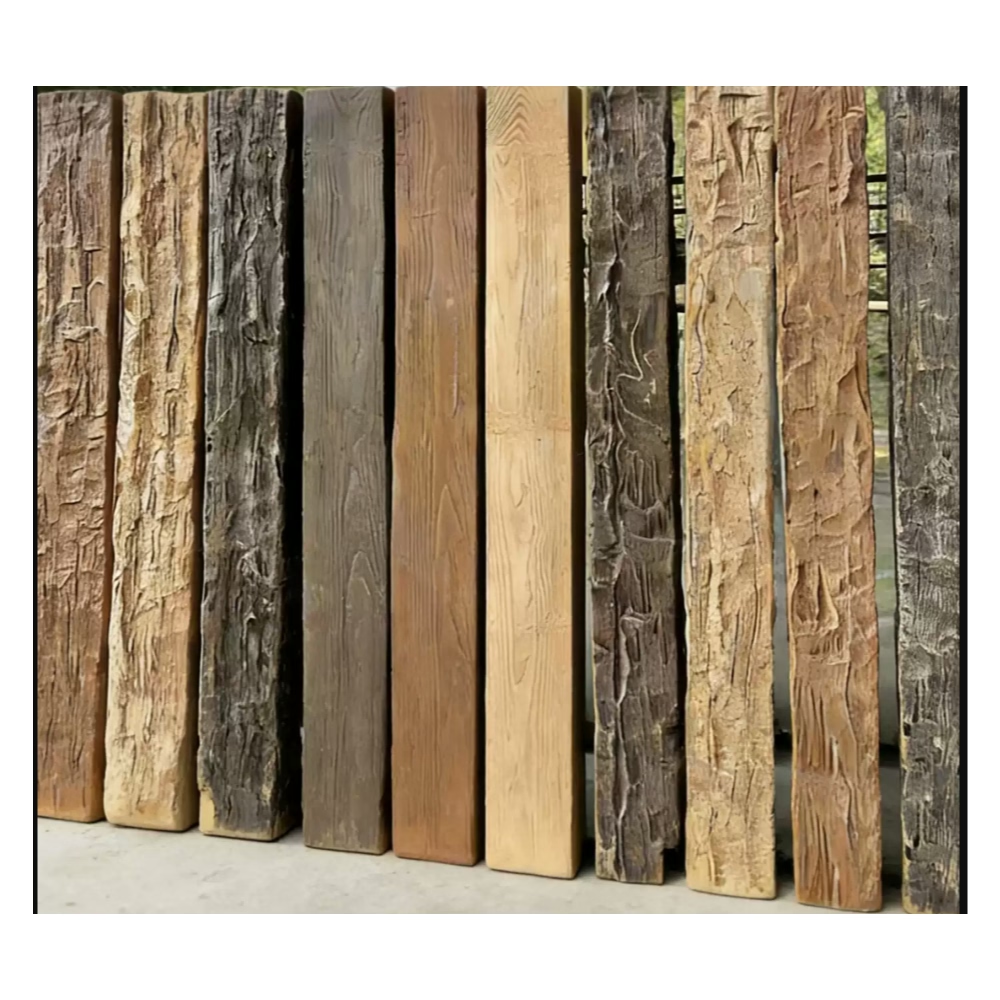
Documentation package for export shipments
The commercial invoice is the most important document in the export package. It must accurately describe the product, state the value, identify the seller and buyer, and specify the terms of sale. Customs authorities in the destination country use the commercial invoice to assess duties and verify that the shipment matches the buyer's import documentation.
The packing list itemizes the contents of each package in the shipment. For shipments with multiple SKUs, the packing list is essential for customs inspection and for the buyer to verify receipt. The packing list should reference the commercial invoice number and include sufficient detail for the buyer to identify each package's contents without opening them.
The bill of lading is the contract of carriage between the shipper and the carrier. It serves as a title document and as evidence of shipment. For ocean freight, the bill of lading is issued by the shipping line or their agent and references the container numbers, seal numbers, and port information for the shipment.
Certificates of origin document where the product was manufactured. Many countries offer preferential duty rates for products from countries with which they have free trade agreements. The certificate of origin, typically on a form like the EUR.1 or Form A depending on the trade agreement, enables these preferences when properly completed.
Working with export freight forwarders
A freight forwarder manages the logistics of international shipments. For polyurethane beam exports, the forwarder coordinates container booking, port handling, ocean freight, and customs clearance in the destination country. Using an experienced forwarder simplifies the export process and reduces the risk of problems.
The forwarder's expertise in documentation is particularly valuable. Experienced forwarders know what each destination country requires and can flag documentation gaps before they cause delays. They maintain relationships with customs brokers in destination markets and can resolve problems faster than a first-time exporter could.
Forwarders also provide freight rate negotiation and container optimization services. Ocean freight rates vary significantly based on season, volume, and carrier. A forwarder who understands the beam product can advise on container loading patterns that maximize space utilization and minimize per-unit freight costs.
Coordination between the factory, the forwarder, and the buyer is essential for smooth exports. The factory should communicate production completion dates, the forwarder should coordinate container pickup and booking, and the buyer should be kept informed of shipping milestones. This coordination prevents misunderstandings about delivery timing and reduces the risk of storage charges at ports.
Common export issues and prevention
Damage during ocean transport is the most frequent export problem for fragile products. Prevention requires proper packaging designed for ocean conditions, not just domestic handling. Spending more on packaging upfront prevents the far greater cost of damaged goods claims, replacement shipments, and damaged customer relationships.
Customs delays occur when documentation is incomplete or inaccurate. Prevention requires verifying requirements with the destination country's customs authority or a local customs broker before shipping. Providing complete, accurate documentation eliminates the back-and-forth that extends clearance times.
Classification disputes arise when the HS code assigned by the exporter differs from the code assigned by customs at destination. Prevention requires confirming the classification with the buyer's customs broker before shipping. A few minutes of confirmation prevents weeks of dispute resolution.
Port congestion and vessel delays affect transit times unpredictably. While these factors cannot be prevented, good communication with the forwarder and the buyer helps manage expectations. Providing tracking information and regular updates keeps buyers informed and reduces anxiety about delayed shipments.
Qualifying suppliers for export-grade products
Verifying export-grade capability requires more than a conversation with the sales team. A factory tour, ideally during production of export orders, shows whether the packaging line, quality control procedures, and documentation practices are truly export-grade. Video calls can substitute for in-person visits when travel is not feasible.
Requesting sample shipments before large orders validates the product and packaging quality. A sample order placed with standard export documentation procedures tests whether the factory can produce, package, and document to export standards. Problems discovered on a small sample order are far less costly than problems discovered on a full container.
Checking references from existing export customers provides insight into how the factory performs on actual export orders. A reference who has ordered from the factory for years, faced problems, and had them resolved satisfactorily is more valuable than a reference who only mentions the good experience.
Third-party inspection services like SGS, Bureau Veritas, or similar firms provide independent verification of product quality and packaging. A pre-shipment inspection confirms that the shipment matches the order, is properly packaged, and meets agreed specifications. The inspection cost is minor relative to the value of a large export order.
Technical References
ASTM standards cited in every specification
Test Data
Lab results from internal testing program
Updated 2026
Reviewed against current product specs


