Ordering beams for container shipments requires different mathematics than ordering for local delivery. When a container costs $2,500 to $5,000 to ship, miscalculation becomes expensive in either direction. Order too few beams and you face emergency reorders with prorated shipping costs. Order too many and you pay import duties on materials that sit in warehouse inventory. The solution is systematic quantity calculation based on actual beam dimensions, packaging efficiency, and container utilization optimization.
Professional importers use container load calculations to optimize every shipment. The goal is maximizing value per container without causing loading problems, transit damage, or customs complications. This guide provides the methodology that enables accurate ordering.
Understanding container dimensions
Standard shipping containers have fixed internal dimensions:
20-foot container — approximately 5.9m × 2.35m × 2.39m usable space
40-foot container — approximately 12.03m × 2.35m × 2.39m usable space
40-foot high cube — approximately 12.03m × 2.35m × 2.69m usable height
The limiting dimension varies by beam length. Long beams constrain lengthwise utilization; tall packaging constrains vertical stacking; beam profile width constrains horizontal density.
Step-by-step calculation methodology
Step 1: Determine beam dimensions
Gather exact specifications for all SKUs in the order:
- Length in meters
- Profile cross-section (e.g., 6" × 8")
- Construction type (hollow or solid)
- Packaging configuration (individual or bundled)
Step 2: Calculate package dimensions
Beams ship in protective packaging that adds to the footprint:
- Individual beam length + 0.1m for protection
- Profile dimension + packaging material thickness
- Standard packaging adds 2-4cm to each dimension
Step 3: Determine orientation strategy
Beams can be loaded in various orientations:
- Lengthwise — beams aligned with container length (most common)
- Crosswise — beams perpendicular to container length (for mixed loads)
- Vertical — beams standing upright (requires rack systems)
Step 4: Calculate units per layer
Divide container floor dimensions by package dimensions:
Units per row = Container width / Package width
Rows per layer = Container length / Package length
Units per layer = Units per row × Rows per layer
Step 5: Calculate layers and total quantity
Maximum layers = Container height / Package height
Total units = Units per layer × Maximum layers × Number of stacks
Practical example: 20-foot container
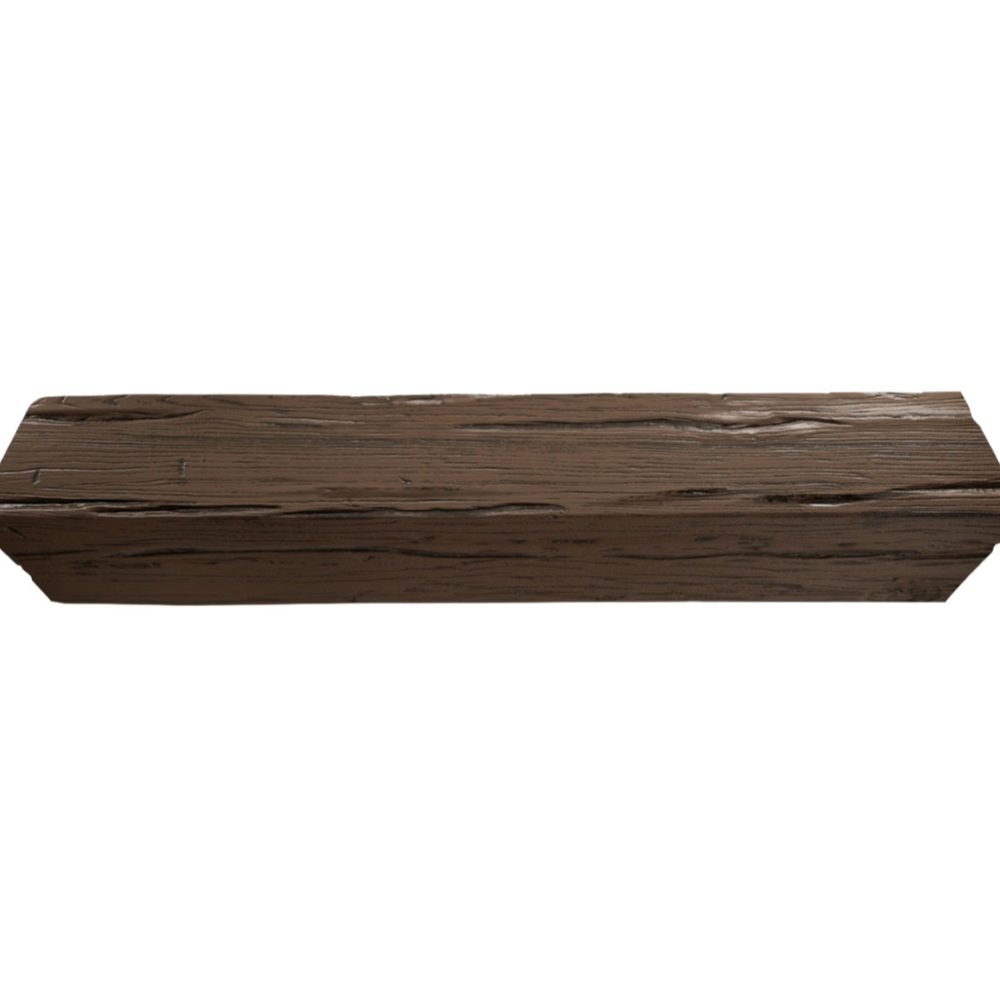
For 8-foot (2.44m) hollow 6x6 beams with standard packaging:
Package dimensions — 2.5m × 0.16m × 0.16m (with protection)
Orientation — lengthwise loading
Per layer calculation:
- Container width 2.35m / 0.16m = 14 units per row
- Container length 5.9m / 2.5m = 2 rows
- Units per layer = 14 × 2 = 28 units
Layer stacking:
- Container height 2.39m / 0.16m = 14 layers possible
Total capacity:
- 28 units × 14 layers = 392 units maximum
Actual loading typically achieves 85-90% of theoretical maximum due to pack stability requirements.
Realistic load — approximately 330-350 units per 20-foot container
Optimization strategies
Maximize container value through strategic loading:
Mixed length loading — combine 8ft, 10ft, and 12ft beams in same container
Profile mixing — smaller profiles pack more densely; balance with higher-value larger profiles
Layer interleaving — offset stack joints to improve pack stability
Corner blocking — protect loads at container walls with blocking materials
Weight distribution — distribute heavy profiles evenly to prevent container stress

Common calculation errors to avoid
Ignoring packaging dimensions — bare beam calculations underestimate space requirements
Assuming perfect stacking — real-world packing achieves 80-90% of theoretical density
Forgetting weight limits — containers have weight limits independent of volume limits
Neglecting customs requirements — packing lists must match container contents exactly
Oversimplifying mixed loads — different SKUs have different packaging efficiencies
Software and professional assistance
Complex orders benefit from professional load planning:
Load calculation software — specialized programs optimize container utilization
Freight forwarder consultation — experienced forwarders provide load optimization guidance
Manufacturer support — quality suppliers offer container optimization assistance
Third-party logistics providers — 3PL services handle detailed load planning professionally
Investment in accurate calculation prevents costly ordering mistakes and ensures containers arrive properly loaded.
A foundation for professional procurement
Accurate container load calculation transforms ordering from guesswork into engineering. The methodology above enables reliable quantity planning for any beam order. Apply these principles consistently, maintain detailed records of actual versus predicted loads, and continuously refine your calculations based on receiving experience. Professional procurement rewards accuracy with efficiency.
Technical References
ASTM standards cited in every specification
Test Data
Lab results from internal testing program
Updated 2026
Reviewed against current product specs