International trade in construction and renovation materials has always been shaped by the fundamental tension between value and logistics. The most desirable finishing materials are often located far from the markets where they are consumed, and the cost of moving them can equal or exceed their production cost. For ceiling beams, this dynamic has historically been particularly pronounced. Solid timber beams are dense, awkwardly shaped, and vulnerable to moisture damage during transport. The freight calculation for shipping timber beams from a European mill to a North American distributor or from an Asian manufacturer to a retailer in the Middle East has often made premium ceiling aesthetics economically inaccessible for all but the highest-budget projects.
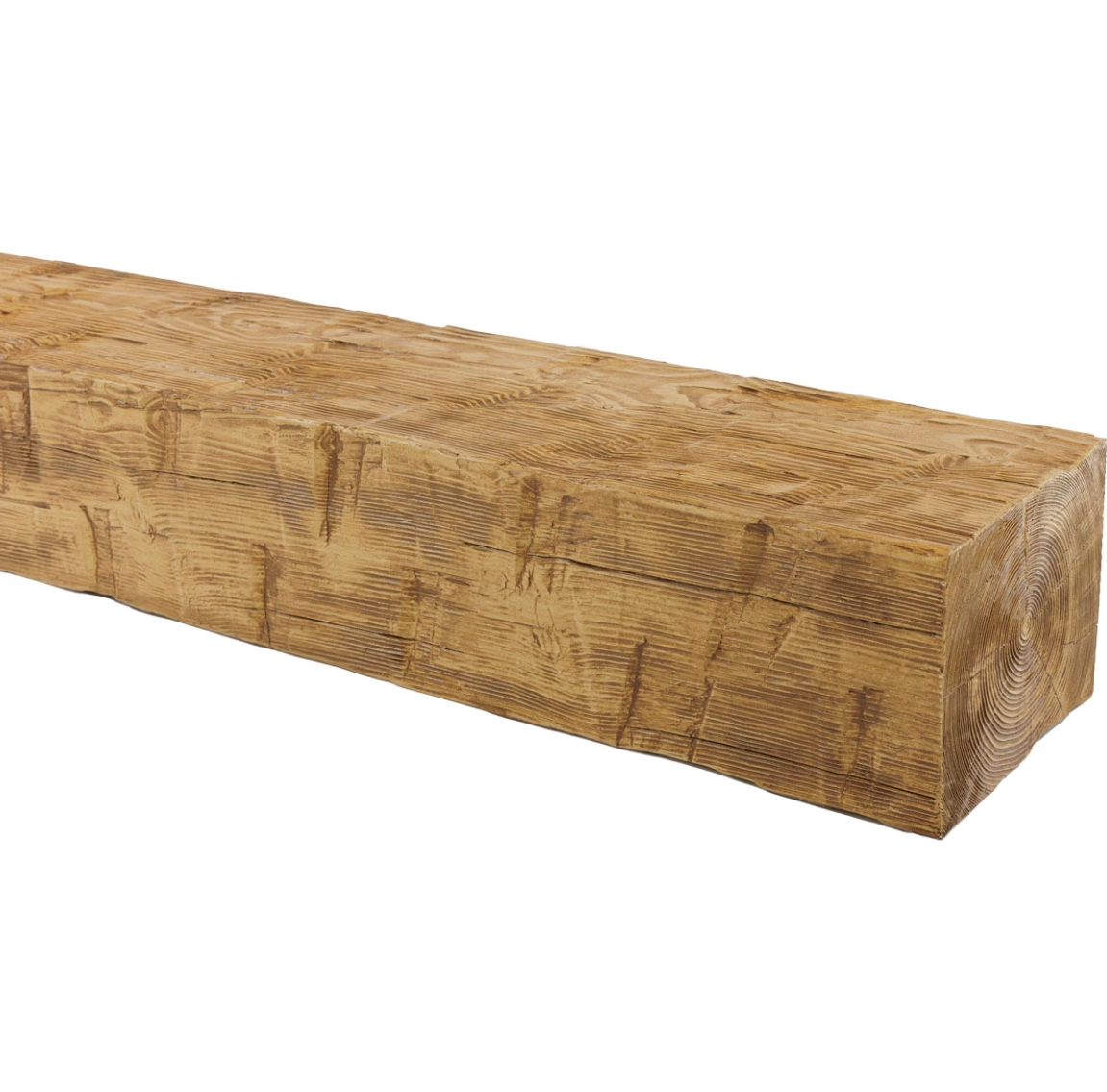
Polyurethane faux wood beams have disrupted this economic model in a way that benefits every participant in the supply chain, from the manufacturer to the end-use consumer. The dramatic weight reduction achieved through hollow-shell construction and low-density foam core transforms the freight economics of ceiling beams entirely. A standard shipping container that might carry 400 to 600 linear feet of solid timber beams can accommodate 2,000 to 3,500 linear feet of equivalent lightweight faux beams. This difference changes the per-unit freight cost from a significant cost driver to a minor line item, enabling competitive pricing across markets that were previously uneconomical to serve.
The Mathematics of Lightweight Freight
To understand the full impact of weight reduction on freight economics, it helps to examine the cost structure of international shipping. Ocean freight rates are typically quoted in two ways: per cubic meter (CBM) for volume-based cargo and per metric ton for weight-based cargo. The rate charged is whichever calculation produces the higher figure, ensuring that carriers maximize revenue from the space and weight capacity of each container. For dense materials like solid timber, the weight calculation typically governs the rate. For bulky but light materials, volume becomes the limiting factor.
High-density polyurethane foam used in quality faux beams has a density of approximately 30 to 60 kilograms per cubic meter, compared to 600 to 800 kilograms per cubic meter for solid pine and 700 to 900 kilograms per cubic meter for hardwoods like oak and walnut. Even accounting for the structural additives, reinforcement materials, and surface coatings that give faux beams their durability and appearance, the finished product weighs 80 to 90 percent less than equivalent solid timber. A 20-foot shipping container loaded with solid timber beams might gross out at 15,000 kilograms before reaching full volume utilization. The same container loaded with lightweight faux beams might contain only 2,000 to 3,000 kilograms of product, with volume utilization still well below capacity.
This weight differential affects not only the ocean freight rate but every downstream logistics cost as well. Trucking rates in most markets are regulated by weight-based formulas that directly penalize heavy cargo. Handling at ports and distribution centers involves equipment rated for specific weight capacities; lighter loads reduce equipment wear, improve handling speed, and minimize the risk of damage during loading and unloading operations. Last-mile delivery to individual customers, which is often the most expensive link in the logistics chain per unit, becomes dramatically more affordable when each beam weighs a fraction of its solid timber equivalent.

Supply Chain Benefits for Distributors and Retailers
For distributors managing inventory across multiple regional warehouses, the lightweight nature of faux beams simplifies logistics in ways that compound over time. Traditional timber beams require climate-controlled storage to prevent moisture absorption, warping, and insect infestation. PU faux beams can be stored in standard warehouse conditions, reducing the overhead associated with specialized storage facilities. The consistent dimensions and uniform packaging of manufactured faux beams also simplify racking, picking, and order fulfillment operations compared to the variable dimensions and irregular shapes of natural timber.
The reduced damage rate during transport represents another meaningful cost advantage. Solid timber beams are susceptible to a variety of shipping-related damage types: end checking from rapid moisture loss, surface dents and scratches from handling, splitting from impact or excessive compression, and biological damage if moisture levels rise during transit. Hollow-shell polyurethane beams are inherently more resistant to these failure modes. Their closed-cell foam structure resists moisture absorption. Their flexible but durable skin absorbs impact without cracking. Their uniform density and manufactured quality control ensure consistent dimensions that pack and protect each other efficiently.
Retailers who sell directly to contractors and homeowners benefit from the same logistics advantages in their final-mile delivery operations. A contractor ordering beams for a residential project can receive delivery in a standard van or pickup truck rather than requiring a specialized freight vehicle. Homeowners who choose to self-collect their beam orders can transport them in a family vehicle rather than renting a truck or trailer. These seemingly minor conveniences remove friction from the purchasing process and expand the accessible market for premium ceiling aesthetics.

Impact on End-Use Pricing and Market Accessibility
The cumulative effect of reduced logistics costs throughout the supply chain is lower prices at the point of sale. This price reduction does not come at the expense of quality; it results from genuine efficiency improvements in how the product moves from factory to finished installation. For consumers in markets where construction materials have historically been expensive due to limited local production and high import costs, lightweight faux beams represent an opportunity to access design aesthetics that would otherwise be financially out of reach.
Emerging markets in Southeast Asia, the Middle East, Africa, and Latin America, where local production of premium finishing materials is limited and import costs have historically restricted product availability, benefit particularly from these logistics advantages. The ability to source high-quality PU faux beams from efficient manufacturers and transport them economically over long distances democratizes access to premium ceiling design. Interior designers and architects in these markets can now specify ceiling beam installations that would have been cost-prohibitive with traditional materials, enriching the built environment and raising the standard of interior design across diverse communities.
Strategic Sourcing for Maximum Cost Efficiency
For buyers and procurement professionals sourcing faux beams for commercial or high-volume residential projects, the logistics advantages of lightweight construction create opportunities for strategic cost optimization. Consolidating orders into full container shipments rather than less-than-container loads can reduce per-unit freight costs by 30 to 50 percent. Planning projects to coincide with optimal shipping seasons, when carrier capacity is abundant and rates are competitive, further improves cost efficiency. Working with manufacturers who offer nested or knock-down packaging options can maximize the number of beams per container, squeezing additional efficiency from each shipment.
The lightweight nature of these products also opens up air freight as a viable shipping option for urgent or small-volume orders. While air freight rates are substantially higher than ocean freight on a per-kilogram basis, the low weight of the product means that air shipping a small order of beams remains economically reasonable. For designers working on high-profile projects with tight timelines, the ability to air-ship replacement beams or additional inventory within days rather than weeks represents a meaningful risk mitigation capability that is simply not available with heavy timber products.
Ultimately, the freight economics of ultra-lightweight PU faux beams create a virtuous cycle: lower logistics costs enable lower retail pricing, which expands the addressable market, which increases order volumes, which further improves manufacturing and distribution efficiency. This dynamic is transforming the global market for ceiling aesthetics, making beautiful timber-look ceilings an accessible design option across market segments and geographic regions that traditional materials could never economically reach.
Technical References
ASTM standards cited in every specification
Test Data
Lab results from internal testing program
Updated 2026
Reviewed against current product specs


