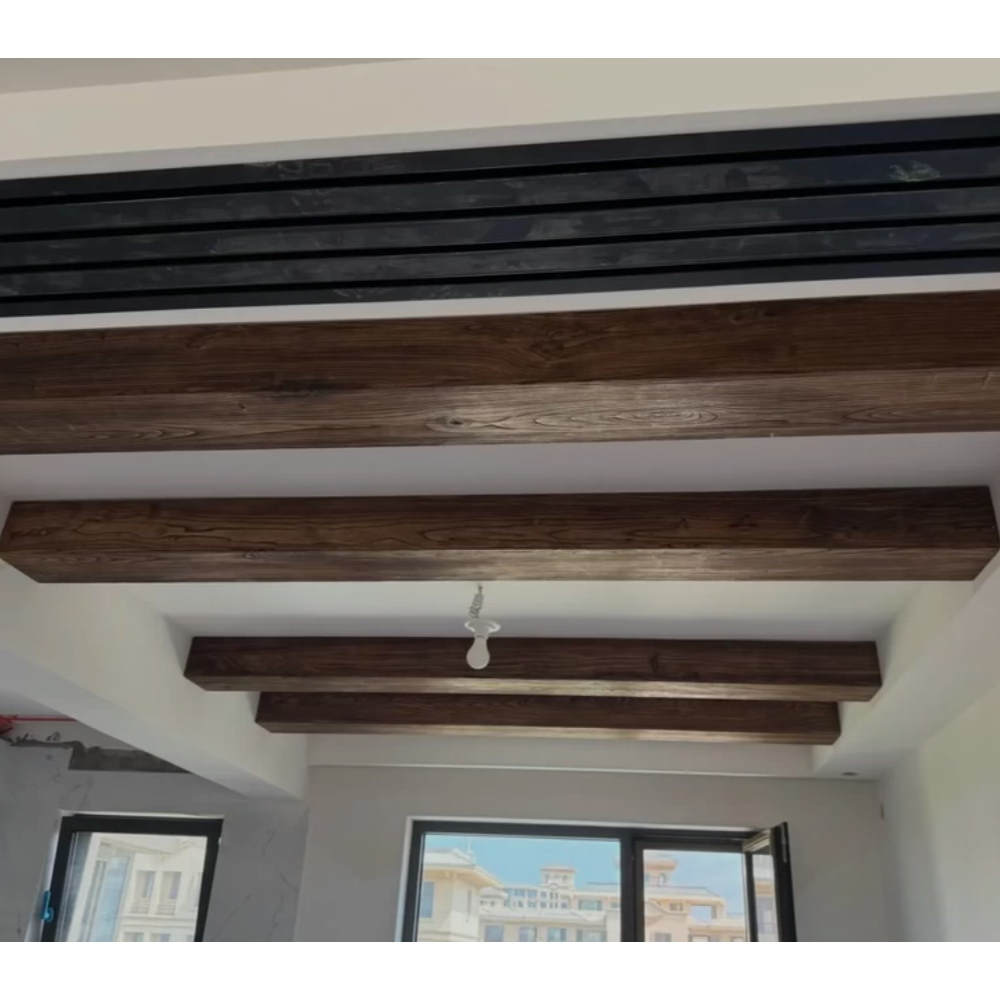
A boutique marketing agency's downtown office renovation illustrates why commercial grade polyurethane faux wood beams have become the preferred choice for office and retail fit-out projects across the globe. The project required forty linear meters of ceiling beams spanning a collaborative workspace, with a tight six-week timeline and a client budget that ruled out solid timber. The installing contractor specified PU faux beams with Class A fire ratings and achieved the warm, professional aesthetic the design team envisioned, completing the install two days ahead of schedule.
This scenario plays out repeatedly in modern commercial interiors because polyurethane manufacturing technology now produces faux beams that satisfy the demanding requirements of professional fit-out operations. The material performs reliably in high-traffic office environments, resists moisture from HVAC systems, and installs without the specialized equipment that real wood demands.
Understanding Commercial Grade Specifications
Commercial grade designation distinguishes these polyurethane beams from residential counterparts through enhanced density, improved fire resistance, and stricter dimensional tolerances. Premium manufacturers produce commercial beams with densities ranging from 180 to 320 kilograms per cubic meter, creating sections that handle job-site handling and structural mounting without chipping or cracking.
The density specifications matter significantly in office fit-out contexts where ceiling grids, drywall channels, or exposed structure systems receive the beam mounting hardware. Higher density polyurethane holds threaded inserts, French cleats, and lag screws with pull-out resistance suitable for ceiling applications in buildings up to twelve stories without additional structural reinforcement.
| Specification | Commercial Grade Value | Residential Grade Value |
|---|---|---|
| Density Range | 180-320 kg/m³ | 120-200 kg/m³ |
| Fire Rating | Class A or B | Class C typical |
| Dimensional Tolerance | ±1mm per meter | ±3mm per meter |
| Impact Resistance | High | Medium |
| UV Stabilization | Standard | Optional |
Fire rating classification represents perhaps the most critical commercial specification difference. Building codes in most jurisdictions require Class A or Class B ratings for commercial interior applications, particularly in office buildings exceeding three stories, spaces with occupancy permits exceeding fifty persons, or corridors serving multiple tenant floors. Polyurethane manufacturers achieve Class A ratings through integrated flame retardant compounds that prevent combustion propagation without the formaldehyde concerns associated with some fire-treated wood products.
Design Applications in Office Environments
Open plan offices benefit tremendously from ceiling beam installations that define zones without constructing walls or using temporary partition systems. A single row of parallel faux beams can separate collaborative work areas from focused concentration zones while maintaining visual continuity and acoustic comfort. The beams create psychological boundaries that employees respond to positively, reducing the perception of visual chaos in large open spaces.
Boardrooms and executive meeting areas frequently employ exposed beam ceilings to project an image of established professionalism. The warm wood tones of polyurethane faux beams soften the corporate aesthetic of glass and steel while requiring minimal maintenance compared to real timber. Executives appreciate the investment in a refined meeting environment, and facilities managers value the absence of seasonal wood movement, insect susceptibility, or refinishing requirements.
Retail showrooms and flagship stores utilize beam installations to create distinctive shopping environments that differentiate brand experiences from e-commerce alternatives. A home furnishings retailer installed dramatic vaulted beam ceilings in their flagship showroom, reducing product display area by approximately eight percent but increasing average transaction value by twenty-three percent—customers lingered longer in the architecturally distinctive space and purchased higher-margin items.
Reception areas and lobbies establish first impressions that influence visitor perception throughout the entire office relationship. Beam installations in these focal spaces communicate stability, attention to detail, and investment in the work environment. Several commercial grade polyurethane products accept custom finishing, allowing exact color matching to brand guidelines or corporate identity standards.
Installation Advantages for Fit-Out Professionals
Polyurethane faux beams reduce installation labor by forty to sixty percent compared to real timber equivalents. The material cuts with standard woodworking tools rather than requiring specialized saws or blades designed for dense hardwoods. Installers report that a two-person crew can complete fifty linear meters of standard beam installation per eight-hour shift, compared to twenty-five to thirty linear meters for comparable solid wood installation.
The weight differential proves transformative in commercial contexts where projects specify ceiling installations above existing tenant improvements or in buildings with weight restrictions on ceiling additions. A six-meter polyurethane beam section weighs approximately twelve to eighteen kilograms, compared to forty-five to eighty kilograms for a comparable solid timber beam. This reduction simplifies handling in elevator-served buildings, eliminates the need for mechanical lifting equipment in most office fit-out scenarios, and reduces structural loading on ceiling grid systems.
Adhesive bonding systems developed specifically for polyurethane substrates enable faster installation than traditional mechanical fastening methods. Construction adhesive applied to beam backs with supplementary screw fastening through predrilled mounting holes creates connections that exceed the load requirements for standard ceiling installations while allowing repositioning during the alignment process. Installers appreciate the forgiveness these systems provide when working with imperfect substrate conditions common in renovation projects.
Cost Analysis for Project Specification
Initial material costs for commercial grade polyurethane faux beams range from sixty to one hundred twenty percent of comparable real timber costs, depending on beam profile complexity, finish quality, and order volume. However, lifecycle cost analysis consistently favors the polyurethane alternative in commercial applications where maintenance budgets, downtime costs, and replacement cycles factor into the specification decision.
Consider a standard office lobby beam installation requiring forty linear meters of eight-inch by eight-inch beam sections. Solid oak timber for this application costs approximately eight thousand to twelve thousand dollars in material alone, excluding the specialized finishes required for commercial durability. Polyurethane commercial grade equivalents for the same application cost six thousand to nine thousand dollars, with factory-applied finishes suitable for commercial traffic levels included.
Maintenance costs over a fifteen-year lifecycle dramatically favor polyurethane. Real timber requires inspection, cleaning, and refinishing every three to five years in commercial environments, with each maintenance cycle costing fifteen to twenty-five percent of original installation expense. Polyurethane beams require only routine cleaning with mild detergents, eliminating the maintenance line item entirely for most commercial applications.
Sourcing and Procurement for Commercial Projects
Successful procurement for commercial fit-out projects requires attention to lead times, quality certification, and logistics coordination. Most manufacturers require four to six weeks for custom commercial orders exceeding two hundred linear meters, with standard profiles available in two to three weeks from warehouse stock. Project managers should coordinate material orders with demolition and rough-in completion to ensure beams arrive when installation crews are ready, avoiding storage complications in finished spaces.
Quality documentation including fire test certificates, dimensional specifications, and material safety data sheets should accompany procurement requests. Reputable manufacturers provide third-party testing verification for fire ratings and structural performance claims. Importers and distributors who cannot supply this documentation should be approached with caution, as building inspectors and code enforcement officials increasingly request specification compliance evidence during certificate of occupancy reviews.
Shipping logistics for commercial orders require coordination with receiving dock availability, material handling equipment, and protection from weather exposure during storage. Commercial grade polyurethane beams ship in protective packaging suitable for fork truck handling, but extended outdoor storage before installation can result in surface contamination requiring cleaning or repair before installation.
Technical References
ASTM standards cited in every specification
Test Data
Lab results from internal testing program
Updated 2026
Reviewed against current product specs


