
An importer in Dubai emails asking how many 8-foot 6-by-6 oak grain faux beams fit in a 40-foot high cube container. The exporter in Fujian wants to know whether the same container can hold three different profiles for two different customers, or whether each needs its own box. The freight forwarder wants a number in cubic meters and a weight in kilograms.
These questions come up every week. The honest answer is that faux beam load planning is less about volume and more about weight — but only because most people underestimate how much volume the light polyurethane actually fills.
The two limits that matter
Every container has a weight limit and a volume limit. The shipping line enforces the weight limit strictly because the chassis, the ship, and the road weight limits downstream all depend on it. The volume limit is enforced by physics — when the container is full, it is full.
For a standard 40-foot high cube dry container:
- Internal length: approximately 12.03 m (39 ft 6 in)
- Internal width: approximately 2.35 m (7 ft 9 in)
- Internal height: approximately 2.69 m (8 ft 10 in)
- Max payload: approximately 26,500 kg (58,400 lb)
- Tare weight: approximately 3,900 kg (8,600 lb)
For a 20-foot standard container, the payload drops to roughly 21,500 kg with about 33 cubic meters of internal volume.
The trick with polyurethane faux beams is that they fill volume faster than they fill weight. The opposite is true for solid timber.
Polyurethane weight per linear foot
Density varies by profile, but typical values for a quality closed-cell PU beam:
| Profile (nominal) | Weight per linear foot | Weight per meter |
|---|---|---|
| 4 inch x 6 inch | 1.4 lb / 0.65 kg | 2.1 lb / 0.95 kg |
| 6 inch x 6 inch | 1.9 lb / 0.86 kg | 2.9 lb / 1.30 kg |
| 6 inch x 8 inch | 2.5 lb / 1.13 kg | 3.7 lb / 1.68 kg |
| 8 inch x 8 inch | 3.2 lb / 1.45 kg | 4.7 lb / 2.13 kg |
| 8 inch x 10 inch | 4.0 lb / 1.81 kg | 6.1 lb / 2.77 kg |
| 10 inch x 10 inch | 4.8 lb / 2.18 kg | 7.3 lb / 3.31 kg |
These numbers are factory averages. A heavy-grain hand-finished beam runs heavier than a smooth matte profile. Use them for planning, then confirm with the actual production line.
Worked example: a 40-foot HC container
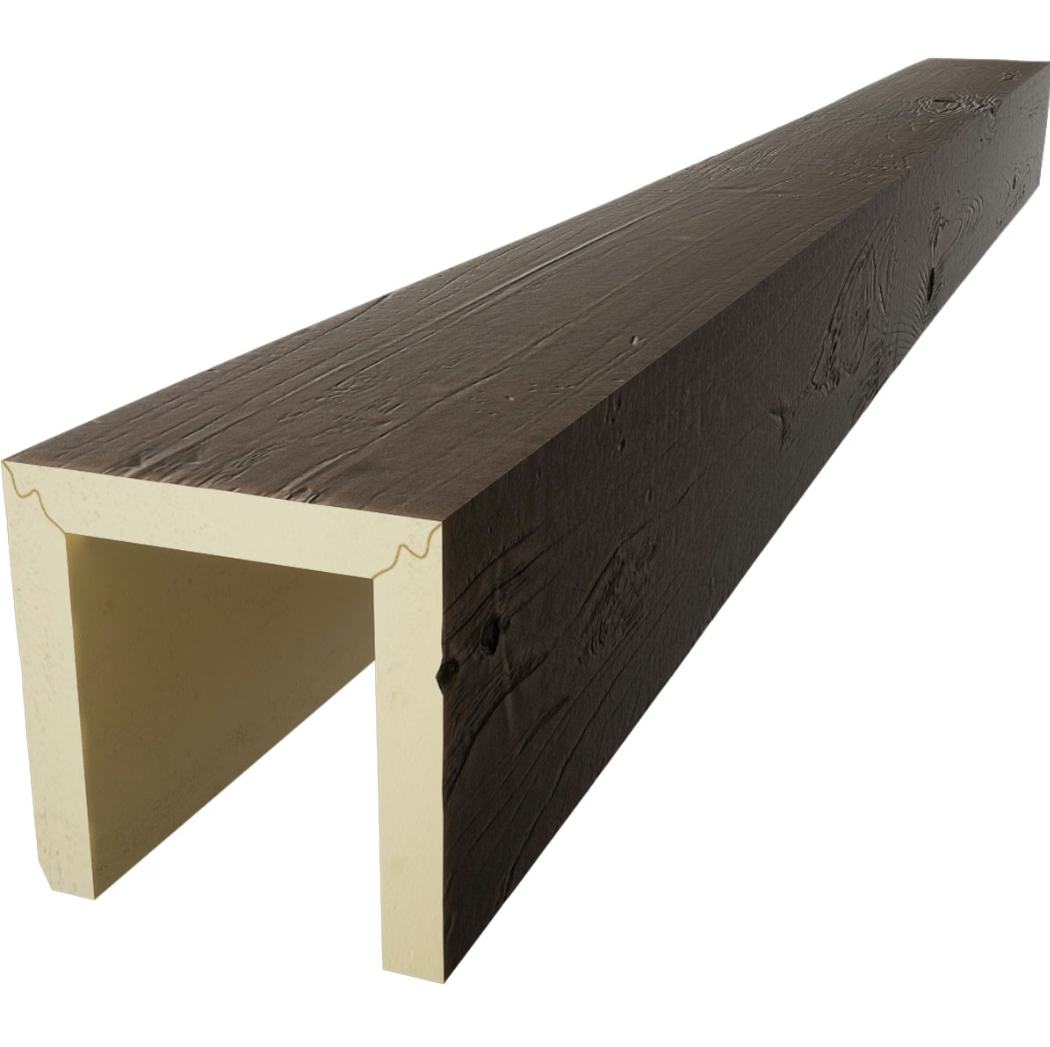
A US distributor is bringing in 8-foot (2.44 m) sections of 6-by-8 oak grain faux beams. The order is for 1,800 linear feet, which works out to 225 individual beams at 10 feet, or 281 beams at 8 feet. Let us assume the customer wants 8-foot sections for retail convenience.
Total linear feet: 1,800. Total linear meters: 549. Estimated gross weight at 1.68 kg per meter: 922 kg.
That is less than four percent of the container's payload capacity. The constraint is volume.
A 6-by-8 beam laid flat takes about 0.5 square feet of floor space per linear foot. 1,800 linear feet is 900 square feet of beam. The container floor is about 270 square feet. So the beams stack roughly three high if laid flat across the floor.
Stacking three high:
- Layer 1: 270 sq ft of beam — about 540 linear feet
- Layer 2: 270 sq ft — another 540 linear feet
- Layer 3: 270 sq ft — another 540 linear feet
- Total flat stack: 1,620 linear feet
That leaves 180 linear feet of beam. We can either add partial layers, or stand some beams on edge in the leftover vertical space at the door end of the container.
A realistic 40-foot HC load for 8-foot 6-by-8 oak grain faux beams is therefore in the range of 1,650 to 1,850 linear feet, depending on stacking pattern and pallet use.

Palletized vs floor-loaded
Floor loading is cheaper per cubic meter but only works for stout profiles. Slim 4-by-6 beams can crack if you stack too high on a flat surface. Anything over 8 inches deep should be palletized.
A standard 40-by-48-inch pallet takes roughly 60 to 100 linear feet of beam depending on profile. For 6-by-8 beams cut to 8 feet, you can stand 16 to 20 beams upright on a pallet, nested, which is about 130 to 160 linear feet per pallet. Stretch wrap and corner protectors, and you can double-stack pallets in the container.
Palletized loads add roughly 8 to 12 percent to the total volume used because of the pallet itself, but they protect the beams far better during inland transport and at the destination port.

Three profiles in one container
The Dubai-style question — three profiles for two customers — is doable, but the loading plan has to be sketched.
A typical plan for a 40-foot HC with three profiles:
- 800 linear feet of 6-by-8 oak grain (heavy section, base layer)
- 600 linear feet of 4-by-6 walnut grain (slim section, upper layer)
- 400 linear feet of 8-by-10 hand-hewn (statement section, end stack)
Total weight: roughly 1,400 kg — still well under the payload limit. Volume will be the constraint again. With three profiles of three different lengths, you lose some efficiency to odd-sized gaps. A realistic load is in the range of 1,700 to 1,800 linear feet total across the three profiles.
What eats the budget on a container
Three costs surprise importers new to faux beam freight.
- Destination handling — many ports charge per container, not per kilogram. A half-full container costs almost as much to unload as a full one.
- Customs inspection — if the inspector opens the box and the beams are loose, the inspection takes longer and costs more. Palletized and labeled loads clear faster.
- Inland trucking — a 40-foot container needs a route with adequate turning radius and bridge clearance. In some markets, two 20-foot containers are easier to deliver than one 40-foot.
For customers in older urban markets where the streets are tight, splitting a 40-foot into two 20-foot containers can actually save money on the inland leg.
Documentation that protects the load
Three documents should always travel with a faux beam shipment:
- Packing list with beam count, length, profile, weight per bundle, and total weight
- HS code for polyurethane articles — typically 3925.90 or 3926.40 depending on destination customs interpretation
- Material safety data sheet for the foam — most PU faux beams are inert and non-hazardous, but the document speeds up customs
A fourth document, less common but worth having, is a photo of the loaded container before the doors close. If there is a damage dispute on the receiving end, the photo is invaluable.
The honest answer for importers
If a customer asks how many faux beams fit in a container, the answer is "it depends on the profile, the length, and how much loading work you want to do." The realistic planning number for a single-profile 40-foot HC load is in the range of 1,500 to 2,000 linear feet for medium-depth profiles, dropping to 1,000 to 1,500 for deeper statement profiles.
The best number comes from the factory, with the actual profile, the actual length, and a target destination in mind. Ask for a loading plan. Any factory that exports regularly can produce one in an afternoon.
Technical References
ASTM standards cited in every specification
Test Data
Lab results from internal testing program
Updated 2026
Reviewed against current product specs


