
The framing is done. The insulation is in. The drywall crew starts Monday. The project manager opens the beam order and realizes the 14-foot sections are backordered three weeks. The schedule is not moving. This is the scenario that contractor-grade specifications are designed to avoid — and the reason builders who use polyurethane faux beams consistently specify stock profiles from suppliers with demonstrated inventory rather than custom orders from factories with long queues.
This article is about the practical realities of specifying, ordering, and installing faux beams on construction projects where the schedule is always tight and the margin for error is thin.
What "contractor grade" means in this context
Contractor grade for faux beams is not a certification or a standardized grade. It is a cluster of characteristics that matter on a job site:
Predictable availability. The profile, length, and finish you need are in stock or can ship within days, not weeks.
Consistent quality. Every section in the run is the same color, the same grain, the same profile. No sorting, no hand-picking, no surprises.
Install-ready packaging. Beams are packed to survive a job site. They arrive on a pallet, strapped and corner-protected, not wrapped in plastic and tossed in a truck.
Documentation. The order ships with a packing list, a spec sheet, and care instructions — not just an invoice.
Support. Someone answers the phone or email who can help with a problem before it becomes a schedule issue.
A factory that stocks the profiles a builder needs, ships them in solid packaging, and has a customer service team is a contractor-grade supplier. A factory that makes beautiful beams but has a four-week queue and no stock is not.
Stock profiles that survive the builder schedule
For most residential and light commercial construction projects, the stock profile that ships fastest is the 6-by-8 oak grain in 10-foot, 12-foot, and 16-foot lengths. This is the profile most factories tool first and most distributors stock deepest.
The second tier of reliable stock profiles includes:
- 4-by-6 oak grain
- 6-by-6 oak grain
- 8-by-8 oak grain
- 6-by-8 walnut grain
Anything outside these profiles — non-standard lengths, custom finishes, specialty profiles — moves into the production queue. For a project with a flexible timeline, that is fine. For a project with a fixed close date, it is a risk.

Specifying for a tract builder vs a custom builder
The two types of builders have different needs.
A tract builder — developing ten to fifty units of similar floor plans — benefits most from standardizing on a single beam profile and finish across all units. The supplier relationship is deeper, the pricing is better, and the installation crew learns the mount once and repeats it efficiently. A 6-by-8 oak grain at 16-foot runs across every great room in a fifty-unit development is a clean, repeatable specification.
A custom builder — doing five to ten high-end projects per year — benefits most from having a supplier who can handle custom profiles and finishes without a six-week queue. The relationship here is with a factory that has mold flexibility and finishing capability, not just a distributor who moves stock.
For both types of builders, the worst outcome is a project with a beam specification that cannot be sourced quickly. The cost of a delayed beam install — painter standing down, flooring crew waiting, HVAC finalized around a beam that is not there — is real money that comes out of the builder's margin.
Installation speed on the job site
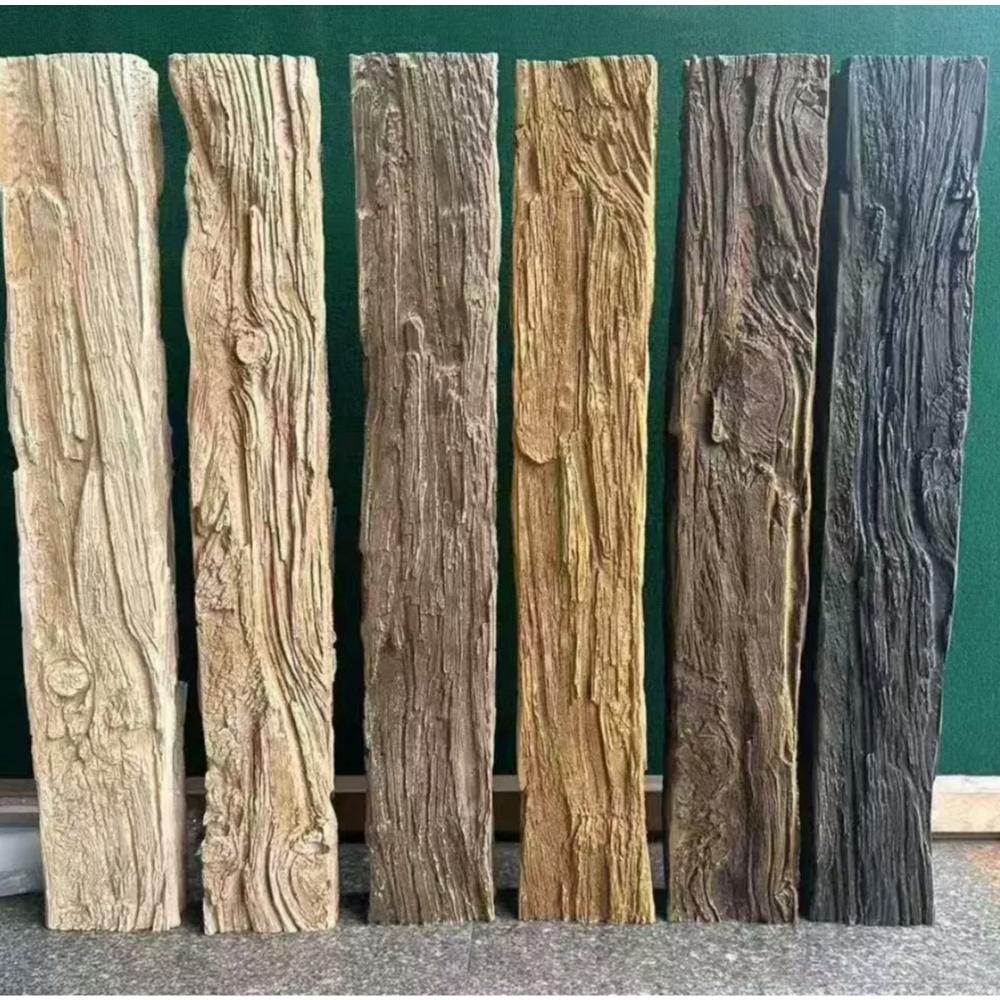
A polyurethane faux beam installs significantly faster than a solid timber beam of comparable size. The difference is almost entirely weight.
| Profile | PU weight per 12 ft | Solid oak weight per 12 ft | Install time (PU vs timber) |
|---|---|---|---|
| 6-by-8 | 30 lb | 145 lb | ~40% faster |
| 8-by-8 | 38 lb | 195 lb | ~45% faster |
| 10-by-10 | 58 lb | 290 lb | ~50% faster |
Two workers can set a 12-foot 6-by-8 polyurethane beam without mechanical assistance. The same beam in solid oak requires at minimum a third worker and typically a beam trolley or a gin pole.
For a builder running multiple units, the labor savings compound quickly. In a fifty-unit development with an average of three beam runs per unit, the labor savings on a 6-by-8 profile across the full project is roughly 60 to 80 labor hours.
Coordinating with the other trades
A beam install that happens before the painter is in the room is faster and cleaner. A beam install that happens after the painter has finished is safer for the paint job but requires more careful protection on the floor and walls.
The best sequencing for most builder projects:
- Framing stage — install blocking at all beam locations (GC responsibility)
- Rough-in — run any wiring that needs to pass above or through beam locations
- Drywall — finish ceiling around blocking and beam pockets
- Beam install — attach beams to blocking, make joints, touch up finish
- Paint — final paint on beams and ceiling together
- Trim and finish — baseboards, crown, lighting
The painter going over the beams in the same visit as the ceiling means the finish is consistent and the touch-up cost is lower.
Common job site problems and how to avoid them
Beams arrive damaged. Order from a supplier with documented damage rates below 1 percent. Inspect every bundle on receipt. Do not sign the freight receipt without noting visible damage.
Beams arrive the wrong length. Confirm the length on the order confirmation before production. A 12-foot beam and a 14-foot beam are visually very different on a ceiling.
Beams do not match each other. Order all sections of a single run from the same production batch. If the run requires sections from different batches, request that the factory ship them together and note the batch on the packing list.
The joint shows. The most common finish issue on a builder project is a visible joint. The fix is in the planning: put joints on blocking, use a 45-degree miter, and have a touch-up kit on site. The installer should expect to spend 15 to 20 minutes per joint on finishing.
The bid estimate
When a builder is pricing a beam installation in a bid, include these line items:
- Beam material by linear foot
- End caps and trim pieces
- Blocking (if not already in the framing scope)
- Installation labor (typically 1.5 to 2 hours per beam for 12-foot sections)
- Touch-up and finish
- Freight and delivery
Do not forget freight. A 40-foot HC container of beams costs $3,000 to $5,000 to ship domestically from a coastal port to an inland city. The material cost of the beams is not the total cost.
What a good supplier relationship looks like
A builder who uses the same faux beam supplier across multiple projects gets three things a one-off buyer does not:
- Pricing tiers. Volume buyers move into lower price brackets.
- Priority allocation. When stock is tight, the regular buyer gets it first.
- Flexible terms. Net-30 or Net-60 terms for established accounts.
A single project relationship is a commodity transaction. A three-project relationship is a partnership. The supplier who knows the builder's specs, the installer, and the schedule is worth more than the cheapest bidder on a single order.
For the builder, the goal is to remove beam sourcing as a risk from the project schedule. The way to do that is to specify stock profiles, use a reliable supplier, and build the relationship over multiple projects rather than chasing the lowest price on each one.
Technical References
ASTM standards cited in every specification
Test Data
Lab results from internal testing program
Updated 2026
Reviewed against current product specs


