
The renovation project is a 1970s split-level that needs to sell for $450,000 in a market where comparable homes are going for $420,000. The real estate agent recommends spending $12,000 on updates. The builder needs to make that $12,000 work hard. A beam install across the great room ceiling — three runs of 6-by-8 oak grain — is $4,800 installed. It is the most visible update in the house. It will photograph well. And when the listing goes live, the ceiling will be the first thing the buyers notice.
This is the math that polyurethane faux beams make possible in construction and renovation: a high-impact architectural feature at a price point that fits a mid-market budget.
Where faux beams fit in construction and renovation
Not every room benefits from a faux beam. The product works best in:
Open-plan great rooms. The beam run defines the living zone without adding a wall. Three parallel beams across a vaulted ceiling add rhythm to a space that would otherwise read as unfinished drywall.
Kitchens above islands. A single beam above the island gives the kitchen a focal point and provides a mounting point for pendant lighting. The island pendant without a beam is an orphan. The pendant on a beam is intentional.
Primary bedrooms above the headboard wall. A single beam across the ceiling at the headboard wall draws the eye to the bed and adds warmth to a room that is otherwise drywall and carpet.
Hallways and entries. A long narrow ceiling is a natural for a single beam run. It makes the corridor feel intentional rather than leftover.
Beams do not work well in small rooms, rooms with very low ceilings, or rooms where the existing trim and millwork already provide enough visual interest.
The renovation case vs the new build case
The specification challenges are different.
In a new build, the beam goes in at a known point in the schedule, the blocking is installed during framing, and the painter finishes the ceiling and beams in the same visit. The variables are controlled.
In a renovation, the beam goes into a finished room. The ceiling is already painted. The floor is already installed. The electrical is already in place. The install has to happen without damaging anything below. The painter comes back for touch-ups. The variables are less controlled.
The faux beam product is better suited to renovation than solid timber because it is light enough to handle in a finished room without risk of damage to the floor, and because the finish is more predictable — no need to stain or seal on site.
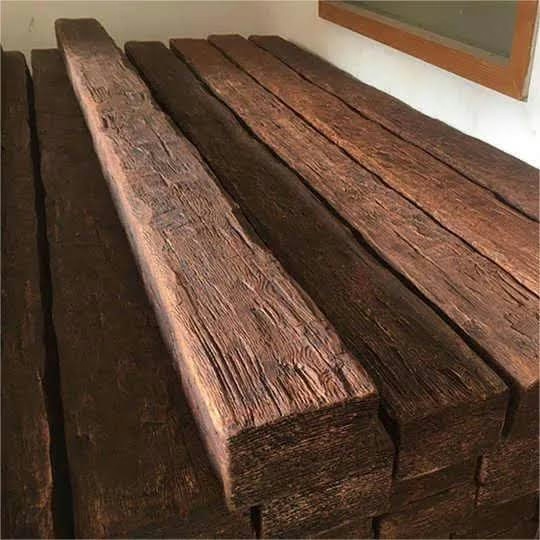
Specification process for a typical renovation
A typical renovation beam project follows this sequence.
Week 1: Site measure. The contractor measures the room and marks the beam layout on the ceiling with painter's tape. This gives the homeowner a visual preview before anything is ordered. Adjust the layout if the spacing looks wrong.
Week 2: Order confirmation. Once the layout is approved, the contractor confirms the profile, length, finish, and quantity with the supplier. Allow two to four weeks for standard stock profiles. Allow four to six weeks for custom finishes.
Week 3: Delivery. The beams arrive on site. The contractor inspects each bundle, checks lengths against the order, and stores them flat in a dry location until installation.
Week 4: Install. Blocking is added if needed. Beams are installed. Joints are made. Touch-up finishing is done.
Week 5: Painter. The painter returns for a final coat on the beams and any ceiling touch-ups. The project is complete.
Six weeks from measure to finished ceiling is a realistic timeline for a standard renovation with stock profiles.
Budget planning for the GC
When a GC is pricing a renovation project that includes faux beams, the line items are:
| Item | Typical cost |
|---|---|
| Material: 6-by-8 oak grain, per linear foot | $40-$55 |
| Material: end caps and trim, per location | $20-$40 |
| Material: touch-up kit | $60-$100 |
| Labor: blocking installation, per location | $30-$60 |
| Labor: beam install, per 12-foot section | $150-$250 |
| Labor: finishing and touch-up | $150-$300 |
| Freight / delivery | $150-$400 |
A typical three-beam great room renovation — 60 linear feet total of 6-by-8 oak grain — comes to roughly $4,500 to $6,500 installed. The painter's final visit is often bundled with other trim work in the house, which reduces the per-visit cost.

What homeowners ask the contractor
Three questions come up in almost every homeowner conversation.
"Will it look real?" A quality polyurethane beam at conversational distance looks like wood. The grain detail in a good mold is convincing. The matte finish removes the plastic sheen that makes cheap faux products obvious. If the homeowner is still skeptical, order one sample section and put it in the room.
"Will it yellow or crack over time?" Quality closed-cell PU with UV-stable topcoat holds its color for a decade in normal interior lighting. The product does not crack the way real timber does. The risk is lower than real timber, not zero.
"Can we change the color later?" Yes. The beam can be sanded lightly and refinished on site. The factory finish is not permanent.
Common mistakes to avoid
Forgetting blocking. A beam mounted to drywall without blocking will pull out over time. Always specify blocking at the framing stage or add it before the ceiling is finished.
Ordering beams that are too long to handle. A 20-foot beam is a two-person carry in a straight hallway and a two-person impossibility in a stairwell. Measure the path from the front door to the room before ordering. If the longest beam does not fit through the route, order shorter sections and join them in the room.
Not ordering extra material. Order 10 percent over the measured linear footage. There will be cuts, mistakes, and waste. An extra beam section is cheaper than a re-order with freight.
Skipping the sample. The color on a screen is never the color on the beam. Always get a physical sample before ordering for a visible room.
Putting beams in before the painter. If the painter can finish the beams and ceiling in the same visit, the color match is better and the cost is lower. Plan the sequence accordingly.
The builder's perspective
For a builder running ten renovation projects per year, the faux beam specification is a reliable revenue line. The margin on material and install is typically 25 to 35 percent. The callback rate for quality installations is low — the product does not move, crack, or fade the way real timber does.
The key to a clean install is blocking. The key to a clean finish is coordinating with the painter. The key to a happy homeowner is a sample in the room before the order goes in. Get those three things right, and the beam project goes smoothly every time.
Technical References
ASTM standards cited in every specification
Test Data
Lab results from internal testing program
Updated 2026
Reviewed against current product specs


