Architecture has employed curved forms throughout history, from Roman arches to Gothic vaulting to contemporary expressions. The visual flow of curved elements creates softness and movement that straight lines cannot match, connecting spaces in ways that feel organic rather than mechanical. Curved arch style PU faux wood beams enable these architectural expressions in contemporary construction while maintaining the warmth and character that wood aesthetics provide.
The Architectural Appeal of Curves
Curved architectural elements engage viewers differently than straight components. Understanding these perceptual effects helps designers employ curves effectively.
Organic character distinguishes curved elements from the mechanical precision of straight lines. The human eye naturally follows flowing forms, creating sense of movement and change that straight geometry lacks. This organic quality aligns with biophilic design values that connect interior spaces to natural patterns.
Spatial transition occurs naturally through curved forms. Arches guide movement between spaces while maintaining visual continuity that walls and doorways interrupt. The transition zone created by curved elements feels expansive and welcoming compared to the abrupt boundaries that straight openings create.
Visual softening counteracts the hard surfaces common in contemporary construction. Glass, steel, and concrete create environments that can feel sterile or institutional without organic counterpoint. Curved wood elements introduce warmth and softness that balance these materials while maintaining contemporary design integrity.
Types of Curved Beam Configurations
Several distinct curved configurations address different architectural requirements and aesthetic objectives. Each produces characteristic effects suited to specific contexts.
Full arch configurations span from floor to structural support in smooth continuous curves. These substantial elements command significant visual presence, creating focal points that anchor entire room compositions. Full arches work particularly well in entries, gathering spaces, and areas where the transition from one zone to another should be emphasized.
Partial arch or scoop configurations provide curved elements that terminate at ceiling or wall surfaces rather than continuing to the floor. These lighter treatments add curved interest without the dominant presence of full arches. Partial configurations work well in living rooms, dining spaces, and other areas where curved aesthetics should complement rather than dominate.
Sculptural curves employ compound curvatures that twist or compound through space rather than following simple arch profiles. These ambitious installations represent the most dramatic applications of curved beam technology, creating one-of-a-kind sculptural elements that become primary room features. Sculptural treatments suit hospitality venues, corporate headquarters, and other spaces seeking distinctive character.
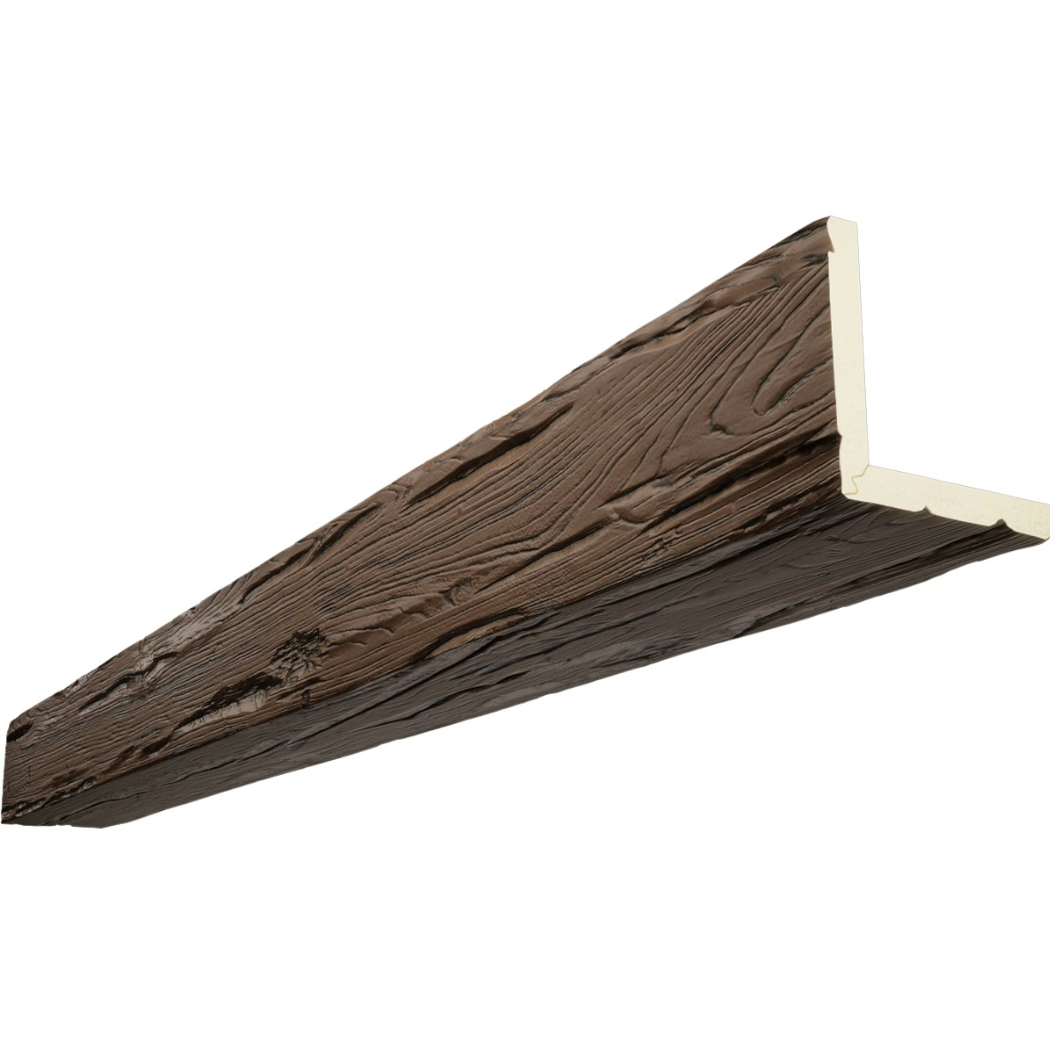
Engineering Curves in Polyurethane
The polyurethane casting process enables curved beam creation that would be impractical or impossible in natural timber. Understanding this manufacturing capability helps designers develop achievable curved concepts.
Mold creation establishes the foundation for curved beam production. Custom molds are crafted to specified curvature, with surface detail and texture incorporated into the mold surface. Once created, these molds enable consistent reproduction of curved profiles across multiple beam runs.
Radius flexibility allows curves ranging from gentle sweeps to tight bends. Minimum radius depends on beam depth and profile complexity, with deeper beams requiring gentler curves to avoid surface distortion. Early coordination between designers and manufacturers ensures that aesthetic objectives align with manufacturing capabilities.
Compound curvature capability addresses beams that curve in two directions simultaneously. These complex shapes require sophisticated mold design and careful production techniques but enable architectural expressions impossible with straight elements. Compound curves suit high-design applications where unique character justifies additional manufacturing complexity.

Design Applications for Curved Beams
Curved beams serve various architectural functions depending on application context and installation approach. Understanding these applications helps designers develop appropriate curved concepts.
Opening framing employs curved beams to define and enhance doorways, windows, and other openings. The curved element creates visual framing that softens transitions while establishing architectural hierarchy that distinguishes primary openings from secondary penetrations. Curved framing works well in both traditional and contemporary interiors.
Spatial division uses curved beams to separate zones within open-plan configurations. Rather than using walls to divide cooking, dining, and living areas, curved beam elements create visual boundaries that maintain spatial flow while establishing distinct character for each zone. This approach preserves the openness that makes open plans appealing while adding the definition that some clients prefer.
Ceiling expression brings curved beams into overhead positions that transform flat planes into dynamic surfaces. Curved beams across ceiling expanses create visual interest that engages viewers and adds depth to otherwise plain overhead surfaces. Ceiling applications work particularly well in large rooms where curved forms can fully express their character.
Scale Considerations for Curved Elements
Curved beams require appropriate scaling to achieve intended effects while fitting within architectural constraints. Several factors influence appropriate dimension selection.
Radius magnitude determines the overall footprint of curved installations. Larger radii create broader, gentler curves that require more horizontal space, while tighter radii create more dramatic bends in compact footprints. The available space constrains achievable radius, which in turn affects the visual character of installed curves.
Beam depth relates to curve radius and overall scale. Deeper beams create more substantial presence but require gentler curves to avoid surface distortion. Shallower beams can achieve tighter curves but may appear insufficiently scaled for large installations. Finding the appropriate depth for intended radius ensures balanced appearance.
Span between supports affects both structural requirements and visual character. Curved beams spanning between fixed supports experience different loading conditions than straight beams, requiring careful attention to support spacing and attachment methods. Longer spans create more dramatic curved expressions but impose greater structural demands.
Finish Treatment for Curved Beams
Curved surfaces present unique challenges and opportunities for finish application. Understanding these considerations ensures appropriate specification.
Light behavior differs on curved versus flat surfaces. The continuously changing angle between curved surfaces and light sources creates gradients of highlight and shadow that animate installations throughout the day. This kinetic quality adds visual interest but requires careful attention to finish selection to avoid unintended highlights or reflections.
Stain application on curved surfaces requires techniques that ensure even color distribution across varying surface angles. Spray application typically provides more uniform coverage than brush application on curved surfaces, ensuring that color appears consistent regardless of viewing angle. Professional finish application ensures that curved surfaces achieve intended appearance.
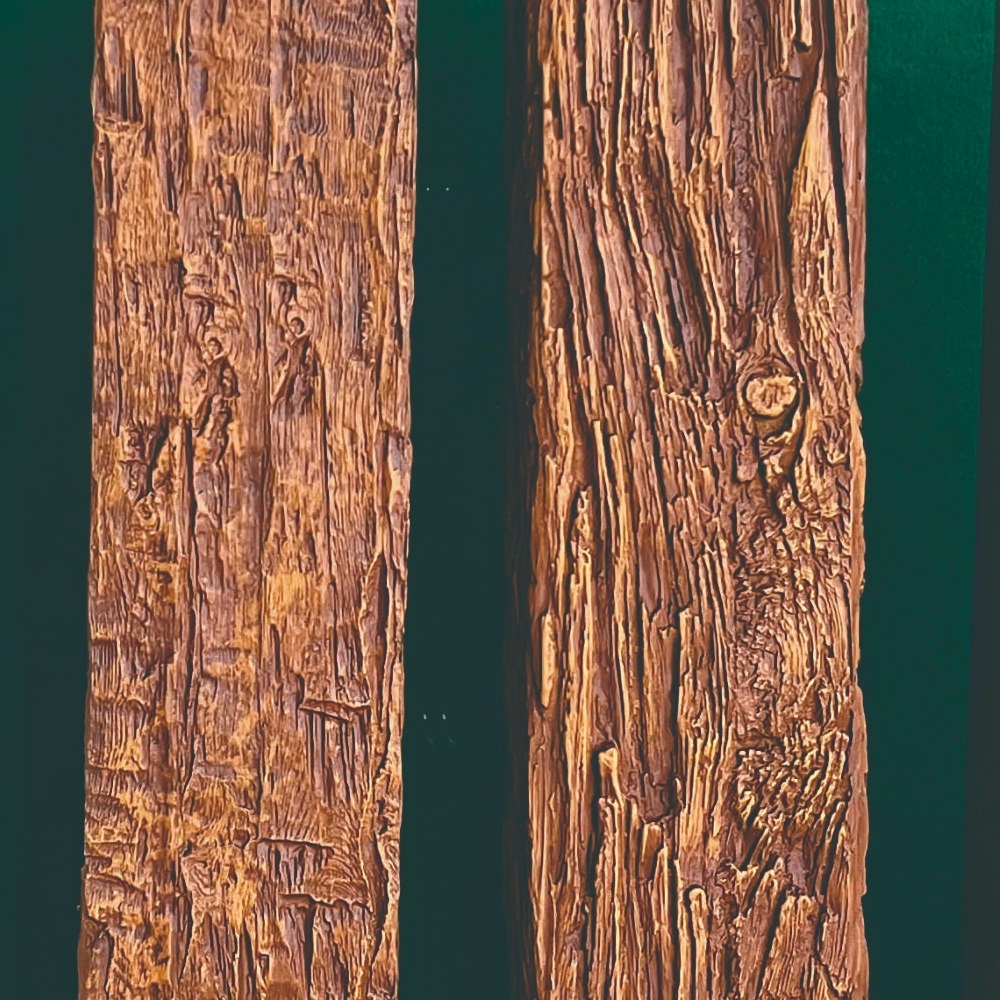
Texture interaction with curvature affects how wood grain patterns read on curved elements. Grain patterns that appear subtle on flat surfaces may appear exaggerated on tight curves where the grain plane angle changes rapidly. Previewing texture behavior on actual curves, rather than flat samples, helps ensure satisfying results.
Structural Support for Curved Installations
Curved beam installations require support approaches that accommodate the unique geometry and loading of curved elements. Professional engineering ensures safe, stable performance.
Curved backing follows the beam curvature to provide continuous support throughout curved runs. This backing must be carefully formed or fabricated to match beam geometry precisely, ensuring even contact that supports the full beam cross-section. Inadequate backing creates stress concentrations that can cause beam failure over time.
Support point distribution on curved beams differs from straight beam practice. The loads from curved elements include lateral components that affect support design. Engineering analysis identifies appropriate support spacing and hardware for the specific curvature, beam dimensions, and loading conditions of each installation.
Connection details at beam terminations require careful detailing to address compound angles where curved beams meet walls or other beams. Custom-fabricated fittings often prove necessary to achieve clean transitions that maintain the continuous character that makes curved beams effective.
Budget Implications of Curved Design
Curved beam installations typically cost more than equivalent straight beam work due to increased manufacturing complexity and installation difficulty. Several factors contribute to this cost premium.
Custom tooling for curved beam production adds setup costs that straight beam manufacturing avoids. Molds for curved profiles require more complex fabrication and may have shorter useful lives than straight molds due to release and handling challenges. These tooling costs amortize across production quantity, making single-beam or small-quantity orders relatively expensive.
Installation labor increases with curvature complexity. Measurement and fitting for curved elements requires more time than straight cuts. Field adjustment to accommodate actual conditions adds further time compared to straight installations with predictable geometry.
Shipping curved elements presents logistics challenges that straight beams avoid. Curved beams may require custom crating, specialized handling, and careful protection during transport. The dimensional and fragility considerations of curved shapes increase shipping costs proportionally.
For architects and designers seeking distinctive architectural expressions, curved arch style PU faux wood beams enable flowing forms that transform ordinary spaces into memorable environments. The investment in curved design delivers returns through interiors that engage and delight viewers through their organic character.
Technical References
ASTM standards cited in every specification
Test Data
Lab results from internal testing program
Updated 2026
Reviewed against current product specs


