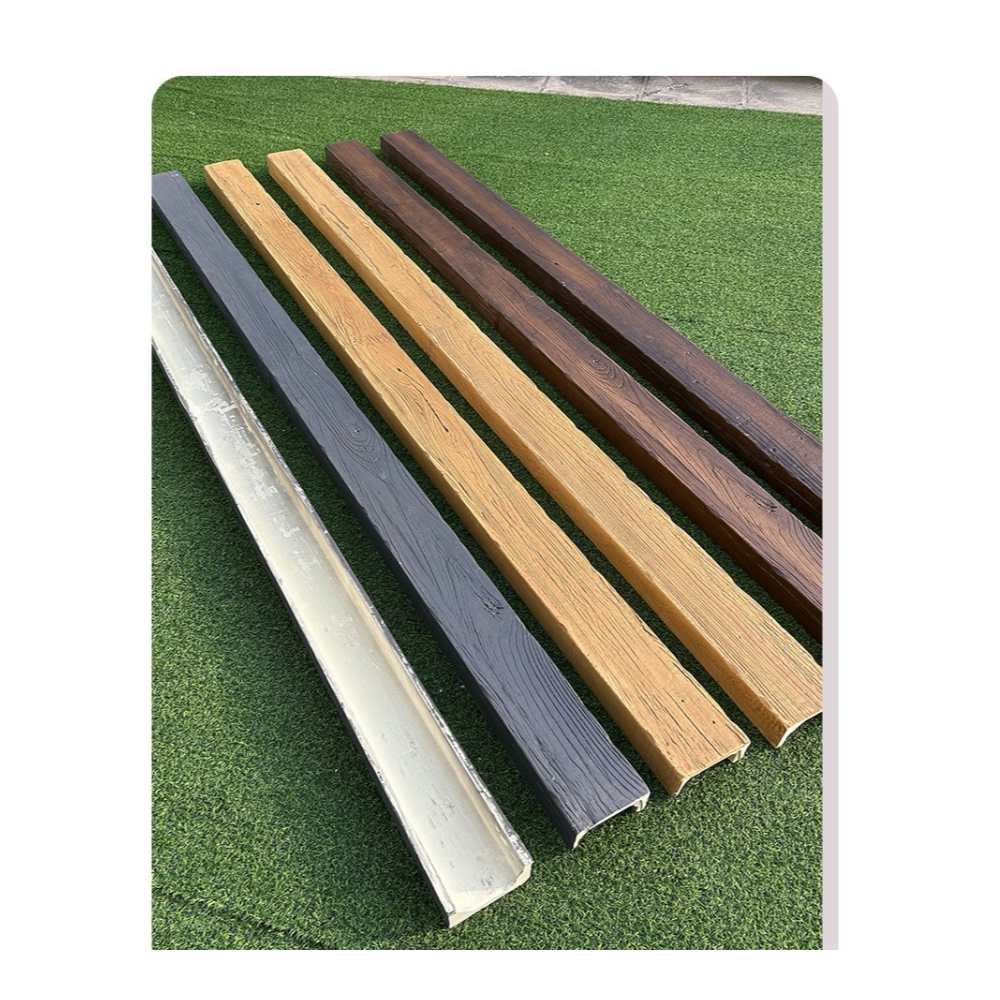
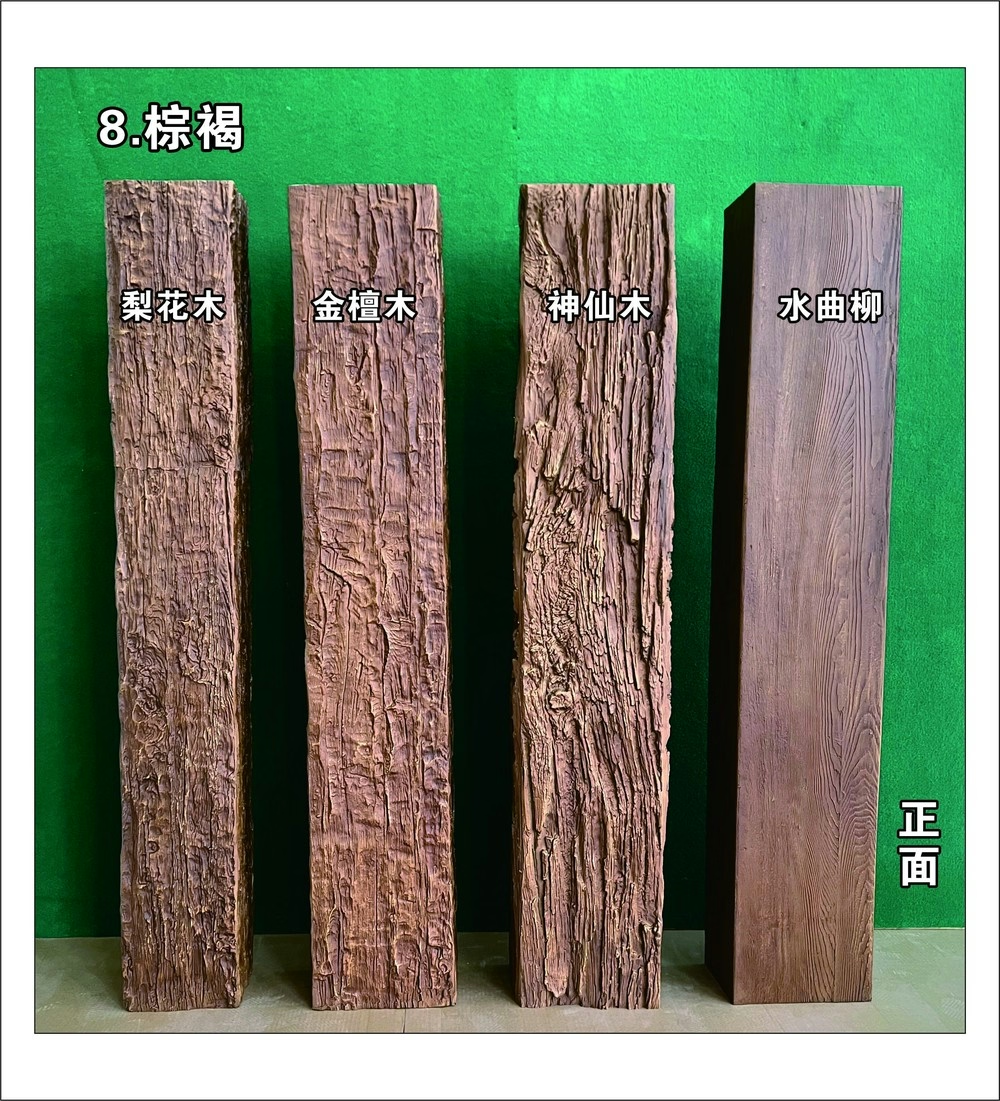
Three years after the original install, the homeowner calls back. They've added a new room onto the back of the house, and they want the beam run to continue into the new space — same profile, same finish, same hand-hewn texture. The original installer is long gone, and there's no documentation of where the beams were sourced.
This is the moment when custom add-on PU beam segments become invaluable.
The "matching problem" in extended layouts
Adding to an existing beam layout sounds simple but is notoriously difficult in practice. Wood ages, finishes fade, profiles change when manufacturers update their tooling. Even when the original supplier is still in business, matching a beam installed years earlier can be a serious challenge.
With polyurethane faux wood beams, the matching problem is solvable if you have three pieces of information:
- The original profile cross-section (width and depth)
- The original surface texture (smooth, hand-hewn, wire-brushed, distressed)
- A close color reference or sample
The first two are usually easy. The third is where most projects run into trouble.
How manufacturers approach custom matches
A serious PU beam manufacturer will approach an add-on order with a specific process:
- Sample submission — The client sends a small piece of the existing beam (a cut-off from the original install, a fallen section, or a carefully photographed reference)
- Profile measurement — The factory confirms the cross-section matches a current mold or can reproduce it
- Color and texture analysis — The factory's finishing team builds a custom stain formula to approximate the original finish
- Sample production — A small test piece is produced and shipped for client approval
- Production run — Once approved, the full add-on order is produced in one batch
The whole process typically takes 4 to 7 weeks depending on the complexity of the match and the production queue at the factory.
When add-on segments make sense
Not every project needs a true custom match. There are three common scenarios:
| Scenario | Approach |
|---|---|
| Recent install with original documentation | Order from the same product line, same finish code |
| Same project, phased construction | Original specifier retains documentation for the add-on phase |
| Existing beam, unknown source | Custom match required using sample reference |
| Intentional contrast | Designer wants new beams to deliberately differ in tone or texture |
For the third and fourth scenarios, custom add-on segments are the right solution. For the first two, a reorder from the original specification may be simpler and less expensive.
Phased construction: the most predictable case
Phased construction projects — where a master plan is divided into two or three build phases over several years — are the easiest add-on scenario. The design team typically retains complete documentation from phase one, including:
- Beam profile numbers and finish codes
- Color samples and reference photographs
- Supplier contact information and product literature
When phase two begins, the specifier simply issues a reorder against the original documentation. Most manufacturers keep mold records for at least five years, often longer. The finish formula may need minor adjustment if the original run was years earlier, but the variation is usually minimal.
Undocumented beams: the hardest case
When the existing beams are from an unknown source, the process gets more involved. The contractor or designer needs to:
- Photograph the existing beam under natural daylight at multiple angles
- Measure the cross-section with calipers
- Cut a small sample (a corner section is usually sufficient and easily patched)
- Send the sample to the manufacturer for analysis
A good PU manufacturer can usually produce a convincing match from this kind of reference within 3 to 5 weeks. The risk is that the match won't be perfect — wood-grain patterns, in particular, are difficult to replicate exactly because each mold produces a slightly different grain texture.
Communicating acceptable variation to clients
For design professionals, one of the most important conversations happens before the add-on order is placed. The homeowner needs to understand:
- The new segments will not be a 100% identical match — they will be close
- The match will be more visible up close than from across the room
- Placing joints in shadow lines or behind columns reduces the visibility of any mismatch
- A slight intentional variation can read as authentic aging rather than poor matching
Designers who set this expectation early avoid the difficult conversation after installation where the homeowner notices a difference and feels the work was done poorly.
Technical considerations for add-on segments
Beyond the cosmetic match, the new segments need to connect physically to the existing beam run. This requires:
- Coordination of joint locations so seams don't land in visually prominent spots
- Confirmation that the new beam can be mounted to the existing blocking or that new blocking will be added
- Verification that the new segments align in plane with the existing ones — older beams sometimes sag slightly, which the new ones won't
For long runs that need to continue across multiple rooms, the installer should establish a new control line from a fixed point rather than trying to extend from the existing beam's endpoint. Existing beams can drift slightly out of true over time.
Lead time planning for extensions
Because add-on segments typically involve some custom work, the lead time is longer than a standard reorder. Realistic timelines:
- Sample submission and analysis — 1 week
- Custom match development — 1 to 2 weeks
- Production — 2 to 3 weeks
- Shipping — 1 to 3 weeks depending on destination
- Installation — 1 to 3 days
Total project timeline is typically 6 to 10 weeks from first contact to finished installation. For phased construction projects that are still in planning, the design team can front-load this timeline by submitting samples early.
What add-on segments cost
Custom add-on segments carry a small setup fee for the custom match work, plus the standard per-linear-foot cost of the beam. Expect to pay:
- Setup and matching fee — typically $250 to $750
- Beam cost — same as the original, assuming comparable profile and finish
- Shipping — depends on quantity and destination
- Installation — comparable to original install
For projects where only a small quantity of add-on segments is needed, the setup fee per linear foot can be significant. Some manufacturers reduce or waive the setup fee if the original order is recent or if the total project value exceeds a threshold.
Best practices for installers
Installers handling add-on segments should:
- Photograph the existing beam run before starting any work
- Confirm joint locations with the designer or homeowner
- Pre-fit each segment before applying adhesive or fasteners
- Use color-matched filler on all joints
- Keep a small touch-up kit on site for the final paint pass
These habits make the difference between an extension that reads as continuous and one that reads as a clearly different add-on.
A note on phased commercial projects
For commercial projects, phased construction is the rule rather than the exception. Hotels add wings, retail stores expand into adjacent space, restaurants open second-floor dining rooms above the original ground floor.
In these cases, the design team should plan ahead by:
- Specifying a beam supplier that retains mold records long-term
- Ordering a small surplus of original beams (typically 5 to 10%) for future phase work
- Documenting the original finish formula with samples kept in a project archive
These three steps reduce the cost and lead time of any future add-on work substantially.
The takeaway for project managers
Custom add-on PU faux wood beam segments are a practical solution for extended layouts, but they require planning. Whether the project is a renovation with existing beams, a phased construction plan, or a homeowners' association standardizing across buildings, the key is documentation and early sample submission.
For importers and distributors, offering a custom match service is a competitive advantage. Most homeowners and contractors don't realize the option exists until they need it — having the capability ready makes your business the one they call.
Technical References
ASTM standards cited in every specification
Test Data
Lab results from internal testing program
Updated 2026
Reviewed against current product specs