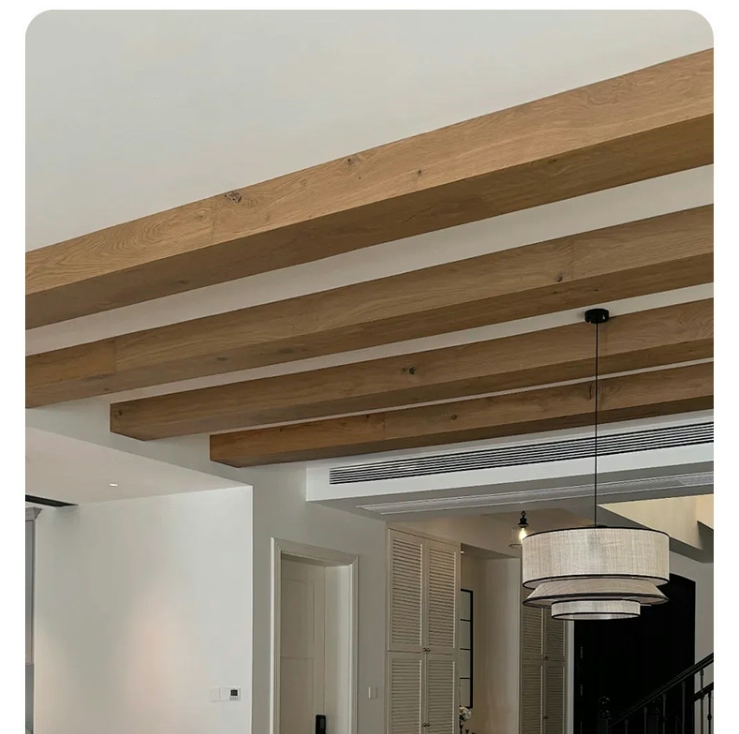
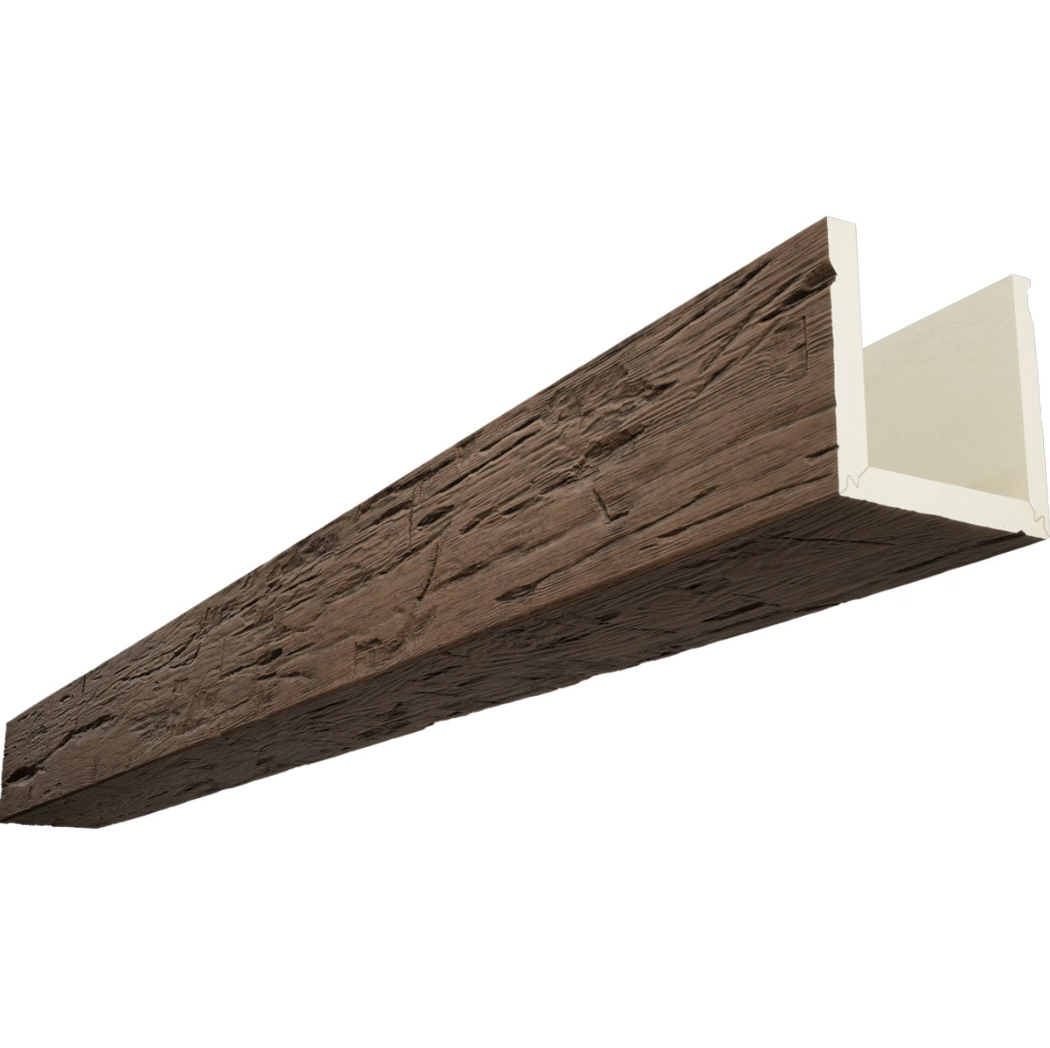
Government procurement operates by its own rules. The tender documents are comprehensive, the technical requirements are specific, the approval chain is longer than in the private sector, and the documentation expectations are rigorous. A supplier that understands how to navigate public sector procurement — and has the documentation systems to back it up — saves the contractor and the government project manager enormous amounts of time and frustration.
We supply curved and straight faux beams to government projects across Southeast Asia, the Middle East, and Africa on a regular basis. The process differs from a private-sector project in several ways, and we've built our systems to handle it efficiently.
Understanding tender documentation requirements
Most government tenders specify documentation requirements in one of three ways.
The first is by referencing a national or international standard: the UK BS 1090 for steel and aluminum fabrications, Singapore's PUB standards for public buildings, the UAE's Dubai Municipality building codes, the Philippines' National Building Code, or Kenya's National Construction Authority standards. The standard itself defines what test data, certificates, and declarations are required, and the supplier must demonstrate compliance.
The second is by listing specific documents in the tender specification itself: fire test certificates, thermal resistance data, dimensional stability reports, material safety data sheets, warranty terms, and references from previous projects of similar scale. These requirements are explicit and non-negotiable.
The third is by requiring compliance with a performance specification: the beam must achieve a certain fire rating, a certain thermal resistance value, or a certain load capacity. The supplier must demonstrate compliance through testing, calculation, or both. This is the most challenging requirement because it requires engineering judgment about how to demonstrate compliance.
We pre-prepare documentation packages that cover all three scenarios. When you send us the tender specification, we identify which scenario applies and provide the corresponding documentation in the format requested.
Common certifications for government beam projects
The certifications we supply most frequently for government beam projects are:
Fire test certificates are the most commonly requested document. PU beams are typically tested to BS 476 Parts 6 and 7 (fire propagation and surface spread of flame), EN 1365 (fire resistance), ASTM E84 (flame spread and smoke developed), or the local equivalent. Our standard beams achieve Class 1 surface spread of flame to BS 476 Part 7 and Class A to ASTM E84. For projects requiring a full fire-resistance rating (30, 60, 90, or 120 minutes), we supply a fire-rated version that has passed EN 1365 or UL 263 testing.
Thermal conductivity test reports document the beam's insulating properties. These are sometimes required for projects where the beam is used as part of a thermal envelope — in insulated ceilings, for example.
Dimensional stability and density reports document the beam's physical properties and demonstrate that the material performs consistently within specified tolerances.
Load bearing capacity statements are required for beams used in applications where they carry any load — suspended fixtures, integrated lighting, signage. We provide load tables and connection details for these applications.
MSDS (Material Safety Data Sheet) for the polyurethane resin and any finishes is standard and usually straightforward.
REACH compliance declarations are required for EU-linked projects under the Construction Products Regulation, documenting that the resin chemistry meets REACH requirements for SVHC (Substances of Very High Concern).
Certificates of Origin, chamber-stamped, are required for most international government imports. We provide these as standard for all export orders.
Warranty certificates are often required and are provided on our standard form or on the government's form if provided.
For projects in the Gulf region, we supply documentation compatible with Emirates Quality Mark and Dubai Municipality requirements. For Southeast Asian projects, we work with PSB Singapore and TÜV for accredited testing.
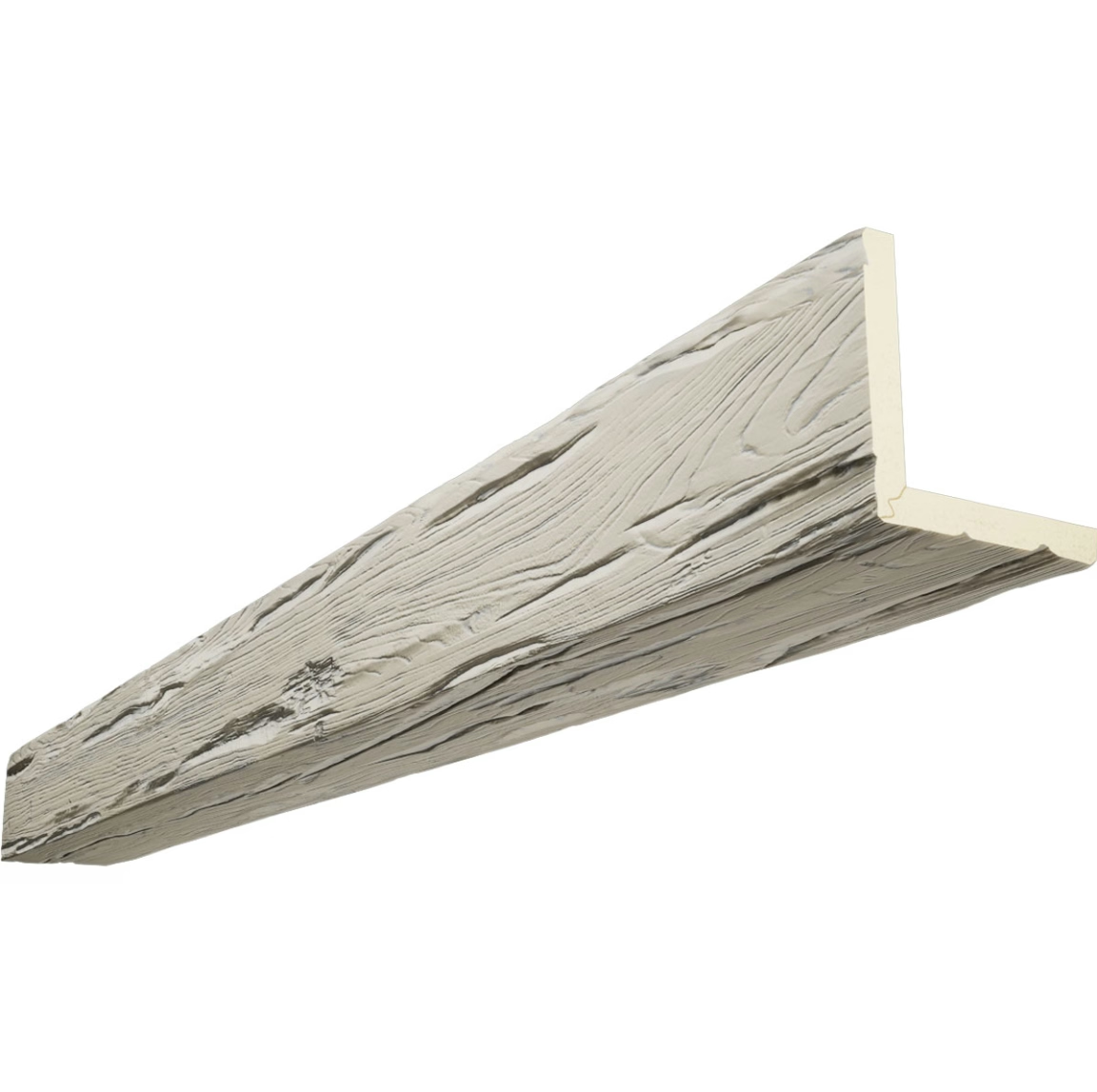
Fire ratings and what they mean
Fire rating is the most common technical requirement in government tenders. PU beams are classified as either non-combustible or limited-combustible depending on the standard and the grade.
To BS 476, our standard beams achieve Class 1 surface spread of flame — the highest classification for interior surface materials. For ASTM E84, the Steiner tunnel test, our beams achieve a Class A rating with a flame spread index under 25 and a smoke developed index under 450. These results are documented on our fire test certificates.
For projects requiring a full fire-resistance rating — where the beam must maintain its structural integrity for a defined period under standardized fire conditions — we supply a fire-rated version. The fire-rated version has passed EN 1365 or UL 263 testing for the specified duration. This version costs approximately 25% more than the standard version and has a slightly higher density. Lead time is 30–40 days.
Shop drawings and technical submittals
Government projects almost always require formal shop drawing submittals before production begins. The submittal package typically includes plan and elevation drawings showing the beam layout, cross-section details for each beam profile, connection details for the mounting system, a material specification sheet, a finish specification sheet, and a quality control plan.
We prepare shop drawings in AutoCAD or Revit format and submit them for approval within 10 business days of order confirmation. For urgent projects, we can produce drawings in 5 business days with a fast-track surcharge.
We respond to architect and engineer comments on drawings, revise as directed, and resubmit. Most shop drawing packages require two to three revision rounds before final approval. We don't charge for revisions within the agreed scope, but revisions that add significant new geometry or change the scope significantly may incur an additional charge.

Payment and contract terms
Government contracts typically specify payment terms of 30, 60, or 90 days from invoice date. We accommodate 30-day terms as standard. 60 and 90-day terms require a credit review and are available for established government suppliers or for projects with confirmed budget allocation and a signed contract.
Performance bonds and advance payment bonds are accepted. We work with contractors who require a bank guarantee for the contract value. The bond value, format, and issuing bank requirements should be specified in the tender documents.
For framework agreements — standing contracts with government entities covering multiple projects over a defined period — we offer volume pricing and dedicated production capacity. Several Middle East government entities and Southeast Asian housing authorities have framework agreements with us that cover beam supply for multi-year public housing and infrastructure programs. These agreements simplify procurement for subsequent individual projects because the terms are pre-agreed.
Delivery and logistics
Government projects often require delivery to a government warehouse, a project site, or multiple sites simultaneously. We coordinate with the contractor's logistics provider and can arrange consolidated container loads to the project port, door-to-site delivery with local transport coordination, staged delivery to multiple sites over a defined program, and on-site storage recommendations for large projects.
For projects in remote areas — inland cities in Africa, rural development projects in Southeast Asia — we work with freight forwarders who have specific experience with the port of entry and the inland transport route. This experience is valuable because border crossings, inland transit permits, and local handling requirements vary by country and change frequently.
Quality assurance and defect management
Government projects have rigorous inspection regimes. Inspectors check beams on arrival for transit damage, verify quantities against the packing list, and may conduct random sampling for dimensional verification.
We minimize defects through a three-stage quality check: during casting (dimensional check of every beam), after finishing (visual and dimensional check of every finished beam), and before packing (final visual and packaging check). We provide a quality certificate with every shipment.
For defect management, we maintain a spare allocation of approximately 3% on all government orders. If a defect is found on site, we ship replacement material within 5 business days of notification. For very large projects, we maintain a dedicated spare inventory at the port of entry so replacements are immediately available without international shipping delays.
Send the tender specification and the project schedule, and we'll return a compliance matrix, a documentation package tailored to the specification, and a quotation within seven business days.
For ongoing government procurement frameworks, we maintain a dedicated account manager who handles all documentation, certification, and coordination for the duration of the framework agreement. This ensures consistent quality and reduces the administrative burden on the contracting authority's procurement team. Several of our government framework clients have been with us for over five years.

Technical References
ASTM standards cited in every specification
Test Data
Lab results from internal testing program
Updated 2026
Reviewed against current product specs