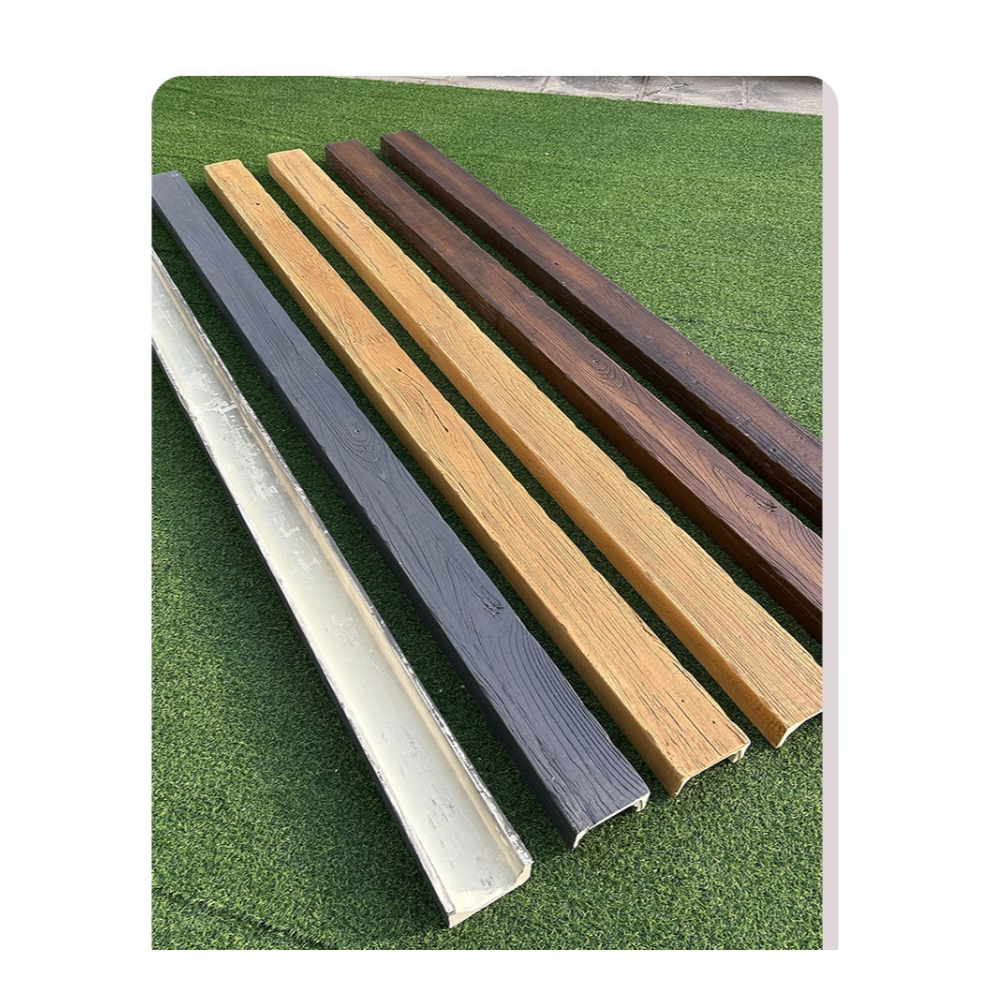
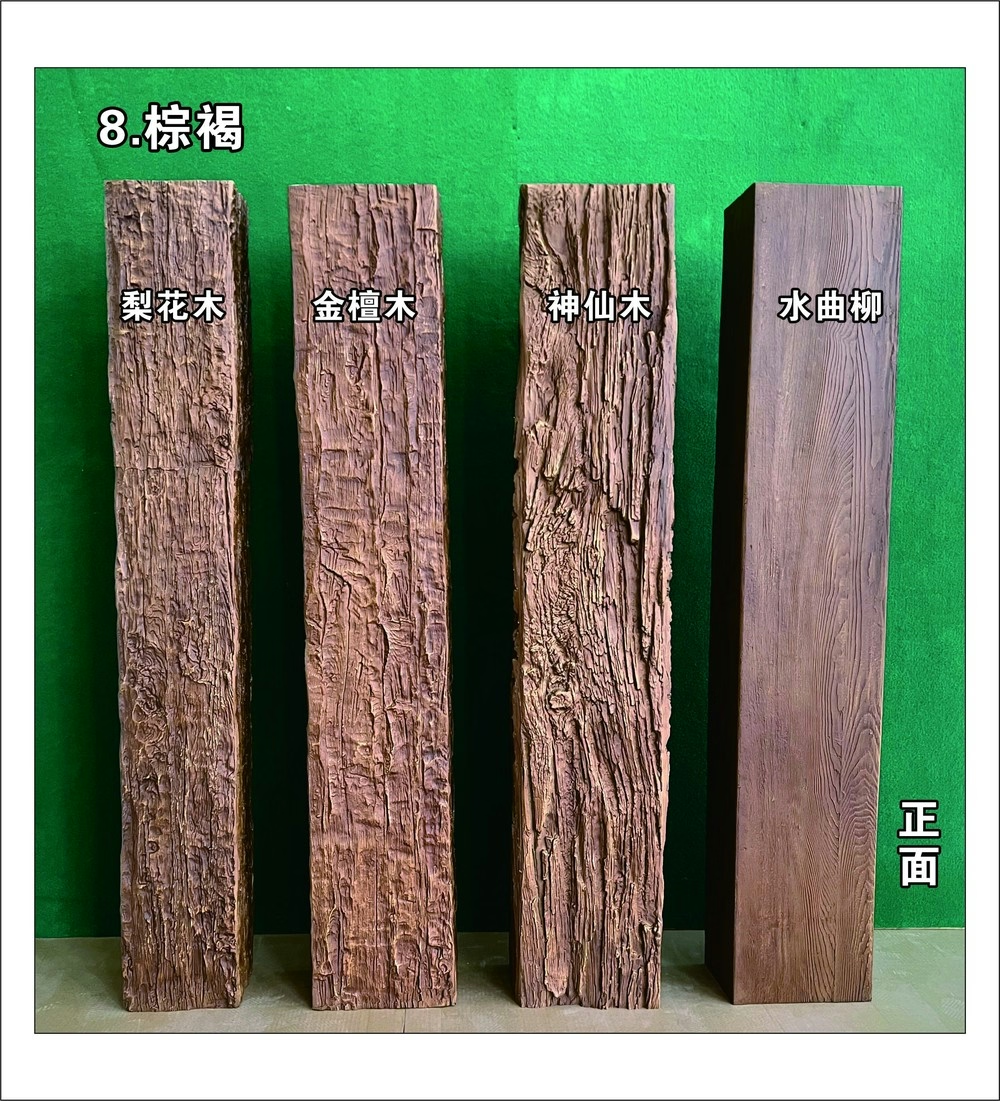
Most ceiling projects involve beams in a handful of standard lengths — 3 meters, 4 meters, 6 meters — with the installer cutting the last piece to fit on site. For projects where every beam length is different, where the ceiling geometry is precise, or where field fitting is impractical, custom cut length polyurethane faux beams deliver the right length from the factory, with no on-site adjustment required.
Why Custom Lengths Make Sense
The instinct in many projects is to order stock lengths and cut them down on site. For a small job with one or two beams, that approach is fine. For larger projects, it becomes a problem.
The first issue is finish damage. Cutting a faux beam on site means sawing through the factory-applied stain and sealer. The cut end is raw material, which has to be touched up to match the rest of the beam. A skilled finisher can do this, but the touch-up is rarely invisible. The cut end is a place where the eye lingers, particularly on a beam that ends against a wall at eye level.
The second issue is dimensional accuracy. A tape measure and a pencil mark are not as accurate as a factory CNC cut. For a beam that ends against an adjacent wall with a 5-millimeter reveal, a field cut that is 10 millimeters long will not fit. The installer has to recut, losing the first attempt's finish and starting over.
The third issue is waste. Every off-fall from a field cut is material that was paid for but cannot be used. For a project with fifty beams all cut to different lengths, the cumulative waste can reach 8 to 12 percent of the total material ordered. Custom cut lengths eliminate that waste.
For projects where these issues matter — high-end residential, commercial millwork, OEM rollouts — custom cut lengths from the factory are the right approach.
How the Factory Handles Custom Lengths
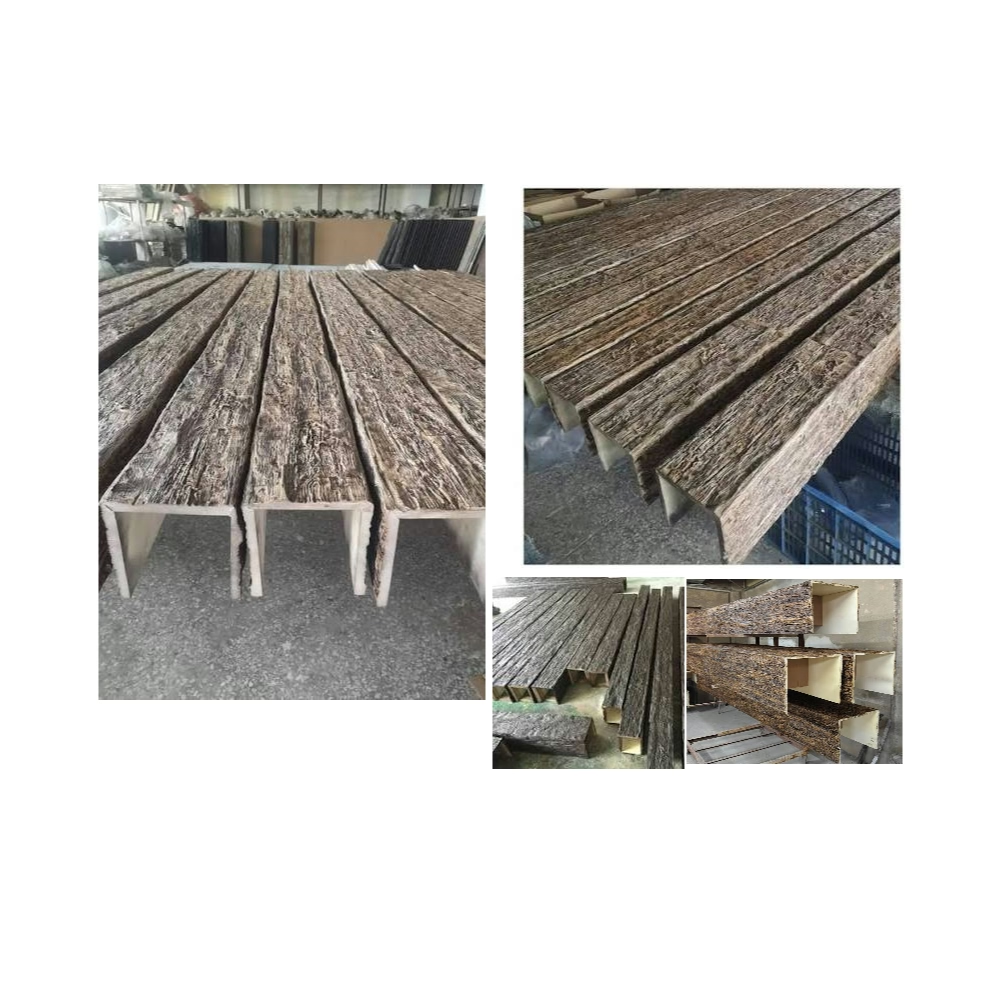
The cut length process starts with a take-off. The project team provides the factory with a list of every beam in the project, including the length, the profile, the finish, and any special cut details at the ends. The factory then cuts each beam to the specified length on a CNC saw, with the cut quality matching the factory-applied finish at both ends.
The factory's CNC saw can hold length tolerance to within 1 to 2 millimeters over a 6-meter beam, which is tighter than a typical field cut. The cut end is then finished by hand to match the surrounding beam surface, with the stain and sealer applied to the cut edge so it reads as a continuous piece.
For beams with compound cuts at the ends — say, a beam that meets a wall at a non-90-degree angle, or a beam that meets an adjacent beam at a mitered joint — the factory's CNC can produce the compound cut directly from the architectural drawing. The angle, the length, and the bevel are all cut in one operation, which is faster and more accurate than field-fitting a compound angle.
Specifying the Length
The length specification for a custom cut beam depends on how the beam meets the surrounding architecture. Several common conditions apply.
Wall-to-wall. The beam runs from one wall to another. The length is the clear span between the walls, plus any desired reveal into the wall. For a beam that butts cleanly against the wall with no reveal, the length is the inside dimension between the finished wall surfaces.
Wall-to-beam. The beam runs from a wall to another beam, typically at a mitered or butt joint. The length is measured from the wall to the centerline of the joint, or to the edge of the adjacent beam, depending on the joint detail.
Beam-to-beam. The beam runs between two other beams, typically in a coffered or grid layout. The length is measured between the centerlines of the perpendicular beams.
Freestanding. The beam ends are visible on both sides, with no adjacent structure to terminate against. The length is the visible length of the beam, with the ends finished as decorative terminals.
For each condition, the factory needs the dimension clearly specified. A beam-to-beam condition with a mitered joint requires both the length to the joint and the miter angle. A wall-to-wall condition with a reveal requires the reveal dimension at each end.
Sequencing a Custom Length Order
A custom length order typically runs in five phases.
First, the project team provides the take-off to the factory. This is usually a spreadsheet with one row per beam, including all the dimensions and the finish specification.
Second, the factory reviews the take-off and flags any inconsistencies. A beam length that does not match the reflected ceiling plan, a profile that conflicts with an adjacent beam, or a finish specification that is incomplete — these are caught at this stage, before any cutting begins.
Third, the factory cuts a sample beam — usually the most complex piece in the order — and ships it for approval. The sample confirms the length, the profile, the finish, and the end conditions.
Fourth, after sample approval, the factory cuts the rest of the order. Each beam is cut, finished, tagged with its location in the project, and packed for shipment.
Fifth, the factory ships the beams to the project site, with a packing list that matches each beam to its location. The installer works from the packing list and the reflected ceiling plan, with each beam going to its pre-planned position.

Lead Times for Custom Length Orders
Custom length orders run faster than fully custom shape orders because the mold is already in production and the cut lengths do not require new tooling. A typical custom length order breaks down as:
- Take-off review and confirmation: 1 week
- Sample production and approval: 1 to 2 weeks
- Production cutting and finishing: 2 to 3 weeks
- Crating and shipping: 1 week
Total: 5 to 7 weeks from approved take-off to on-site delivery. For repeat customers with an established profile and finish, the timeline can compress to 3 to 4 weeks because the sample approval phase is eliminated.
End Conditions and How They Affect Length
The end condition of a beam is part of the length specification, not a separate item. The factory needs to know what is happening at each end of every beam, because the end condition affects both the length and the cutting detail.
A square end is the simplest. The beam is cut perpendicular to its centerline at the specified length. A square end is appropriate for beams that butt against a wall or against an adjacent beam at a 90-degree corner.
A mitered end is cut at an angle. The angle is specified by the project, typically to match the angle at which the beam meets a wall, a ceiling, or an adjacent beam. A mitered end requires both the length and the miter angle in the take-off.
A returned end is profiled to match the beam's cross-section, with the profile wrapping back into the wall or ceiling. A returned end requires the factory to fabricate a small return piece and attach it to the beam end, which adds a step to the finishing process.
A decorative end is a finished termination, such as a corbel, a scroll, or a custom profile. A decorative end requires the factory to produce or supply the termination as part of the beam, with the joint between the beam and the termination finished to read as a continuous piece.
For each end condition, the factory needs the specification clearly stated. A take-off that says "beam length 4.2 meters" without specifying the end conditions forces the factory to guess, which usually results in a quote for the simplest end condition and a field surprise when the beam arrives.
Field Installation
Custom cut length beams install faster than field-cut beams because there is no cutting on site. The installer lifts each beam into position, checks the fit, and fastens it to the track or blocking. A crew that would spend a day measuring, cutting, and fitting field-cut beams can install the same number of custom cut beams in half the time.
The faster installation is not just a labor saving. It is also a quality improvement. Field cutting introduces dust, requires touch-up finishing, and creates the conditions for measurement errors. Factory cutting eliminates all three.
For projects where the installation window is tight — a hotel renovation between guest seasons, a retail buildout before the grand opening, a residential install before the homeowner moves in — the time saving from custom cut lengths is often the difference between meeting the schedule and missing it.
When Custom Length Is Worth Specifying
Custom cut length polyurethane faux beams cost slightly more per piece than stock length beams, but the savings in field labor, the improvement in finish quality, and the reduction in waste typically make the total installed cost lower. For projects where finish quality matters, where installation speed matters, or where the beam lengths are non-standard, custom cut lengths are the right specification.
Technical References
ASTM standards cited in every specification
Test Data
Lab results from internal testing program
Updated 2026
Reviewed against current product specs