
A cathedral ceiling that soars to 8 meters and curves from wall to wall in a smooth parabolic sweep presents a spatial challenge that no straight piece of lumber solves well. You can cantilever and scar joints, you can kerf-bend thin stock, you can laminate and fill — but every one of those solutions costs serious money and still produces a result that reads as approximation when you stand in the room and look up.
Custom molded curved polyurethane faux beams do something different. They capture the full geometry of the vault in a single molded piece, run grain continuously across the entire sweep, and arrive on site ready to hang. The question isn't whether curved PU beams can solve a vaulted ceiling — they can. The question is how to get from a set of architectural drawings to a beam that fits.
Understanding vaulted geometry in beam terms
Not all vaulted ceilings are the same, and the differences matter a lot for how a curved beam is designed and priced.
Barrel vaults
A barrel vault is the simplest vault form: a half-cylinder section rotated around a horizontal axis. Every cross-section perpendicular to the vault axis is a perfect semicircle. Barrel vaults are relatively straightforward for curved beams because the radius is constant along the entire length.
The beam geometry for a barrel vault is a segment of a cylinder — essentially a curved beam with a constant radius. The cross-section of the beam is cut from the cylinder surface. A rectangular cross-section produces a beam that sits on the cylinder like a tendon. A trapezoidal cross-section produces a beam that fills more of the vault section.
Barrel vaults are the most common vault type in commercial renovation — old warehouses, industrial lofts, churches converted to event spaces. They're also the most economical for curved beam sourcing because a single mold geometry can produce every beam on the project.
Rib vault ceilings
A rib vault — common in Gothic architecture and in modern reproductions of Gothic forms — is formed by the intersection of two or more barrel vaults. The structural ribs of the vault are exposed, and in a timber reproduction they would be the decorative members.
With PU beams, the ribs can be individual curved beams that intersect at a central boss or keystone. The intersection geometry has to be designed carefully: either the beams are mitered to meet at a point, or a separate decorative connector piece fills the intersection. For a four-way rib vault, you typically need four identical curved beams and a central octagonal or circular medallion piece.
Rib vault beams are more expensive than barrel vault beams because of the intersection geometry. The mold tooling is more complex, the pouring is more precise, and the finishing requires care at the miter joints.
Parabolic and compound curves
Modern architecture frequently uses parabolic vault profiles — the curve that gives cathedrals their soaring feel — rather than circular barrel profiles. Parabolic curves are more challenging to mold because they have a changing radius at every point along the sweep.
A true parabolic vault requires a custom mold with a parabolic inner surface. The tooling cost is higher because the curve cannot be generated with a simple radius sweep on a CNC machine; it has to be calculated and machined as a parabolic profile.
Compound curves — where the beam bends in two directions simultaneously, like a beam that curves along its length and has a curved cross-section — are the most expensive to produce. They're rare in practice, appearing mostly in high-end residential and bespoke commercial interiors. A compound curve beam requires a fully three-dimensional mold, usually machined from aluminum with tight tolerances, and the production yield is lower than for single-direction curves.
The mold design conversation
The mold is the central cost driver for any curved beam project. Getting the mold right — which means getting the geometry right before the mold is cut — is the most important step in the sourcing process.
Engineering the parting line
Every two-part injection or pour mold has a parting line: the plane where the two mold halves meet. For a barrel vault beam, the parting line typically runs along the neutral axis of the curve — the imaginary line through the middle of the beam's cross-section that neither stretches nor compresses when the beam is bent. Placing the parting line on the neutral axis minimizes flash (foam squeeze-out at the seam) and produces the cleanest surface finish.
For parabolic and compound curves, the parting line is more complex. It has to follow the neutral axis of the curve at every point, which means it may not be a flat plane — it can be a curved surface. A curved parting line requires more precise mold machining and more careful clamping during production. It's doable, but it adds to tooling cost.
Grain texture placement
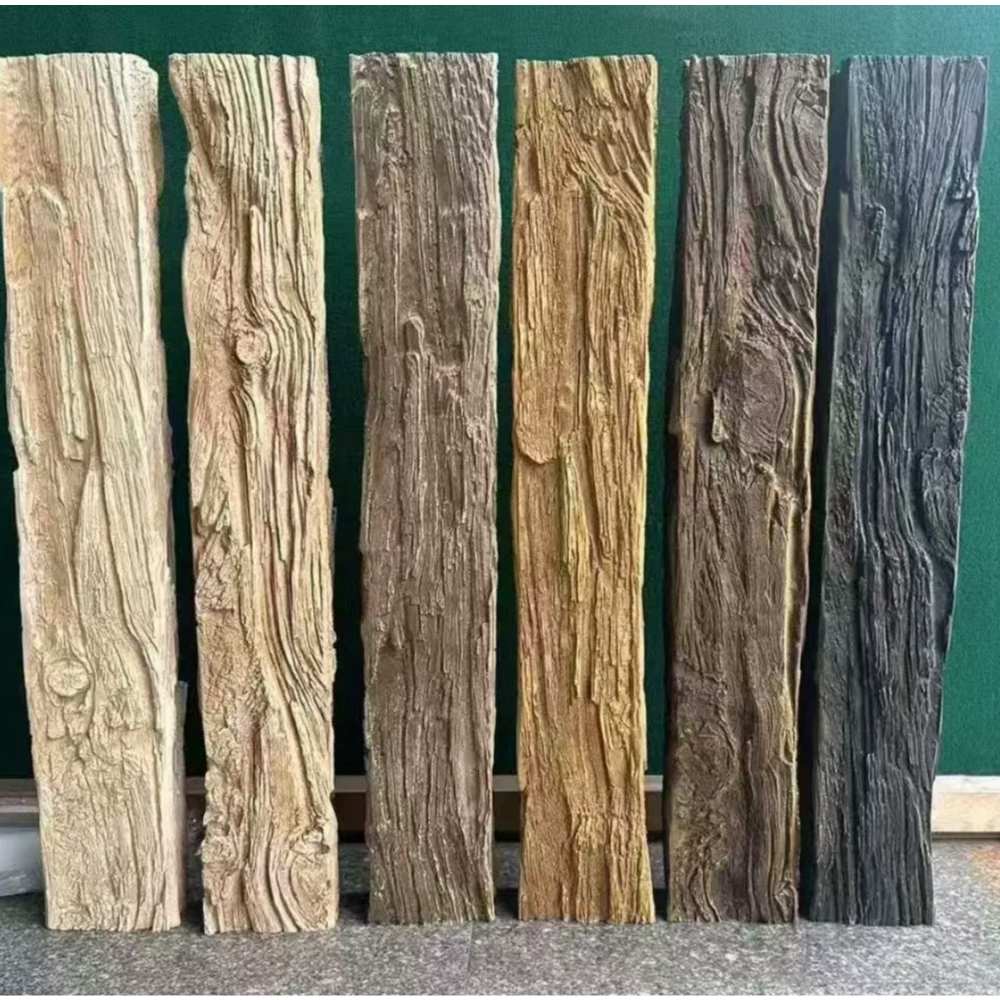
The wood grain texture on a PU beam is pressed into the mold surface, not carved into the beam. The mold's inner surface carries the negative of the grain pattern, and the PU foam picks it up as it cures against the mold wall.
For curved beams, grain placement has to be engineered relative to the curve. The grain direction is defined in the mold design phase. You can specify:
- Longitudinal grain running along the inner or outer curve of the beam
- Transverse grain running perpendicular to the curve (a rare choice that reads as unusual and intentional)
- Diagonal grain running at an angle to the curve (a compromise between the two that minimizes visual distortion at the curve's apex)
The factory will recommend a grain direction based on the curve geometry and typical aesthetic preferences. For most vaulted ceiling projects, longitudinal grain along the inner curve is the default — it matches how natural wood grows and how a laminated timber beam would look.
Radius ranges and what they cost
Different curve radii produce different tooling and production challenges. Here's a practical guide to radius ranges and what they mean for pricing:
| Radius range | Mold complexity | Typical tooling cost | Production feasibility |
|---|---|---|---|
| 2,000 mm + | Low — simple arc | $3,000 - $6,000 | Excellent |
| 1,200 - 2,000 mm | Medium — tighter arc | $5,000 - $10,000 | Good |
| 600 - 1,200 mm | High — tight arc, special clamping | $10,000 - $20,000 | Moderate |
| Below 600 mm | Very high — flexible mold required | $15,000 - $30,000+ | Challenging, specialist factories only |
Tight-radius beams below 600 mm are typically not produced as single-piece curved beams. Instead, the factory will produce multiple short segments that are joined on site with hidden steel brackets. The joints are concealed by the grain pattern and by the finishing process, but the on-site joinery adds labor cost.
For a vaulted ceiling with a radius of 3,000 mm (a moderate cathedral curve), you're in the sweet spot for curved PU beam production: the tooling is affordable, the production is reliable, and the beam installs cleanly.
The intersection problem: beams meeting walls and ridges
A curved beam running along a vaulted ceiling doesn't end in a flat plane — it ends in a compound cut where the beam's curved surface meets a wall, a ridge, or another beam. That end cut has to be designed and fabricated correctly.
Wall terminations
When a curved beam meets a wall, the end of the beam needs to be cut to match the wall's surface — which at the intersection point is not perpendicular to the beam's axis. The cut is angled in two planes. The factory can cut this end geometry at the production stage if you provide accurate wall-angle data. Alternatively, the end cut can be left long and cut on site by the installer.
For production-cut ends, provide the factory with a section drawing showing the beam axis, the wall plane, and the required end-cut angles. The factory will machine the end cut on a multi-axis CNC beam end mill.
Ridge and peak intersections
Two curved beams meeting at a ridge or peak — a common configuration in barrel vault hallways — require mitered ends that meet perfectly along the ridge line. The miter angle is half the angle between the two beam axes at the intersection point.
For a symmetric barrel vault, this is a 45-degree miter on each beam. For asymmetric vaults or parabolic vaults, the miter angle varies along the beam length and the factory has to calculate a compound miter that meets the adjacent beam cleanly.
Miter tolerances of ±1 mm are achievable in production. Tighter tolerances require on-site fitting and are not standard for most projects.
Finishing curved beams to match vault geometry
The finishing process for curved beams is the same as for straight beams — sanding, priming, staining, and sealing — but the application of finish products requires adjustment for the curved surface.
Spray application is preferred for curved beams. Rollers and brushes can work but tend to leave uneven coverage in the tight radius sections. A factory with a spray booth and curing oven can apply a consistent finish across a curved surface faster and more uniformly than on-site finishing.
Stain settling on curved surfaces is worth watching. Stain tends to pool in the low points of the grain texture, which on a curved surface means it migrates toward the inner (concave) face of the beam. The migration is usually subtle and reads as natural wood aging rather than a defect, but for a pristine multi-tone finish, a pre-stain conditioner helps even the absorption.
Sourcing and logistics for vaulted ceiling projects
Vaulted ceiling projects typically involve more pieces than a standard straight-beam project and larger individual beams. Both factors affect logistics.
A curved beam for a 6-meter barrel vault is a 6-meter-long piece. It needs custom-length shipping — typically horizontal on a crate base, not vertical in a standard pallet. Shipping cost for a 6-meter curved beam from China to a U.S. or European port typically runs $80 to $200 per beam depending on quantity and destination.
For European destinations, 6-meter beams fit in standard 20-foot containers if shipped lying flat. For U.S. West Coast ports, 6-meter beams may require a 40-foot container or a flatrack. For U.S. East Coast ports, containerization is straightforward.
The factory will typically ship curved beams fully assembled and finished — no site assembly required for single-piece beams. For very large beams (over 8 meters), the factory may ship in two pieces with a concealed steel joiner bracket for on-site assembly.
A project manager coordinating a vaulted ceiling beam installation should plan for a two-week buffer between beam delivery and ceiling installation, to account for inspection, touch-up finishing, and any on-site adjustments that become apparent when the beams are in hand.
Getting started on a vaulted ceiling beam project
If you have a vaulted or barrel-vaulted ceiling and you're exploring curved PU beams as a solution, the first step is to get the geometry into a format the factory can use. A dimensioned section drawing showing the vault profile, the beam cross-section, the overall length, and the termination conditions is the minimum. A 3D model is better.
Share the drawing with two or three qualified factories and ask for a feasibility review. Most factories will do this at no charge for serious RFQs. The feasibility review should confirm whether the geometry is producible, what the tooling cost and per-beam cost will be, and whether there are any simplification recommendations that preserve the visual intent while reducing cost or risk.
That conversation — from geometry to quote to production — typically takes three to five weeks for tooling development and an additional four to eight weeks for the first production run, depending on factory scheduling and the complexity of the curve.
Vaulted ceilings are some of the most satisfying projects in faux beam work. A well-designed curved PU beam in a barrel vault or cathedral ceiling transforms a space in a way that a straight beam never can. The geometry is the design. Get the geometry right and the rest follows.
Technical References
ASTM standards cited in every specification
Test Data
Lab results from internal testing program
Updated 2026
Reviewed against current product specs


