
Most beam projects call for standard rectangular profiles. The supplier has the molds, the production line is dialed in, and the quote comes back within a day. But there's a persistent class of projects where the architecture calls for something else entirely: a fan-vaulted ceiling with hexagonal ribs, a Victorian parlor restoration with turned corbels, a contemporary office with I-beam-shaped decorative beams that mirror the structural steel above the ceiling.
These are special-shape projects. They require custom molds, custom pours, and — critically — a factory that has the engineering capability to take a drawing and turn it into a producible mold.
What counts as a special shape
The term "special shape" in the PU beam world covers a wide range of geometry, but in practice it breaks down into a few distinct categories.
Non-rectangular cross-sections
The most common special shape request. Instead of a simple rectangle, the beam has a chamfered profile, a step, a tongue-and-groove interlocking cross-section, an I-beam or H-beam silhouette, or a custom profile with one or more decorative faces. The beam runs straight along its length — the special geometry is in the cross-section only.
Non-rectangular cross-sections are the easiest special shapes to produce because the mold tooling is two-dimensional: the cross-section is machined into the mold, but the beam runs straight along a single axis. The tooling cost is moderate, the production is reliable, and the per-beam cost is typically 15 to 40 percent above a comparable rectangular beam.
Tapered beams
A tapered beam gets narrower from one end to the other — either symmetrically (like a gable-end truss chord) or asymmetrically (like a bracket or corbel). Tapered beams require a mold that changes cross-section along the beam's length, which means either a multi-part segmented mold or a flexible mold material.
Tapered beams are more expensive to produce than uniform cross-section beams. The tooling cost is higher because the taper has to be machined or hand-shaped, and the production cycle is longer because the foam has to fill the full tapered cavity consistently. Expect a 30 to 60 percent premium over a rectangular beam of similar dimensions.
Polygonal and curved cross-sections
Octagonal, hexagonal, circular, elliptical, or lenticular cross-sections. These are produced by machining the corresponding profile into a two-part or multi-part mold. Polygonal profiles with four to eight sides are straightforward. Curved profiles (circular, elliptical) require precision-machined aluminum molds and careful clamping.
Polygonal beams are common in Victorian and Gothic revival restorations, where the original timber structure was often octagonal. They're also increasingly used in contemporary design as a way to add visual interest without resorting to texture or ornament.
Sculpted and compound profiles
The top end of the complexity range. A sculpted profile has decorative carving or relief on one or more faces — egg-and-dart moldings, acanthus leaf capitals, rope twist details. A compound profile combines two or more special shape types — a tapered beam with a hexagonal cross-section and carved acanthus details, for example.
Sculpted profiles require either hand-carved master molds (for high-relief ornamental details) or CNC-machined molds (for repetitive geometric relief). Hand-carved master molds are more expensive and slower but produce more faithful reproduction of classical ornament. CNC-machined molds are faster and cheaper but work best for geometric patterns that can be described mathematically.
The tooling conversation
Special shape beams live or die by the mold. Getting the tooling right is the single most important factor in whether a special shape project succeeds.
From drawing to mold
The process starts with a dimensioned drawing of the beam's cross-section and a specification of the beam's length. The factory's engineering team reviews the drawing and assesses moldability — whether the profile can be faithfully reproduced in a two-part mold, whether undercuts in the profile will prevent clean demolding, and whether the beam length is compatible with the factory's production equipment.
For simple cross-section changes (chamfers, steps, simple profiles), the factory can often generate a CNC toolpath directly from a 2D drawing. For complex profiles or sculpted ornament, the factory may need a 3D model as a master reference. A STEP or IGES file from any standard CAD software is ideal.
Mold materials
The choice of mold material affects cost, production speed, and surface finish quality.
Aluminum tooling board (CNC-machined) is the most common choice for special shape molds. It machines cleanly, resists PU resin chemical attack, and produces a smooth surface finish on the cured foam. Aluminum tooling board molds are durable enough for production runs of 200 to 500 pieces before needing refurbishment.
Aluminum casting (CNC-machined from solid billet) is used for high-volume special shape production or for profiles with very fine detail. The tooling cost is significantly higher than tooling board, but the mold life is 2,000+ pieces.
Silicone-lined molds are used for profiles with undercuts or very deep relief that can't be released from a rigid two-part mold. A silicone liner flexes to release the cured foam. Silicone molds are slower to produce and have shorter production lives than aluminum, but they're the only practical choice for certain ornamental profiles.
Undercuts and demolding angles
Every mold has to allow the cured foam to release without damage. For a straight beam with a rectangular cross-section, the demold is straightforward. For a special shape, the demold angle — the slight taper built into the mold walls to allow the part to release — has to be engineered into the tool design.
Undercuts (where the beam profile steps inward rather than outward relative to the mold) require a different mold architecture: either a sliding mold plate that withdraws perpendicular to the pull direction, or a flexible silicone liner. Both solutions add cost and complexity.
When briefing a factory for a special shape beam, ask specifically about demold. A profile that looks simple on a drawing may have hidden undercut geometry that complicates the mold design.
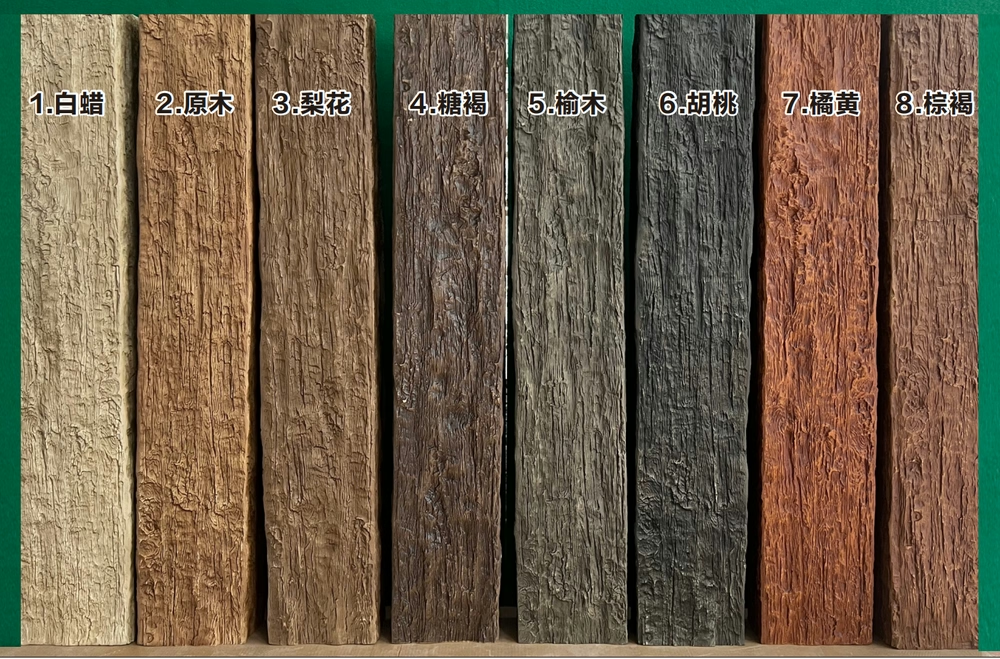
Common special shape requests we see
Chamfered and reeded beams
A beam with one, two, or four chamfered corners. The chamfer breaks the rectangular silhouette and introduces a subtle play of light and shadow. Chamfered beams are one of the most common special shape requests — they're an easy upgrade from standard rectangular beams and they're not significantly more expensive to produce.
Reeded beams — where the beam face has a series of parallel convex ribs — are a related request. The reeds can be machined into the mold surface at any spacing. Reeding adds material cost (the foam has to fill the reed grooves) but is otherwise straightforward.
Stepped beams
A beam with one or more horizontal steps on the visible face. A two-step beam might have a 150 mm face with a 30 mm recess at 75 mm from the top and bottom. Stepped beams mimic the look of layered timber construction — beams built up from multiple boards, which was common in Victorian and Tudor timber framing.
Stepped profiles are straightforward to machine and demold. The step itself acts as a visual anchor and provides natural stopping points for finishing, which makes on-site touch-up easier.
I-beam and steel-look profiles
A decorative beam shaped like an I-beam — narrow web and wide flanges — that mirrors structural steel but is made entirely from PU. I-beam profiles are popular in industrial-loft style restaurants and offices, where exposed structural steel is part of the aesthetic but the budget doesn't allow for real steel.
I-beam PU beams are produced by machining the profile into a two-part mold. The web (the narrow vertical section) requires careful pour technique to avoid air trapping. The flanges (the wide horizontal sections top and bottom) are straightforward.
Custom ornamental profiles
The catch-all category for anything that doesn't fit the other categories. A client's logo extruded into a beam face. A Art Deco geometric pattern. A Victorian acanthus capital. A corbel that matches a specific historic photograph.
Custom ornamental profiles are the highest-complexity special shape work. The mold may require hand carving, 3D printing of a master pattern, or a combination. Lead time for a custom ornamental mold is typically 6 to 12 weeks. The production cost per beam is the highest in the special shape range.
Pricing special shape beams
Special shape pricing follows a tiered model based on tooling complexity and production difficulty.
| Shape category | Tooling cost | Per-beam premium vs. rectangular | Production complexity |
|---|---|---|---|
| Chamfered / simple profile | $500 - $2,000 | 10 - 20% | Low |
| Stepped profile | $1,000 - $3,000 | 15 - 30% | Low-Medium |
| Polygonal (4-8 sides) | $2,000 - $5,000 | 20 - 40% | Medium |
| Tapered | $3,000 - $8,000 | 30 - 60% | Medium-High |
| Curved cross-section | $4,000 - $10,000 | 30 - 50% | High |
| Sculpted / ornamental | $5,000 - $20,000+ | 50 - 100%+ | Very High |
These are rough ranges. The actual cost depends heavily on the specific profile, the production volume, and the factory's equipment. A simple chamfered beam at 500 pieces may not carry any tooling surcharge — the factory may already have the chamfer tooling in-house. An ornamental corbel at 20 pieces will carry full custom tooling cost.

Working with the factory on a special shape project
A successful special shape project requires clear communication between the designer and the factory's engineering team.
Provide a cross-section drawing
A dimensioned drawing of the beam's cross-section, in any standard format — paper PDF, CAD file, even a clear hand sketch with dimensions — is the starting point. The drawing should show the full profile including any chamfers, steps, or decorative details.
Specify the beam length
The length affects how the beam is produced and shipped. Standard production lines handle beams up to 6 or 8 meters in a single pour. Longer beams require multiple pieces with concealed joiners or a different production method.
Discuss the finish early
Some special shapes are easier to finish than others. A simple chamfered beam can be stained and sealed on the production line. A deep ornamental profile with sharp inside corners may require hand brushing at the corners and spray application on flat surfaces. The factory's finishing team should be consulted before the mold is cut.
Ask for a sample before committing to production
A sample beam — even a short section of the profile, produced in the same foam and finish as the production beams — is the best way to verify that the special shape looks and feels right before the full production run starts. Most factories will produce a sample for a nominal charge or a small tooling deposit. Budget for a sample.
Special shape PU beams are where the technology earns its keep. The ability to capture any cross-sectional profile in a lightweight, installable, finish-ready foam member is something real timber cannot do at the same price point. For architects and designers working with non-standard architectural details, the special shape route is almost always the right one.
Technical References
ASTM standards cited in every specification
Test Data
Lab results from internal testing program
Updated 2026
Reviewed against current product specs

