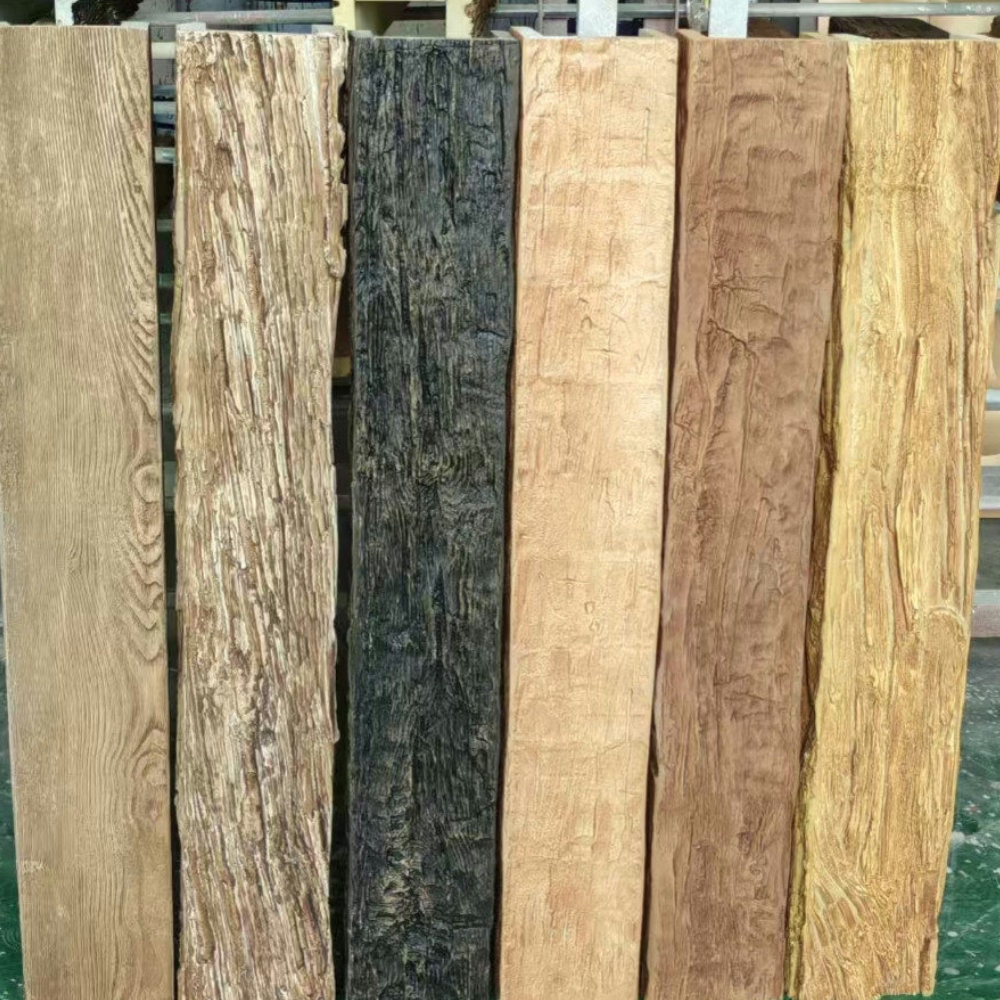
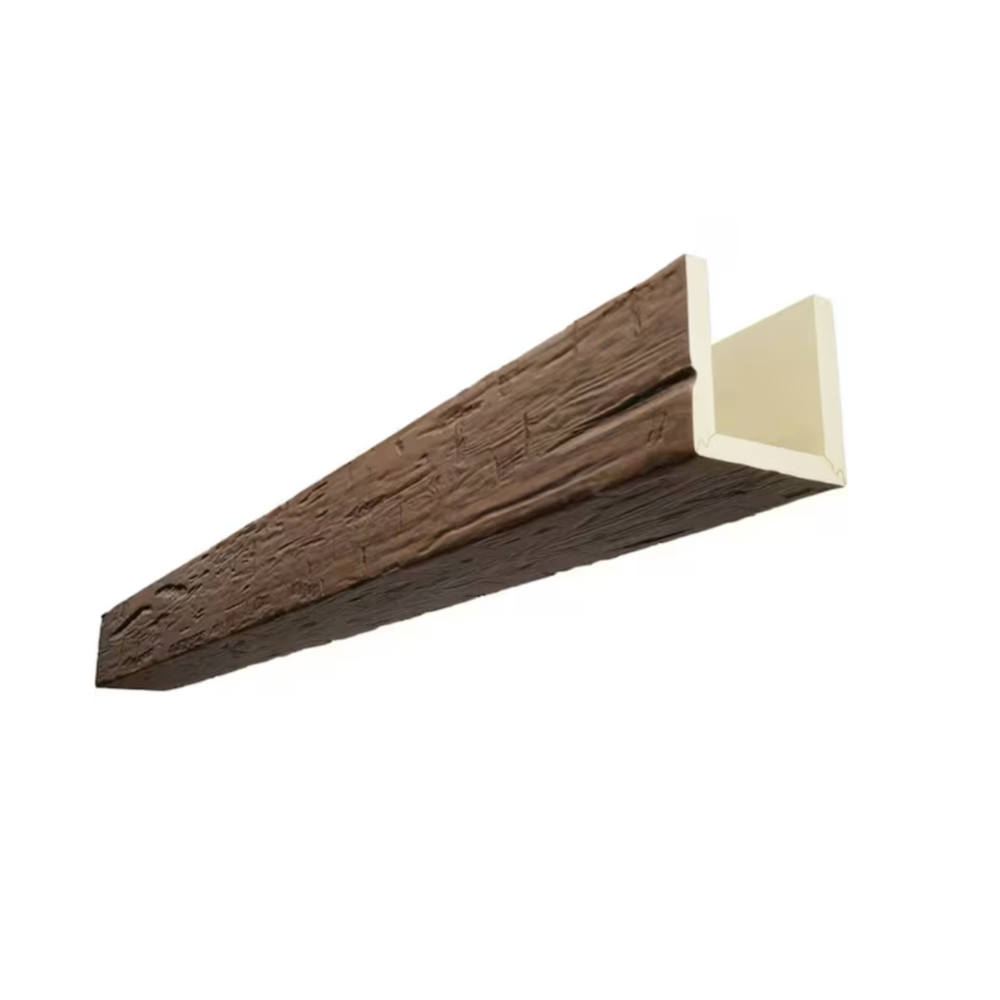
Curved real timber is a compromise. You can laminate thin strips, you can kerf-cut and bend, you can steam and press. Each method has limits, and none of them produces a curved piece with grain that runs naturally along the curve's axis. The grain lines either run straight across the curve (creating a visual break where the grain doesn't follow the form) or run along the inner or outer curve (creating stretched or compressed grain that looks wrong at certain points).
Molded polyurethane faux timber sidesteps this problem. A curved PU beam is poured into a mold that has the grain texture embossed on its inner surface. The foam cures against that textured surface and picks up the grain exactly as it exists on the mold. The grain can be oriented to run along the curve in any direction the designer specifies.
This technical advantage — being able to mold grain onto a curved surface with the grain running in any direction — is what makes curved PU beams superior to real timber for most curved applications. But it comes with its own set of challenges.
The geometry of grain on a curve
Grain direction on a curved beam is not as simple as "run it along the length." The geometry of a curve introduces visual distortions that don't exist on a straight beam.
What happens when grain runs along a curve
Imagine a grain line that runs parallel to the inner curve of a beam — exactly mimicking how wood fibers would run if a tree were bent into that shape. The grain lines are concentric with the inner surface of the beam. They follow the curve precisely.
Now consider the outer surface of the same beam. The outer surface has a larger radius than the inner surface — the same arc angle covers more linear distance on the outer surface than on the inner. If the grain lines are truly concentric with the inner surface, they appear to spread apart slightly on the outer surface. The spacing looks slightly wider on the outer face than on the inner face.
This is a subtle effect. At normal viewing distances — 2 to 4 meters from a barrel vault ceiling — most observers don't notice it consciously. But trained eyes catch it, and under close inspection or directional lighting, the spacing discrepancy is visible.
The neutral axis approach
The solution most factories use is to run the grain along the neutral axis of the beam — an imaginary line that runs through the middle of the beam's cross-section, equidistant from the inner and outer surfaces.
On the neutral axis, the arc length for a given angle is exactly the same as the straight-line projection. Grain lines that run along the neutral axis appear equidistant from each other on both the inner and outer surfaces. The visual distortion is minimized.
The trade-off: grain along the neutral axis is not concentric with either surface. It doesn't match how real wood grows. But it's the best practical compromise for most curved beam applications.
Radial grain
An alternative approach is radial grain — grain lines that radiate from the center of the curve, like spokes on a wheel. Radial grain is historically associated with the end grain of a log (the rings seen from above) rather than with the face grain of a plank.
Radial grain on a curved beam can look striking and intentional, particularly in formal interiors where the geometric quality of the grain is appreciated rather than hidden. It doesn't look like natural wood grain, but it looks like a deliberate design choice.
Radial grain is more common on curved beams with circular or elliptical cross-sections (not rectangular cross-sections). It works best when the beam is meant to be noticed as an architectural element rather than a subtle decorative detail.
Diagonal grain
A compromise between neutral-axis grain and radial grain. The grain lines run at an angle to the beam's axis — typically 30 to 45 degrees — which distributes the visual distortion of the curve across the grain pattern rather than concentrating it in one direction.
Diagonal grain is less common but is occasionally specified for projects where a conventional grain direction would look awkward given the specific curve geometry.
Texture depth on curved surfaces
Grain texture embossing depth on a curved beam has to be calibrated carefully. The embossed grain lines create shadows and highlights that interact with the beam's curved surface, and the interaction changes across the curve.
Lighting on curved grain
Under overhead lighting, a straight beam's grain texture creates a uniform shadow pattern. The light hits the top of each embossed grain line and casts a shadow in the grain valley, and the pattern is consistent across the beam face.
On a curved beam, the angle between the light and the grain surface changes across the curve. At the apex of the curve (the highest point), the grain faces upward and catches direct light from above. At the springing points (where the curve meets the horizontal), the grain faces more toward the light source's side. The shadow pattern shifts, and the grain reads differently at different points on the curve.
This variation is actually an advantage. It makes the beam look more dimensional and more natural — real wood grain also reads differently at different angles. The key is to calibrate the grain depth so that the texture reads clearly at all points on the curve without looking exaggerated at the apex.
Embossing depth recommendations
For curved beams with a radius of 2,000 mm or more, a standard grain depth of 0.8 to 1.2 mm works well. The depth is sufficient to cast visible shadows under normal room lighting without being so deep that the apex reads as heavily embossed.
For tighter curves (radius 1,200 to 2,000 mm), reduce the grain depth slightly — 0.5 to 0.8 mm. The tighter curve exaggerates the apparent embossing depth because the grain lines are closer together relative to the viewing angle.
For very tight curves (under 1,200 mm radius), consider a very shallow grain — 0.3 to 0.5 mm — or a hand-scraped style texture rather than a deep natural grain. Deep embossing on a tight curve can look cartoonish.
Finish considerations for curved grain
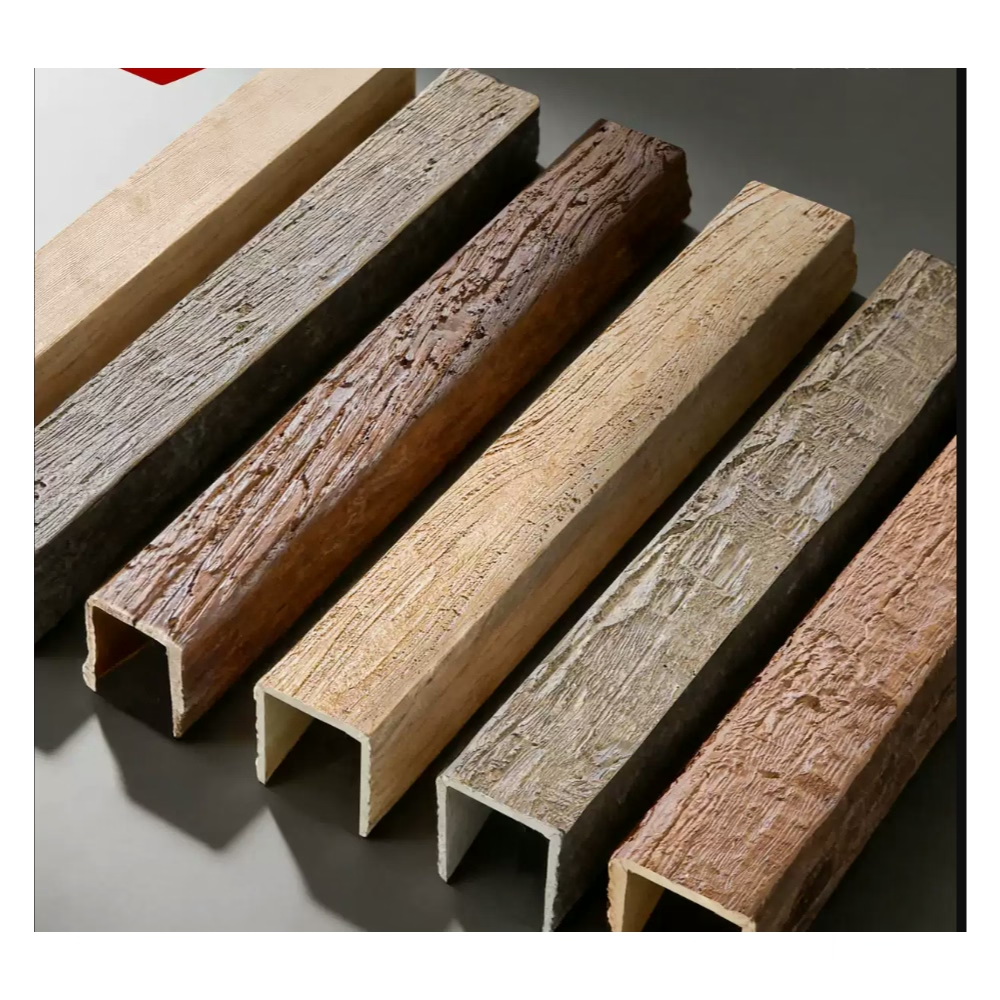
Multi-tone finishing on a curved beam requires the same four-layer approach as on a straight beam, but the application is more challenging because the surface is curved.
Spray application
Spray is the preferred application method for multi-tone finishes on curved beams. A spray gun can apply an even coat over the curved surface without the brush marks that occur when brushing over a curve.
The finisher should work from the top of the curve downward, applying each layer in the same direction (typically top to bottom for a barrel vault). This creates a consistent finish across the curve.
Shadow pooling on curves
When applying a dark shadow layer (the fourth layer in the multi-tone model), the glaze naturally pools in the grain valleys. On a curved surface, the glaze also pools toward the low point of the curve — gravity pulls it downward along the curve's arc.
This gravitational pooling is desirable up to a point. It creates a natural gradient that emphasizes the curve's form. But if the pooling is too pronounced, the lower section of the beam becomes too dark. Control it by adjusting the glaze viscosity and the wiping technique.
End grain on curved beams
The end grain of a curved beam is more complex than the end grain of a straight beam. On a straight beam, the end grain is simply the cross-section face. On a curved beam, the end grain follows the curve — it has a compound angle relative to the beam face.
For a barrel vault beam, the end grain at the springing point is roughly perpendicular to the wall. At the apex, the end grain faces upward. The finish on the end grain should follow this angle naturally if the finisher is wiping in a consistent direction.
End-grain coloring is typically darker and more saturated than face-grain coloring on real timber. Apply a slightly darker tone to the end grain of a curved beam to simulate this effect.
Coordinating grain direction with room geometry
In a vaulted or domed ceiling, the curved beams don't exist in isolation. They're part of a spatial system, and the grain direction on the beams should respond to that system.
Radial room layouts
In a room with a central dome or radial vault, curved beams typically radiate from the center. The grain on each beam should run in the same direction relative to the beam's axis — typically along the neutral axis — so that the grain pattern reads consistently from beam to beam.
The visual effect of radial beams with consistent grain direction is powerful. The grain lines create a subtle vortex pattern as the eye moves from the edges of the room toward the center.
Linear barrel vaults
In a linear barrel vault hallway, the beams run perpendicular to the vault's axis (across the width of the barrel). The grain should run along the beam's length (from one end of the vault to the other), not across the beam face. Grain running across the face of a barrel vault beam would create a pattern that is interrupted at each beam — visually busy and wrong for the space.
Asymmetric vault geometries
Gothic arches, ogee curves, and other asymmetric vault geometries require careful grain direction planning. The grain should follow the dominant curve of the geometry — the arc that carries the most visual weight.
For a Gothic arch with two asymmetric arcs meeting at a peak, the grain can follow each arc independently, which means it changes direction at the peak. This directional change is visible and should be noted. An alternative is to run the grain along the chord (straight across the peak), which is architecturally incorrect but may be preferable visually.
Getting the grain right on a curved beam project
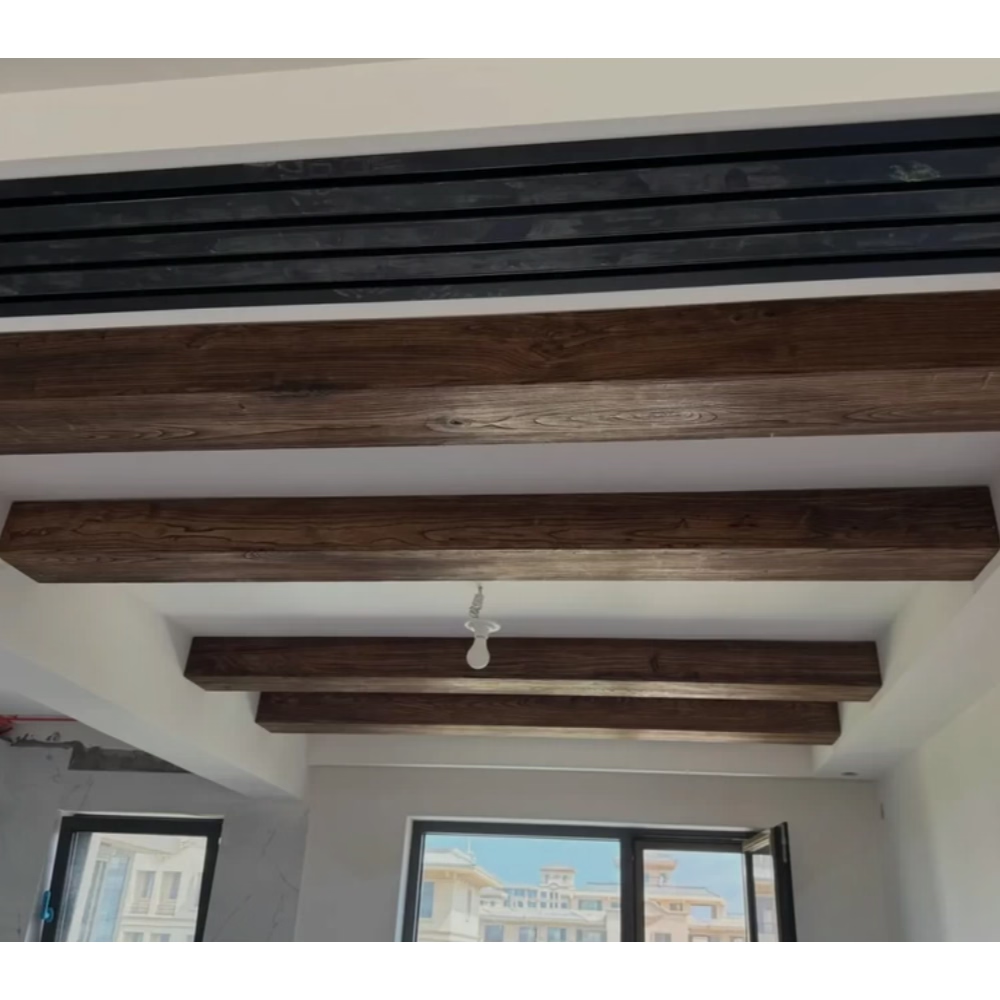
The most reliable way to specify grain direction and quality for a curved beam project is to work with a factory that has direct experience with curved beam grain textures. Ask to see samples of previous curved beam projects, specifically looking at:
- Whether the grain direction reads consistently across the curve
- Whether the grain depth is appropriate for the radius
- Whether the finish (if multi-tone) is applied evenly across the curved surface
A factory that can't produce a convincing grain sample on a curved surface is not the right partner for a curved beam project, no matter how good their straight beam work is.
Curved PU beams with authentic natural grain textures represent the technology's strongest advantage over real timber. The grain can follow the curve. The depth can be calibrated to the radius. The finish can be applied uniformly. Get the specification right and the result is a curved timber element that no real-wood method can match.
Technical References
ASTM standards cited in every specification
Test Data
Lab results from internal testing program
Updated 2026
Reviewed against current product specs