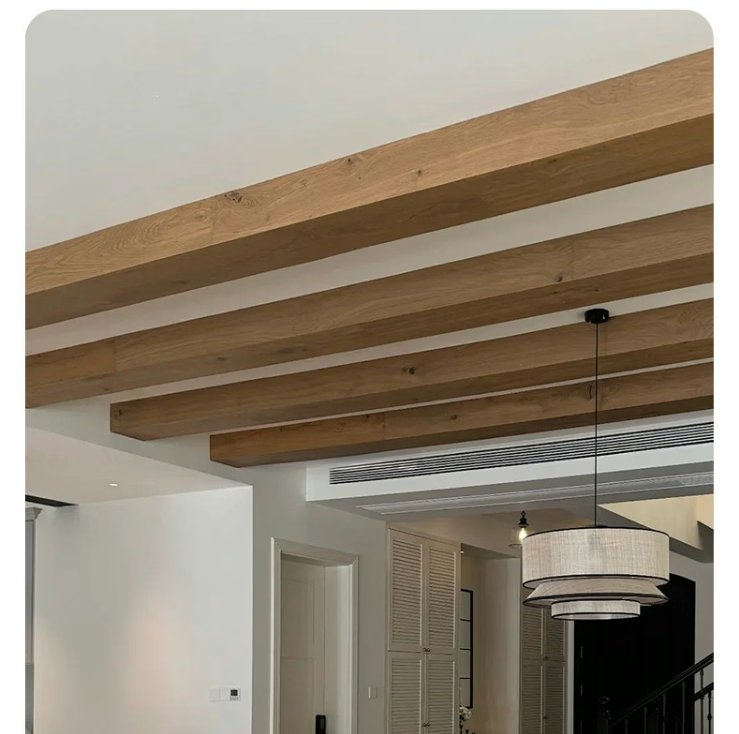
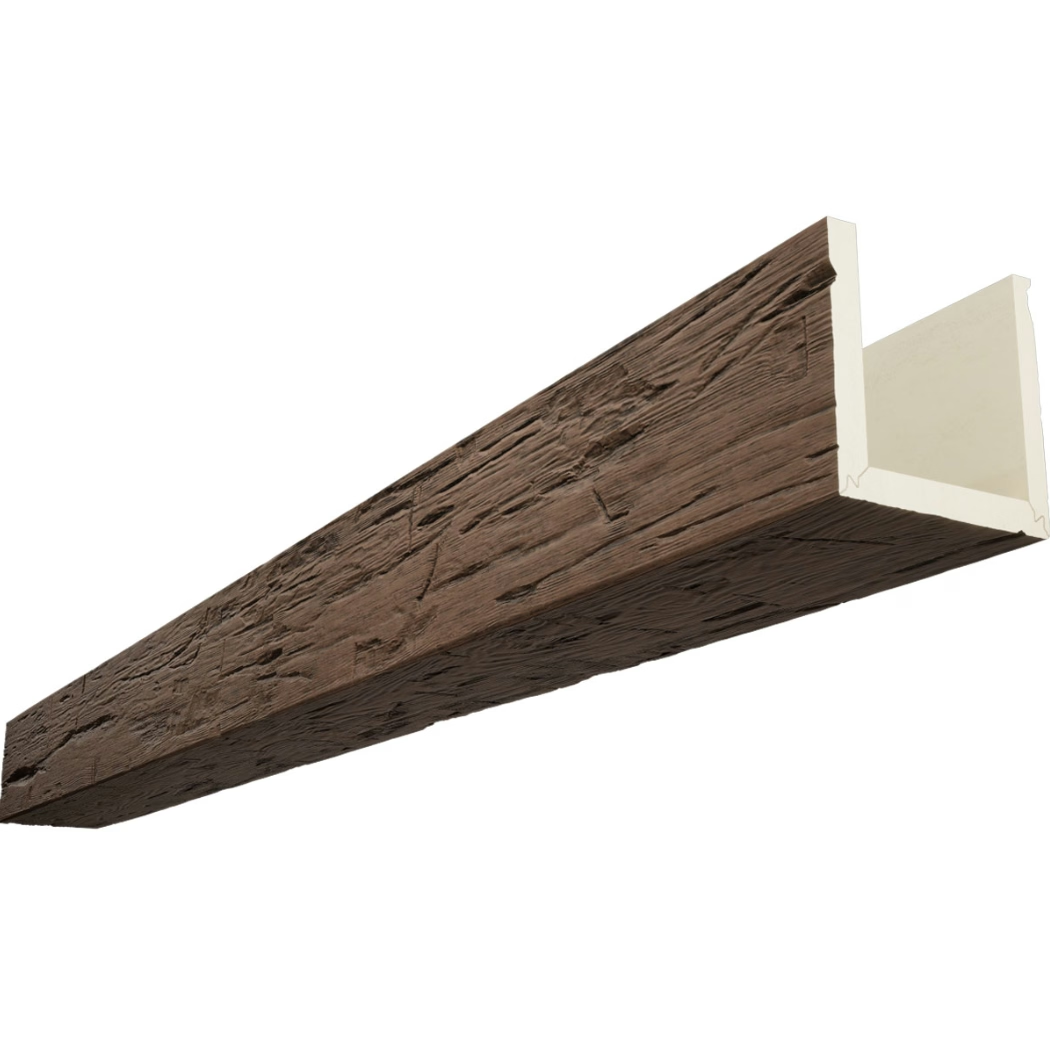
Wholesale distribution of faux wood beams is a different business than retail or project supply. Wholesale customers — lumber yards, building supply dealers, online retailers, design center showrooms — buy in volume, expect consistent quality, need product information that supports their own marketing, and judge suppliers primarily on reliability and margin.
Building a branded wholesale product line on top of OEM polyurethane faux beams requires a factory partnership that understands the wholesale market and is set up to support it. This article covers what wholesale distributors should look for in an OEM partner and what they need to bring to the relationship.
What wholesale customers actually want
A wholesale customer buying faux wood beams is solving a different problem than a retail consumer or a project buyer. They're not deciding whether to use faux wood beams in a room. They've already decided. They're choosing which supplier to stock, and the decision is driven by:
- Profit margin: The wholesale customer needs margin between the factory price and their sale price to retailers. Without sufficient margin, the product isn't worth stocking.
- Quality consistency: The wholesale customer needs the same product quality from order to order. Inconsistency creates customer service issues downstream.
- Packaging and presentation: The product needs to look professional in the warehouse and on the retail floor. Crappy packaging signals a cheap product.
- Product information: The wholesale customer needs specification sheets, installation instructions, and marketing materials they can pass on to their customers. Without these, they can't sell the product effectively.
- Availability: The wholesale customer needs reliable re-supply. Stockouts are lost sales.
A factory that understands these requirements and builds its OEM service around them is a wholesale-friendly factory. A factory that treats every order as a one-off transaction is not.
Branded product line development
A branded wholesale product line is more than a logo on a box. It's a coordinated set of products that share a brand identity, complement each other, and address the wholesale customer's catalog needs.
Product range
A branded wholesale line typically includes:
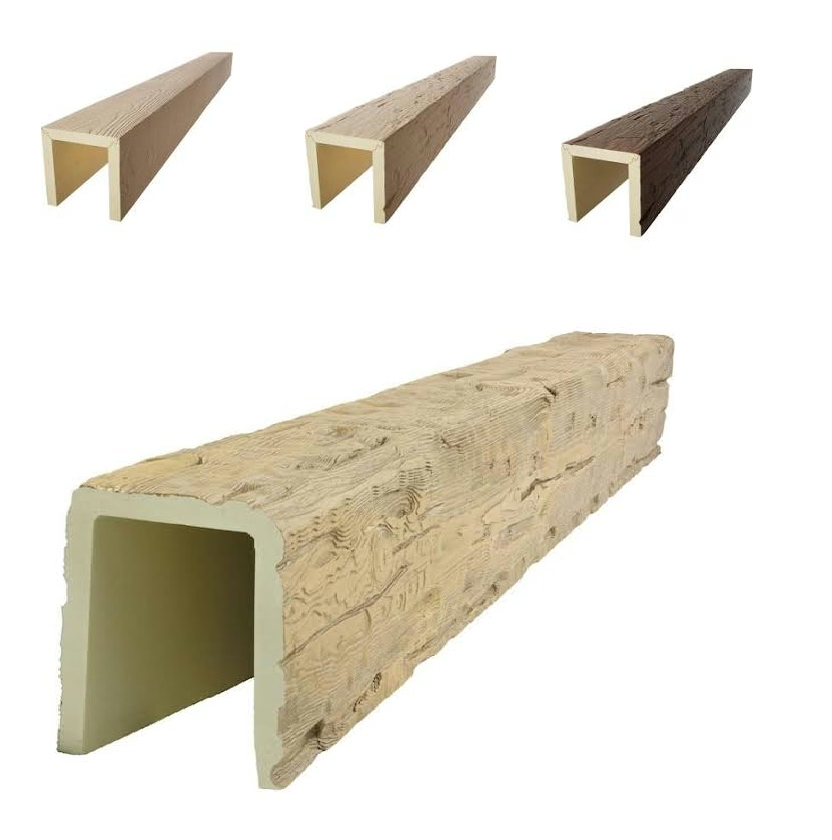
- Standard profiles: 4 to 8 standard profiles that cover the most common applications (small residential, medium residential, large residential, small commercial, etc.)
- Finish range: 4 to 8 standard finishes per profile, from natural tones to dark walnut
- Accessory products: Corbels, brackets, beam straps, ceiling mounts, and other complementary items that allow the customer to complete the installation
- Length range: Standard lengths that match common ceiling spans (8, 10, 12, 14, 16 feet for the U.S. market; 2.4, 3.0, 3.6, 4.2 meters for European markets)
The product range should be deep enough to address most projects without being so broad that the wholesale customer can't stock it.
Brand identity
The brand identity should differentiate the line from competitors. Differentiation can come from:
- Distinctive profiles: Profile shapes that are unique to the brand and protected by mold ownership
- Signature finishes: Custom color and finish systems that the brand is known for
- Quality reputation: Word-of-mouth about consistent quality and reliable supply
- Marketing materials: Catalog design, website design, showroom displays that present the brand professionally
A brand that competes only on price is vulnerable to competitors who can produce at lower cost. A brand that competes on quality, identity, and support has a more sustainable position.
OEM factory requirements for branded wholesale
A wholesale-focused OEM factory needs capabilities beyond basic production.
Production capacity
The factory must be able to produce at the volumes a wholesale customer requires — typically 1,000 to 10,000 pieces per profile per year. A factory that can produce 100 pieces per week but can't scale to 500 pieces per week is not the right partner for wholesale.
Production capacity also affects lead times. A wholesale customer that places a large stock order needs the order shipped in 4 to 8 weeks. A factory with tight capacity may quote 12 to 16 weeks, which doesn't work for the wholesale customer's inventory planning.
Quality systems
For consistent quality across thousands of pieces, the factory needs formal quality systems:
- Documented production procedures: Standard operating procedures for each production step, from raw material handling to finished beam packaging
- Incoming material inspection: Testing of raw materials (PU resin, colorants, finishes) before they enter production
- In-process quality checks: Inspection points during production to catch issues early
- Finished product inspection: Final inspection against the approved sample and the specification
- Statistical process control: Data collection and analysis that identifies trends before they become quality problems
A factory that doesn't have these systems will produce inconsistent product — not necessarily bad, but variable enough to create customer service issues for the wholesale customer.
Packaging capability
Branded wholesale product requires branded packaging. The factory should be able to:
- Print branded labels and boxes: Either in-house printing capability or a nearby supplier
- Assemble retail-ready packaging: Product in a printed box, with installation instructions and warranty information
- Create master cartons for wholesale: Multi-unit cartons optimized for warehouse storage and shipping
- Apply UPC or EAN labels: If the wholesale customer sells through retailers that require barcode labels
A factory that ships product in plain unmarked boxes is not set up for branded wholesale.
Documentation capability
Wholesale customers need product documentation. The factory should provide:
- Specification sheets: Dimensions, weight per piece, fire rating, recommended installation, etc.
- Installation instructions: Clear, illustrated installation procedures that the wholesale customer can pass on to end users
- Care and maintenance instructions: How to clean and maintain the beam finish
- Test reports: Any relevant test reports (fire rating, VOC emissions, etc.) that the wholesale customer can provide to their customers or to building code officials
- Marketing support images: Professional photographs of the finished product in installed settings
A factory that produces beams but can't produce the documentation to support them is not a wholesale-friendly partner.
Pricing strategy for wholesale
The pricing conversation with an OEM factory has several layers.
Per-piece price
The factory's per-piece price is the starting point. This is the cost for the actual production — raw materials, labor, overhead, and factory margin. For a standard rectangular beam in a single-tone finish, per-piece prices typically run $25 to $80 depending on size and quality.
Tooling cost recovery
For branded products that require custom molds, the tooling cost may be amortized into the per-piece price over an agreed volume, or it may be paid upfront as a one-time fee. The amortization approach reduces upfront capital requirements but locks the buyer into a specific factory for the duration of the amortization period.
Volume discounts
Most factories offer tiered volume discounts. Typical structure:
- 100 to 500 pieces: Standard pricing
- 500 to 2,000 pieces: 5 to 10 percent discount
- 2,000 to 5,000 pieces: 10 to 20 percent discount
- 5,000+ pieces: 20 to 30 percent discount, often with negotiated terms
The discount structure should be explicit in the supply agreement. Verbal commitments to volume discounts are not reliable.
Payment terms
Standard OEM payment terms in China:
- 30 percent deposit upon order confirmation
- 70 percent balance against copy of shipping documents (bill of lading, packing list, commercial invoice)
Some established relationships negotiate 30/70 with net 30 days on the balance, or even open account terms for trusted long-term partners. The payment terms affect cash flow and should be negotiated alongside the per-piece price.
Managing a wholesale OEM relationship
Once the relationship is established, ongoing management requires attention to:
Forecast sharing
Share your wholesale sales forecast with the factory. A 6 to 12 month forward forecast allows the factory to plan raw material purchases, schedule production, and allocate capacity. Without a forecast, the factory can't plan and may not be able to deliver when you need product.
Quality feedback loop
Feed customer feedback back to the factory. If wholesale customers are reporting specific quality issues, the factory needs to know to address them. If customers are asking for specific variations, the factory may be able to develop new products that address those requests.
Continuous improvement
Treat the relationship as a partnership that improves over time. Negotiate annual price reductions based on volume growth. Ask the factory to propose process improvements that reduce cost or improve quality. Build a relationship that gets stronger each year.
Risk management
Don't put all your production with one factory. Most successful wholesale distributors maintain relationships with two or three factories, even if they concentrate 80 percent of their volume with one. The secondary factories provide backup if the primary has capacity issues, quality problems, or financial difficulties.
A wholesale OEM relationship is a long-term commitment. Choose the partner carefully, build the relationship deliberately, and manage it actively. The factory that becomes your OEM partner for branded wholesale will, in many ways, become an extension of your own company.
Technical References
ASTM standards cited in every specification
Test Data
Lab results from internal testing program
Updated 2026
Reviewed against current product specs