
A bespoke interior is one where nothing was selected from a catalog because nothing in the catalog was quite right. That is the kind of project our custom radius curved PU resin faux ceiling beam service exists for. Whether you are designing a private residence where the ceiling is the room's centerpiece, or a hospitality venue where the beams tie together an entire brand language, the workflow below describes how we translate a designer's intent into a beam you can actually install.
Where Bespoke Ceiling Beams Come From
Most bespoke beam projects begin with one of three design briefs. Understanding which one applies to your project helps us shape the response.
The room has a non-standard geometry. A double-height dining room with a barrel vault, a sunken lounge with a domed ceiling, a circular entry vestibule. The beams are curved because the architecture is curved, not because the designer wanted a curve.
The beams are the design statement. A residential great room where the beams are deliberately oversized, deeply textured, and finished in a tone that anchors the entire material palette. The geometry of the ceiling is otherwise ordinary; the beams elevate it.
The beams integrate with other systems. Recessed lighting, hidden audio, sprinkler runs, HVAC ducts. The beams are not just decoration; they are the visible face of a multi-system ceiling assembly.
Each scenario calls for a different balance between structural precoordination, finish refinement, and integration detailing. The same curved beam profile can serve all three, but the project management approach changes.
From Sketch to Sample
A typical bespoke curved beam project follows a predictable rhythm. Sketches and concept renderings come first. We respond with feasibility notes — what is possible, what is expensive, what needs to be redesigned for fabrication reality. Then come technical drawings, prototype samples, and finally mass production. Each phase has a deliverable and a decision.
Concept Phase
Send us hand sketches, mood boards, or preliminary renders. We review them and respond within a few business days with a feasibility flag (green, amber, or red) per concept, suggested cross-section dimensions consistent with the visual weight, recommended radius range or arc geometry, and a note on whether the concept can use existing mold profiles or requires new tooling.
Technical Phase
Once a concept is selected, we produce shop drawings in CAD. For curved beams, this includes the setting-out curve, segment joints, lifting points, fixing method, and connection details to the surrounding architecture. The drawings are issued for client approval — usually stamped by the architect of record.
Prototype Phase
A 300-600 mm sample of the curved beam is cast and finished in the proposed texture and color. For projects where the curve geometry is novel, a full-scale section (1-1.5 m of arc) is produced to verify that the curve reads correctly across multiple segments. Prototypes typically take 2-3 weeks.
Production Phase
Mass production follows prototype approval. Casting cycles are scheduled, finishing batches are run, and packing follows the logistics plan agreed during the technical phase. Lead time for production is typically 30-45 days after sample approval.
Design Variables That Drive Cost
In a bespoke curved beam, the unit cost is shaped by a handful of variables. Some are obvious; some are not.
- Radius. Smaller radii require tighter molds, slower casting, and more segmenting on site. Plan for a 10-20% cost increase for every halving of the radius below R3000 mm.
- Cross-section size. Each step up in beam depth or width increases both material and finishing labor. Doubling the cross-section roughly doubles the cost per meter.
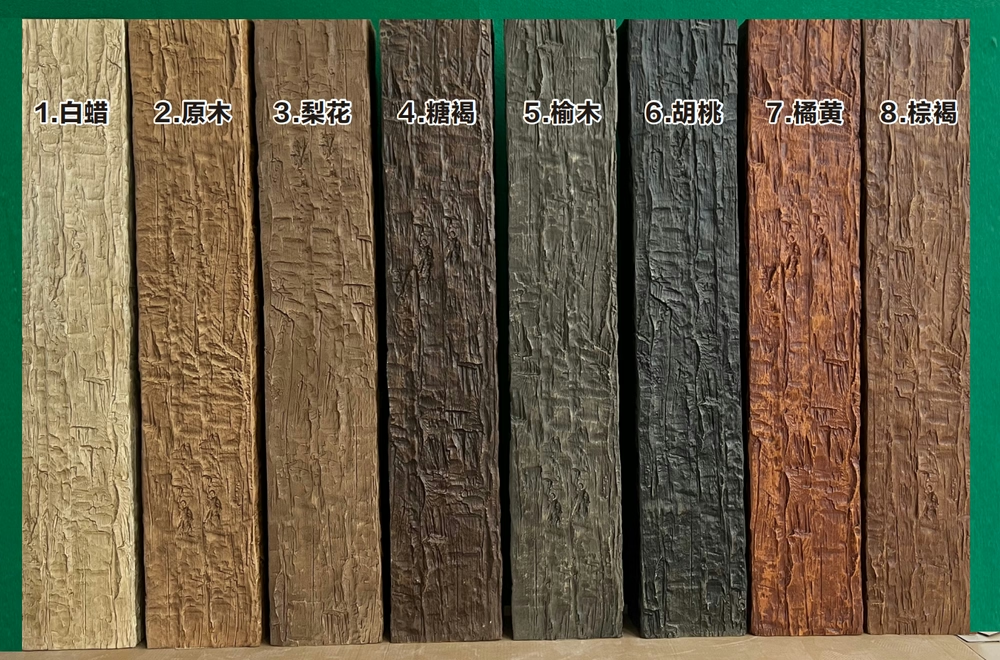
- Texture depth. A smooth cast is fastest. Light wire-brushing adds modest cost. Deep hand-hewn texture with chisel marks and irregular grain can double the finishing time.
- Color complexity. Single-tone stained finishes are the baseline. Two-tone finishes where the grain valleys are darker than the peaks require a glaze wash and clear coat, adding labor.
- Quantity. As with any custom mold, the more pieces produced from a single setup, the lower the amortized mold cost per piece.
A clear budget conversation early in the project helps us prioritize these variables. Sometimes the most expensive visual upgrade is a deeper texture, and the cheapest upgrade is a more dramatic color — knowing that lets the designer steer the spend where it pays off.
Installation and On-Site Coordination
A bespoke curved beam often arrives on site with an installation kit that includes marked fixing points corresponding to the structural backing, splice plates or alignment dowels for segment joints, touch-up paint matched to the factory finish, and installation drawings with numbered sequence.
The installer follows the sequence to build up the curve. Each segment is dry-fit first, then secured. Joints are finished by the installer using the materials in the kit. Final clear coat is applied after all segments are in place.
We strongly recommend that the installer visits the factory or attends a virtual installation walk-through before the beams ship. A 30-minute video call can prevent a full day of on-site confusion.
What "Bespoke" Does Not Mean
Bespoke does not mean unrestrained. Some design concepts cannot be delivered in polyurethane regardless of budget:
- Beams that need to bear structural load
- Beams that will sit in standing water or in direct soil contact
- Beams that must meet non-combustible fire ratings in some jurisdictions
- Beams with a profile so complex that the mold cost exceeds the project budget
In each of these cases we say so at feasibility review and propose alternatives. A good bespoke project is the result of honest conversations between designer and maker about what is possible, what is expensive, and what is worth the cost.
Bespoke curved beams are not a product you order. They are a collaboration you enter into. The designer's vision, the manufacturer's engineering, and the installer's craft all have to align for the finished ceiling to read as one coherent piece. When they do, the result is an interior that no one else has and that could not have been built any other way.
Technical References
ASTM standards cited in every specification
Test Data
Lab results from internal testing program
Updated 2026
Reviewed against current product specs


