The first time a hospitality client asked a Los Angeles–based design studio to "get me the matte finish of that Tuscan farmhouse beam but in a 10-meter continuous run with a Type A fire rating," the answer was no longer timber. It was high-density polyurethane resin, cast from hand-carved masters, finished in a controlled factory environment. The industry has shifted, and trade buyers who haven't revisited their specification playbook in three years are quietly overpaying for reclaimed stock that arrives cracked, warped, or short by two meters.

What "designer preferred" actually means in practice
Designers don't pick a material because it photographs well on Pinterest. They pick it because it solves a chain of problems that run through procurement, scheduling, installation, and long-term performance. With PU resin faux wood beams, that chain looks something like this on a typical $4M residential project:
- Spec written to match a hand-hewn white-oak reference photo sourced from a Belgian estate
- Five beam profiles, totaling 38 linear meters, two of them curved to a 4.2-meter radius
- Delivery window: 6 weeks from PO to jobsite, no room for kiln-dried solid timber to acclimate
- Code requirement: Class A fire rating across the full assembly, including the foam core
- Finish: matte neutral with a gray wash, must read as authentic at 1 meter and 5 meters
Solid timber fails roughly four of those five requirements on most U.S. jobsites. PU resin, properly sourced from a manufacturer with mature mold-making capabilities, clears them all.
Surface fidelity has crossed the threshold
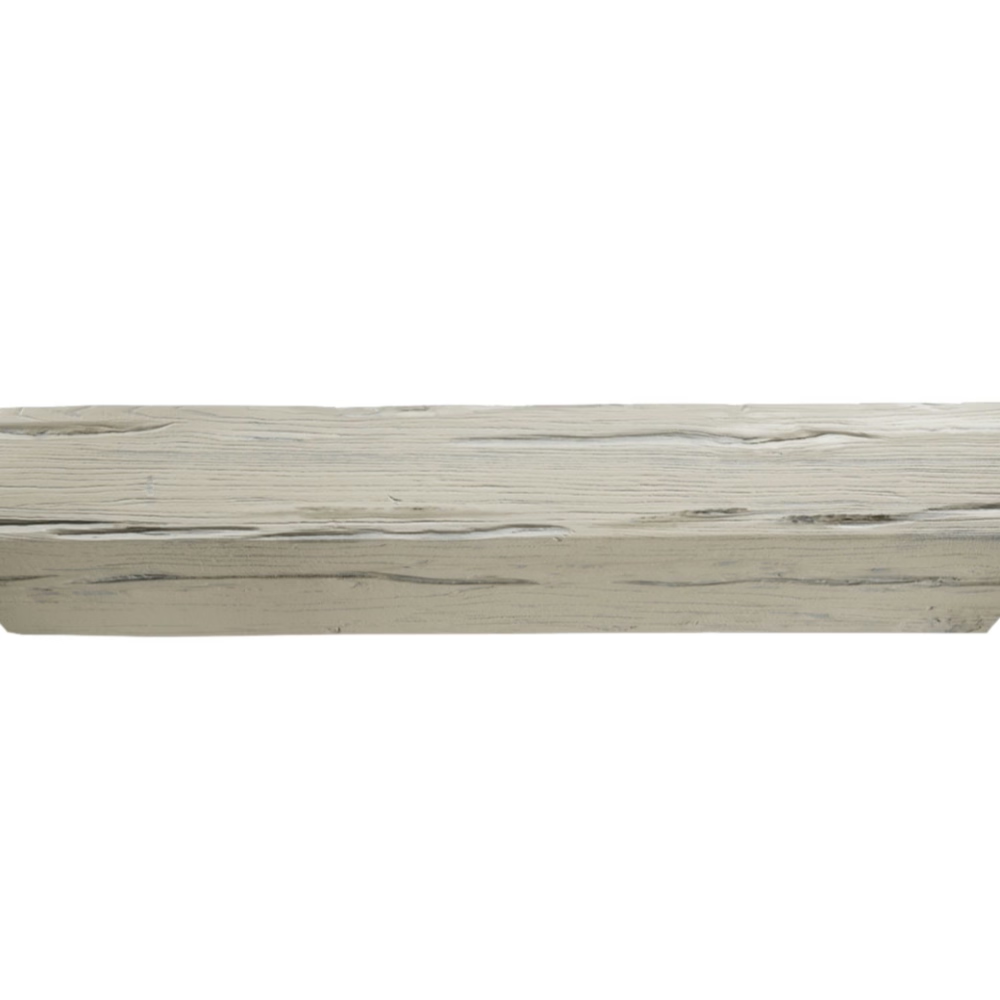
Five years ago, the giveaway was always the end grain. The polyurethane cast couldn't replicate the tight ray-flecks of quartersawn white oak, and the repetition across a 6-meter span gave the material away. Both problems are now solved. High-end PU manufacturers use multiple-part molds captured from real beams (often reclaimed timber), rotate mold placement during demolding, and hand-paint each beam's end cuts before shipping. The visible repetition is, for practical purposes, gone.
The other technical leap has been in the matte finish. Older PU beams had a telltale sheen under raking light. Newer factory-applied UV-cured coatings, often called "invisible matte," have a 3–4° gloss reading at 60°, well below the 12–15° of a waxed solid beam. Designers can now specify a satin or matte finish without worrying about hot spots under cove lighting.
Fire performance without compromise
Hospitality, multi-family, and commercial work in California, New York, and the UAE almost always falls under a Class A or Class B interior finish requirement. PU faux beams earn those ratings by formulation rather than by applied treatment, which means no field-applied fire-retardant coatings that can yellow over time or alter the hand-feel of the surface.
A typical Class A PU beam from a reputable factory will carry documentation including:
| Property | Typical value | Test method |
|---|---|---|
| Flame spread index | 0–25 | ASTM E84 |
| Smoke developed index | 0–450 | ASTM E84 |
| Density (foam core) | 320–480 kg/m³ | ASTM D1622 |
| Surface hardness | 45–55 Shore D | ASTM D2240 |
| Heat distortion | ≥70°C | ASTM D648 |
Importers and project managers should request the test reports dated within the last 18 months. Factory formulations do drift, and dated documentation protects both the designer and the contractor at inspection.
Weight, spans, and the contractor's reality
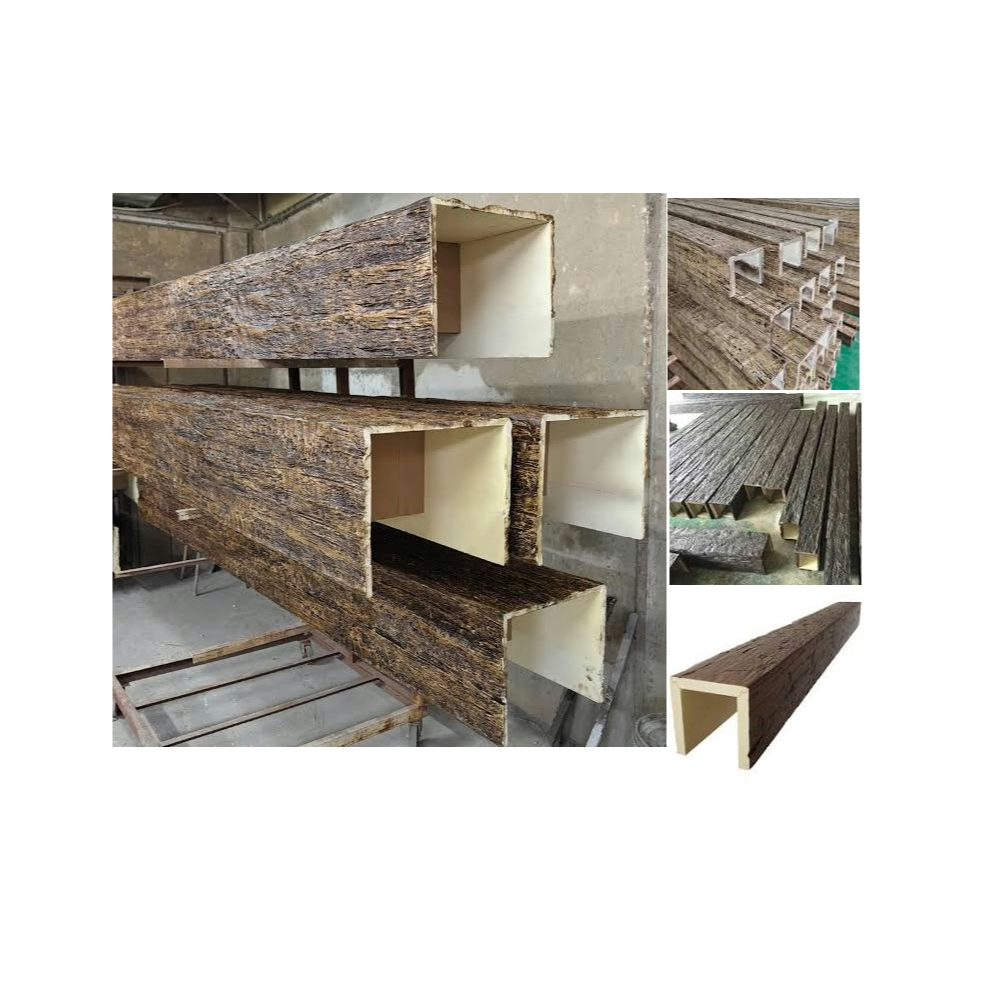
A solid oak 8x10 beam, kiln-dried, weighs roughly 22 kg per linear meter. A hollow three-sided PU faux beam of the same face dimensions weighs around 4.5 kg per linear meter. That ratio shifts an entire crew dynamic:
- Two installers can lift a 6-meter beam into place on a 12-foot ladder without staging
- No need for engineered blocking behind the ceiling finish to carry dead load
- Hangers sized for light-fixture loads are typically sufficient
- Freight costs drop by roughly 60–70% per cubic meter for the same coverage
For international shipments, the weight savings cascade further. A 40-foot high-cube container that can carry 18–22 km of 8x10 PU beam (in nested form) will only carry 7–9 km of comparable solid timber before hitting payload limits.
The custom curve problem designers actually need solved
The single biggest reason working designers move to PU is curved profiles. Real curved beams require either steam-bending, which only works on straight-grain softwoods and adds substantial cost, or laminated veneer, which always reads as laminated. Solid curved members in hardwood are a custom millwork project that can run 12–16 weeks.
PU curves are cast in segmented molds against a CNC-machined former. A typical curved beam — say, a 3-meter arc with a 4.2-meter radius — can be produced in 4–5 weeks including tooling, and the only seams are at the ends where adjacent straight beams join. Designers specifying a barrel vault, a groin ceiling, or a barrel entry portico can now treat the curve as a normal SKU rather than a one-off.
Sourcing considerations for trade buyers
Importers and design-build firms sourcing PU faux beams for the North American, EU, and Gulf markets should run a structured supplier audit. A mature factory will offer:
- Mold library documentation, including photographs of original timber masters
- Multiple resin formulations (high-density structural, lightweight hollow, fire-rated)
- In-house finishing, ideally with color-matching spectrophotometry
- Engineered connections (steel internal brackets for long splices, rather than field-built blocking)
- Containerized sample programs, so designers and clients can evaluate finishes under site lighting before bulk production
Lead times on custom finishes run 30–45 days from approved sample. Design teams that plan backwards from install date — sample approval locked 90 days before final installation — avoid the most common schedule panic.
Where PU is still the wrong choice
Designer honesty matters. PU faux beams are not the right answer in every scenario. For period-correct restoration of a listed 1890s timber-frame home, the local heritage authority may require solid timber, and reasonable arguments exist around authenticity, longevity of finish, and structural repairability that outweigh the cost. Similarly, exterior applications where the beam is fully exposed to UV without overhang protection can degrade the factory finish faster than a stained hardwood would — though new UV-stable formulations have closed most of that gap.
The pragmatic rule of thumb: if the design intent, the code requirement, and the schedule all point toward a particular surface quality that PU can deliver, the cost of switching to solid timber rarely justifies itself. If any one of those three constraints pushes genuinely toward solid — code-listed heritage restoration, structural load-bearing replacement, or a five-decade exterior exposure with zero maintenance budget — the designers in the spec are right to insist on real wood.
Budget framing for client conversations
Clients rarely react to per-linear-meter pricing in a useful way. They react to total project cost compared to alternatives. A useful script:
"The reclaimed timber option would arrive at $X with a 14-week lead time, a 12% spoilage allowance for cracking during acclimation, and a field finishing window of three weeks onsite. The PU option arrives at 60% of that number with a 5-week lead time, no field finishing, and a 15-year factory warranty on the coating system."
When the conversation is framed around total installed cost, lead time, and warranty, designers win the specification roughly eight times out of ten. The other two jobs really do need solid timber, and the right call is to spec it.
The trade has matured. PU resin faux wood beams are no longer a compromise product. They're the default specification for most high-end interiors, with solid timber reserved for the projects that genuinely demand it.
Technical References
ASTM standards cited in every specification
Test Data
Lab results from internal testing program
Updated 2026
Reviewed against current product specs


