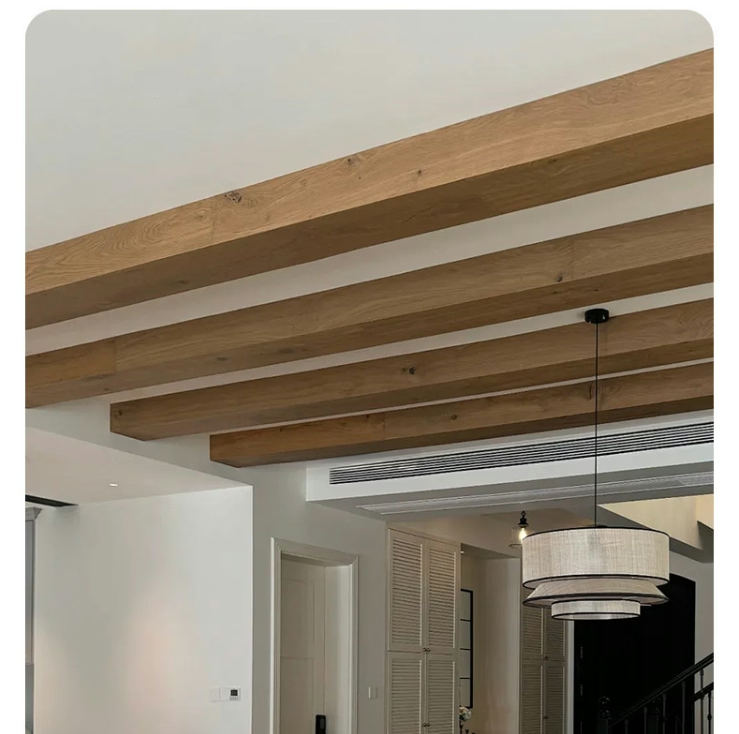
A distributor in Texas places a single PO for 2,400 linear feet of polyurethane faux beams, mixed across six profiles and three finishes, split between two warehouses. The factory quotes the order in 48 hours, confirms production in 9 days, and ships within 21. Every detail works because the buyer understood the size options before the inquiry went out.
A different distributor sends the same volume request with vague specs. Three weeks of clarification emails follow, the lead time stretches, the freight quote balloons, and the customer loses the project. The factory did not fail. The size conversation did.
Bulk PU faux beam purchases live or die on size clarity. This article maps what a serious wholesale buyer needs to know before sending the first email.
Profile Geometry: Width, Height, and Wall Thickness
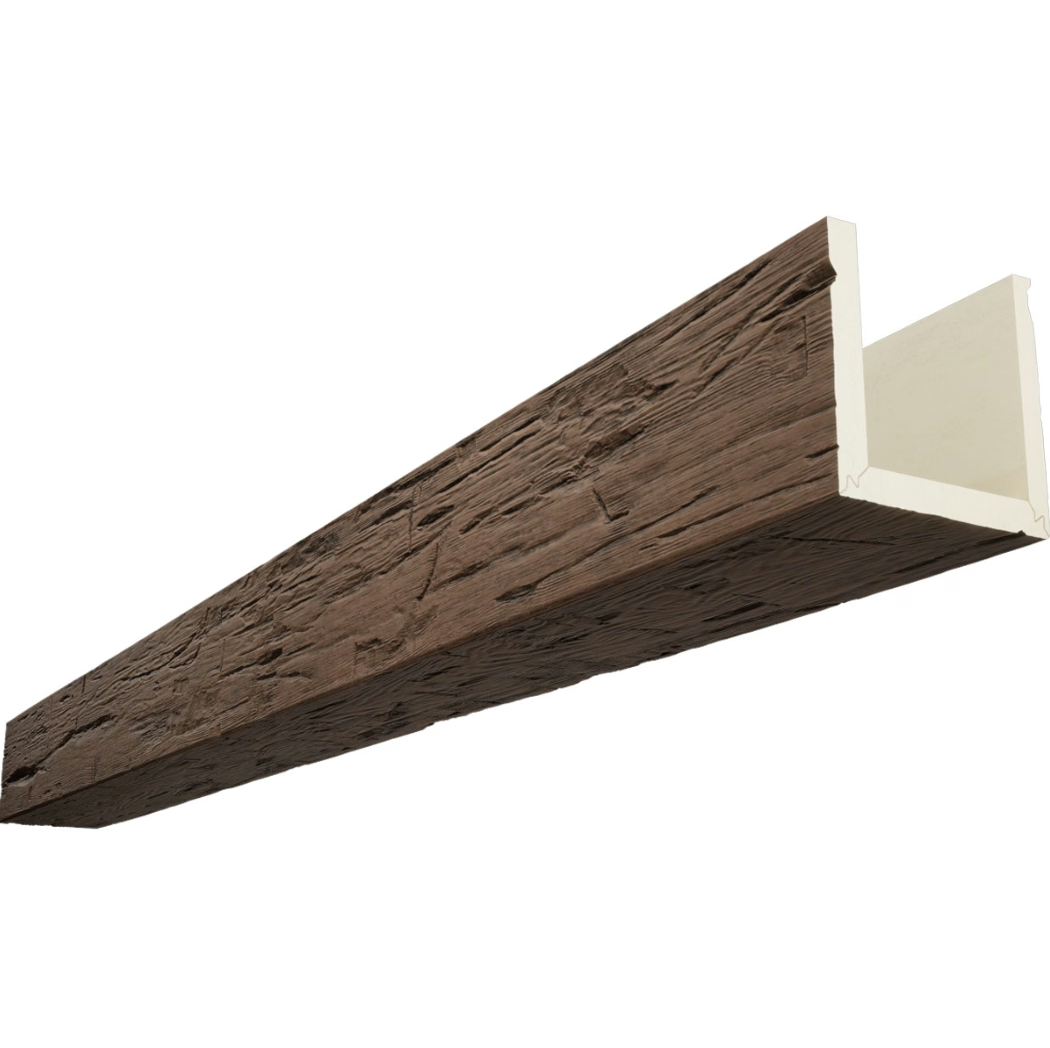
Polyurethane faux beams ship as one of two formats. U-shaped wraps, which slide over a structural wood member, and solid castings, which work for shorter spans or as standalone decorative pieces. Each format has its own sizing logic.
For U-shaped wraps, the relevant dimensions are interior width and interior height. The wall of the wrap adds 1 to 2 inches to the outer profile, so a 6-inch interior wrap reads as 7 to 8 inches on the outside. Most importers default to interior dimensions when ordering, then quote the exterior in their catalog.
For solid castings, the dimensions are outer width and outer height only. These are typically used for spans under 12 feet where no internal support is required, or for cross-beams and decorative pieces that do not bear load.
| Profile | Interior Width | Interior Height | Exterior Width | Typical Use |
|---|---|---|---|---|
| Slim residential | 4" | 6" | 5" | Bedrooms, studies, hallways |
| Standard residential | 6" | 8" | 7" | Living rooms, kitchens |
| Commercial | 8" | 10" | 9" | Restaurants, hotel lobbies |
| Lodge/feature | 10" | 12" | 11" | Vaulted ceilings, great rooms |
| Oversized feature | 12"+ | 14"+ | 13"+ | Custom projects |
A 60/30/10 inventory split across standard residential, slim residential, and commercial covers most residential and light commercial demand. Anything beyond that is custom and carries a longer lead time.
Length Options and Seam Strategy
Polyurethane faux beams ship in standard lengths of 4, 8, 10, 12, 16, and 20 feet. Longer beams require either continuous casting capability or scarf-jointed assemblies. Not every factory has the former, and most buyers should not assume it.
For bulk orders, the length mix matters because:
- 20-foot beams minimize seams but increase freight cost. A 20-foot beam in a 40-foot container takes up significant linear space.
- 12-foot beams hit a sweet spot for residential work. They fit standard ceiling geometries and stack efficiently in containers.
- 8-foot beams work for retrofits and small rooms. Also stack well in mixed container loads.
A distributor aiming for resale should carry 8, 12, and 20-foot lengths as the core inventory. Anything shorter than 8 feet is usually a special-order item, and anything longer than 20 feet is almost always scarf-jointed on site.
Sample Length Mix for a 2,000-Linear-Foot Order
| Length | Quantity | Percentage | Likely End Use |
|---|---|---|---|
| 8 ft | 50 | 20% | Bedrooms, hallways, retrofit jobs |
| 12 ft | 100 | 40% | Standard residential runs |
| 16 ft | 40 | 16% | Living room feature runs |
| 20 ft | 60 | 24% | Open-plan and commercial |
The exact mix depends on the buyer's downstream customers, but a balanced order like this keeps the warehouse useful without flooding any single length.
Finish Variants Across a Bulk Order
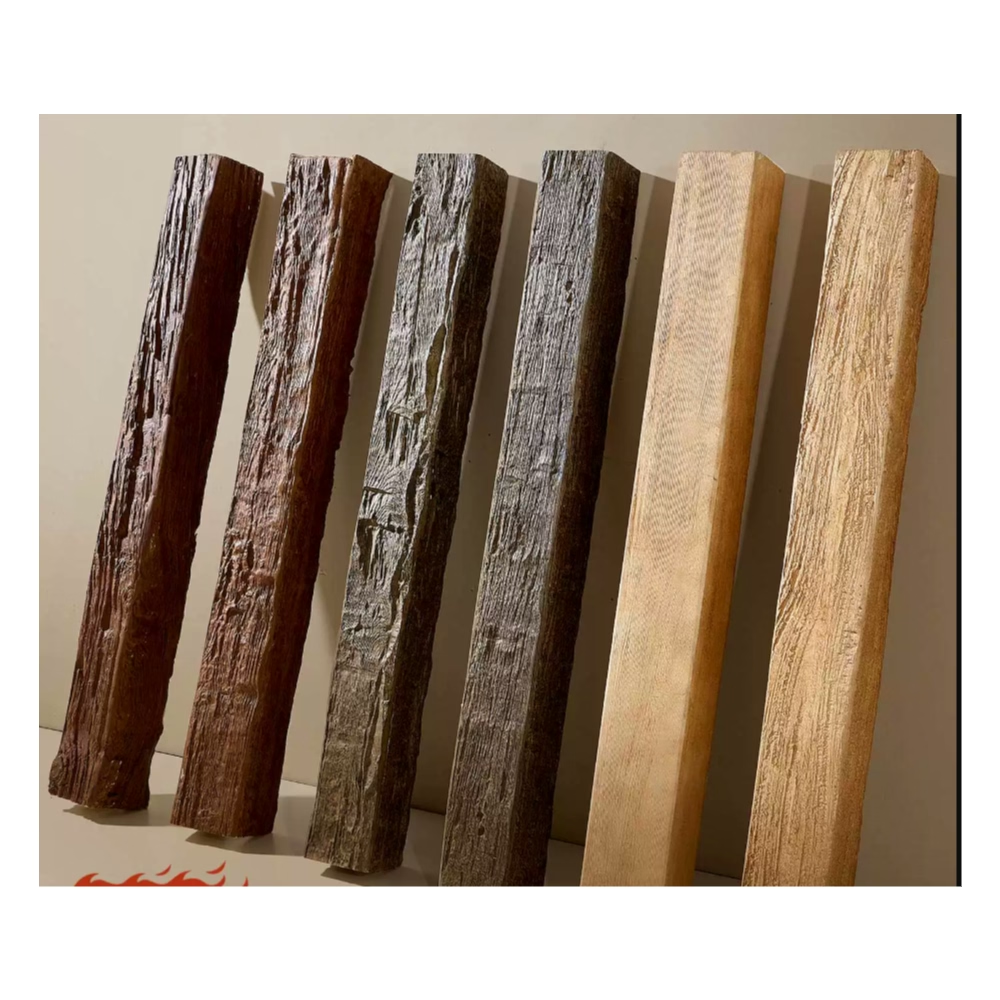
Most factories offer three to six standard finishes per profile. Whitewashed pine, driftwood grey, antique walnut, dark oak, light oak, and barnwood are the most common. Some factories offer custom color matching for orders above a minimum volume, typically 500 linear feet or more.
Importers should think about finish split the same way they think about length split. A 2,400-line-foot bulk order split evenly across six finishes gives 400 feet per finish, which is a manageable inventory position. A 2,400-line-foot order skewed 80/20 toward one finish leaves the warehouse with one fast-moving SKU and several slow movers.
The fastest-moving finishes in most markets are:
- Whitewashed pine (coastal, farmhouse)
- Driftwood grey (modern farmhouse, Scandinavian)
- Antique walnut (traditional, transitional)
- Dark oak (colonial, lodge)
- Light oak (Scandinavian, contemporary)
New finishes can shift the ranking. Smoke-stained and ebony finishes have grown in urban contemporary projects over the past three years. Buyers sourcing for upscale urban markets should keep an eye on those.

Crating, Palletization, and Container Math
Bulk orders need crating that survives container shipping. The standard approach is cardboard crating with foam end caps, palletized at the factory and stretch-wrapped before container loading. A 40-foot high-cube container holds roughly:
- 1,200 to 1,500 linear feet of 6x8 profile beams
- 800 to 1,000 linear feet of 8x10 profile beams
- 500 to 700 linear feet of 10x12 profile beams
These numbers shift with finish, because some finishes require additional protective wrap. Distressed finishes in particular tend to need corner protectors and face film to avoid scuffing in transit.
Buyers should always request a loading plan from the factory before confirming a bulk order. The plan shows how the beams are arranged in the container, which pallets go in first, and how the weight distributes. A poorly loaded container can shift in transit and arrive with damaged corners. A well-loaded one arrives ready to break down at the warehouse.
Crating Standards to Confirm
| Item | Standard | Why It Matters |
|---|---|---|
| Cardboard grade | Double-wall corrugated | Survives stacking in container |
| End caps | Foam, 20mm minimum | Protects beam ends from impact |
| Face film | Optional, used for distressed finishes | Prevents scuffing during handling |
| Pallet | Heat-treated, ISPM 15 stamped | Required for international shipping |
| Stretch wrap | 3 layers minimum | Holds load together during transit |
A factory that confirms all five of these without prompting has shipped internationally before. One that hand-waves any of them is taking risks with the buyer's inventory.

MOQ, Lead Time, and Order Cadence
Minimum order quantities vary by factory. Most reputable PU beam factories require:
- 200 to 500 linear feet for stocked finishes in standard profiles
- 800 to 1,200 linear feet for custom finishes
- 2,000+ linear feet for fully custom profiles or lengths
Lead time follows from order size:
| Order Size | Production Time | Shipping Time (Sea) | Total |
|---|---|---|---|
| Under 1,000 LF | 7-10 days | 25-35 days | 32-45 days |
| 1,000-3,000 LF | 10-15 days | 25-35 days | 35-50 days |
| 3,000-6,000 LF | 15-25 days | 25-40 days | 40-65 days |
| 6,000+ LF | 25-40 days | 30-45 days | 55-85 days |
Distributors running repeat orders typically place a new PO every 60 to 90 days, timed so the next container arrives just as the current inventory clears. That cadence keeps cash flow steady and avoids both overstock and stockouts.
Working with Custom Sizes
Some buyers want profiles that are not in the factory catalog. A resort project might need a 14x18 beam. A historic renovation might need a profile that exactly matches the original timber. Both cases trigger a custom run.
Custom orders require:
- A drawing or template with the exact profile dimensions
- A finish sample or reference piece
- A realistic MOQ, typically 800+ linear feet
- A longer lead time, typically 30 to 50 percent beyond the standard
The factory may also charge a one-time mould fee for custom profiles. This fee can range from a few hundred to a few thousand dollars depending on the profile complexity. Distributors should amortize that fee across the order quantity and disclose it transparently to their downstream buyers.
Communication Templates That Save Time
Bulk buyers who send clear inquiries get faster, more accurate quotes. A complete inquiry should include:
- Profile and dimensions (interior for U-wraps, exterior for solid)
- Length mix with quantities
- Finish list with quantities
- Order destination port
- Required delivery date
- Any project-specific requirements (fire rating, UV stability, finish match)
A buyer who sends an inquiry with all six elements typically gets a quote within 48 hours. One who sends just a profile and quantity often waits a week for clarification.
Pricing Dynamics for Bulk Orders
Polyurethane faux beam pricing has three tiers:
- Stocked finishes, standard profiles, full container orders. Lowest tier. Typically $4 to $8 per linear foot at the factory gate depending on profile.
- Custom finishes or non-standard profiles in mid-volume orders. Middle tier. Typically $8 to $14 per linear foot.
- Fully custom profiles with finish development. Highest tier. $14 to $25 per linear foot.
Volume discounts kick in at roughly 3,000 linear feet and again at 6,000. Buyers structuring multi-container orders for a single project can negotiate better per-foot pricing by consolidating into a single PO rather than splitting into multiple smaller ones.
Freight is the variable most buyers underestimate. A 40-foot container from China to the US West Coast runs roughly $3,000 to $5,000 in normal market conditions. To the US East Coast or EU, that jumps to $5,000 to $8,000. To the Middle East or Latin America, ranges widen further. Freight can equal or exceed the factory cost on small orders, which is why MOQ matters.
Avoiding Common Wholesale Mistakes
The most frequent bulk order failures fall into four buckets:
- Profile mismatch. Buyer specifies interior dimensions for a wrap but the catalog lists exterior. Beams arrive 2 inches too small for the cleat.
- Length under-order. Buyer orders 2,000 linear feet and runs out at 1,800 because of field cuts and waste. The make-up order costs more than the savings from the original bulk price.
- Finish drift. Buyer orders a "driftwood grey" from one factory and a "driftwood grey" from another. They do not match. Customer blames the importer.
- Crating damage. Buyer skips the loading plan and accepts whatever the factory crating looks like. Beams arrive with corner damage on distressed profiles.
Each of these is preventable. The factory is a partner, not a vending machine. Buyers who treat the relationship that way get consistent quality. Buyers who treat it as a transaction get whatever comes out of the production line that week.
Final Thoughts on Wholesale Sizing
Bulk PU faux beam purchasing rewards preparation. The buyer who walks into a quote conversation with a clear profile list, a balanced length mix, a finish split that matches their downstream demand, and a freight plan already in mind gets better pricing and faster lead times than the buyer who treats sizing as a negotiation detail to be settled later.
The size options are diverse for a reason. They exist because the downstream market is diverse. Buyers who respect that diversity, and order accordingly, build a wholesale business that scales. Buyers who treat all faux beams as one product end up with a warehouse full of inventory that does not move.
Technical References
ASTM standards cited in every specification
Test Data
Lab results from internal testing program
Updated 2026
Reviewed against current product specs