
If you have ever tried to sell a 10-foot beam through a typical Shopify store with a 2-day shipping promise, you already know the problem. Standard ecommerce logistics assume your product fits in a shoebox. Faux wood beams — at 8, 10, 12, sometimes 16 feet long — do not fit in any conventional courier's automated sorter. Yet customers expect the same frictionless online buying experience they get for phone cases and t-shirts. The gap between what ecommerce infrastructure expects and what faux beams actually require is exactly where the dropshipping model earns its keep.
Dropshipping oversized home improvement products is not new, but it has matured considerably in the last few years. What was once an awkward arrangement of freight forwarders and manual quote emails is now a reasonably well-oiled ecosystem with regional warehouses, automated freight booking, and API integrations with the major ecommerce platforms. For ecommerce entrepreneurs, interior designers expanding into product sales, importers diversifying their channels, and small business owners testing a new category without committing to inventory, dropshipping polyurethane faux beams has become a viable entry point.
This piece walks through how the model actually works, what to look for in a dropship supplier, where the economics land, and where the operational pain points still are.
Why faux beams are a dropship-friendly product
The combination that makes a product suitable for dropshipping is: high enough margin to absorb the logistics cost, light enough to ship without specialized freight, standardized enough that the supplier can fulfill without back-and-forth, and durable enough to survive parcel shipping without damage. Polyurethane faux wood beams score well on three of those four.
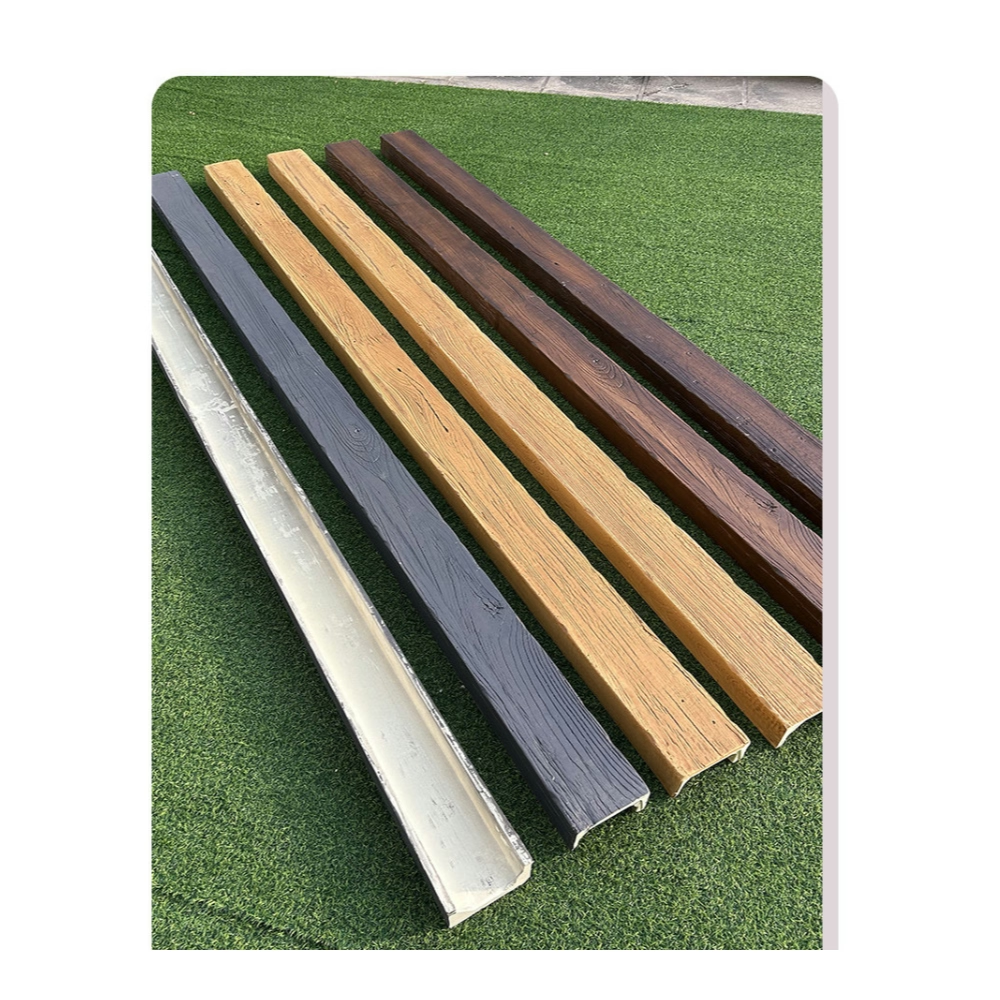
Polyurethane is dramatically lighter than real timber. A hollow faux beam at 8 inches by 6 inches by 10 feet weighs roughly 12 to 18 pounds depending on wall thickness and internal structure. The same dimension in solid oak would be 80 to 100 pounds and would require freight shipping on a pallet. The lighter weight means faux beams can move through LTL carriers, regional couriers, and in some cases small-parcel networks that real timber cannot.
Standardization is the second strength. A beam is a beam — the SKU for an 8-inch by 4-inch by 10-foot driftwood grey faux beam is the same SKU whether it ships to a customer in Berlin, a project in Dubai, or a renovation in Toronto. Color, profile, length, and finish specifications are stable across production runs, which means the supplier can pick, pack, and ship without consulting with the seller for every order.
The fourth criterion — damage resistance — is where polyurethane has historically had an edge. The closed-cell foam structure absorbs impacts that would crack or chip real timber, and the multi-tone finish hides minor scuffs that would be visible on a stained wood surface. Packaging is still important, but the product is forgiving.
The third criterion — margin — is where the seller's job comes in. Faux beams sold direct to consumer at typical retail pricing carry enough margin to absorb the cost of dropship fulfillment, but only if the seller has chosen the right pricing tier and resisted the temptation to compete on price with full-retail brands that hold their own inventory.
How the dropship model actually operates
In a standard retail ecommerce model, the seller purchases inventory, stores it in a warehouse, picks and packs orders, and ships to customers. In a dropship model, the seller lists the product, takes the order, and forwards the order to a supplier who picks, packs, and ships directly to the customer. The seller never touches the product.
For faux beams, the most common dropship arrangement works like this: the seller lists beams in their ecommerce storefront (Shopify, WooCommerce, Amazon, eBay, Etsy, or a custom site). When a customer places an order, the order is routed — manually, by automation, or via an integration — to the supplier. The supplier picks the beam from finished-goods stock, packages it for the destination (often a crated package for international orders, a corrugated box with edge protection for domestic), and hands it to a carrier.
The customer receives the beam with the seller's branding on the packaging insert and shipping label, but with no indication that the product came from a third-party warehouse. From the customer's perspective, the experience looks identical to a traditional retail purchase.
The seller keeps the difference between the retail price they charge and the dropship cost they pay the supplier, minus ecommerce platform fees, advertising costs, payment processing, and customer service overhead. Margins vary widely depending on price point, but a typical range for a mid-priced faux beam sold direct to consumer is 25 to 45 percent gross margin before advertising costs.

What a dropship-ready supplier needs to provide
Not every faux beam supplier is set up for dropship. Sellers evaluating suppliers should look for several specific capabilities.
Blind-ship packaging. The supplier must be willing to ship in plain packaging with the seller's branding on the shipping label and packing slip, but no mention of the supplier's own company on the exterior. This protects the seller's relationship with the customer and prevents the supplier from being solicited directly.
SKU-level inventory visibility. The seller needs to know what is in stock, what is on backorder, and what has been discontinued. Real-time inventory feeds via API or daily CSV uploads are the standard expectation. Manual stock checks do not scale beyond a handful of SKUs.
Multi-carrier shipping options. The supplier should be able to ship via LTL freight for large orders, parcel carriers for single-beam orders, and international freight forwarders for overseas customers. Pricing should be transparent or available via API so the seller can present accurate shipping costs at checkout.
Documentation handling. International dropship orders require commercial invoices, HS codes, certificates of origin, and sometimes fumigation certificates or material safety data sheets depending on the destination country. The supplier should be able to generate these documents automatically for each shipment.
Returns processing. A defined returns process — where the customer sends the beam back, who pays for return shipping, who inspects and restocks the product, and how refunds are issued — needs to be in writing before the seller lists the first product.
Sellers who skip this evaluation stage tend to discover the gaps when their first international order ships without the correct commercial invoice and gets held in customs for three weeks. The due diligence upfront saves significant operational pain later.

Regional warehouses and where the model breaks
The single biggest variable in faux beam dropshipping is distance from the warehouse to the customer. A beam shipped from a Chinese factory directly to a US customer takes 25 to 45 days by ocean freight, which is too long for a typical ecommerce transaction. The solution that has emerged is regional warehousing: the supplier holds finished inventory in warehouses in North America, Europe, the Middle East, and Australia, and ships from the nearest facility to the customer's address.
For the seller, this means the dropship cost varies depending on the destination. A domestic US order might ship in 3 to 7 business days via LTL carrier at a cost of $40 to $80 per beam. An order to Germany might ship from a European warehouse in 5 to 10 business days at a similar cost. An order to a smaller market without a regional warehouse might still default to factory-direct ocean freight at a longer transit time but lower per-shipment cost.
The honest conversation to have with a potential supplier is: where are your warehouses, and which destinations can you ship from each within 10 business days? If the answer is "only our factory in China, by ocean freight, in 30 to 45 days," then the dropship model only works for customers who are willing to wait — which is a smaller pool than the addressable market for home improvement ecommerce.
Some sellers mitigate this by holding small quantities of best-selling SKUs in their own regional warehouse (Amazon FBA, a 3PL, or even a garage with shelving) and dropshipping the rest. This hybrid model sacrifices some of the inventory-free benefit of pure dropshipping but dramatically improves delivery times on the highest-volume products.
Margins, advertising, and unit economics
The numbers matter, so let's be specific. Suppose a seller lists an 8-inch by 6-inch by 10-foot driftwood grey faux beam at $389 retail. The dropship cost from the supplier is $179. The platform fee (Shopify subscription, payment processing, app subscriptions) runs about $30 per order amortized. Shipping is free at checkout, absorbed into the retail price. Gross margin per order before advertising: $180.
Now the advertising cost. A typical cost-per-click for "faux wood beams" in Google Ads or Meta Ads is $1.50 to $4.00, with a conversion rate of 1.5 to 3 percent for a well-optimized product page. That puts customer acquisition cost at $50 to $270 per order. At a $180 gross margin, the seller is profitable on every order with a $50 CAC and underwater on every order with a $270 CAC.
The math works for sellers who can drive organic traffic (SEO, Pinterest, YouTube, Instagram reels showing installed beams), who can run retargeting campaigns to previous visitors at $0.50 to $1.00 per click, and who have built email lists for repeat and referral business. The math does not work for sellers relying entirely on cold paid traffic against the most competitive keywords.
This is why many successful dropship sellers in the home improvement category build content assets first — installation guides, before-and-after project posts, room tours, designer interviews — and monetize that traffic with a product line that includes faux beams. The content does the heavy lifting on customer acquisition, the product line does the heavy lifting on revenue.
Common pitfalls and how to avoid them
Dropshipping faux beams has several recurring failure modes worth flagging.
Damage in transit. A beam that arrives with a crushed corner or a cracked end cap is a return, a customer service issue, and a negative review. The supplier's packaging needs to be evaluated — order a sample shipment to yourself, examine the packaging, simulate a rough handling event by dropping the package from three feet onto concrete, and inspect the beam inside. If the packaging fails your test, find another supplier.
Color drift between samples and production. The driftwood grey you approved on a hand sample may not match the production run that ships to your customer six months later. Reputable suppliers hold approved samples for reference and color-check each batch against the standard. Less reputable suppliers make whatever finish the line is running that week. Request a written color-consistency guarantee.
Lead time surprises. A listing that says "ships in 3 to 5 business days" is a commitment. If the supplier's actual lead time is 14 business days for non-stocked SKUs, the seller absorbs the customer service cost of the delay. Either adjust the listing or find a supplier with shorter lead times on your best-selling SKUs.
Returns on cut or modified beams. Once a beam has been cut to length by the customer, it is non-returnable. This needs to be clear in the product listing and in the order confirmation. Sellers who fail to communicate this absorb the cost of custom-cut beams that customers decide they do not want.
Customs and duties on international orders. The customer is responsible for import duties in most countries, but the duty amount can be significant on a long, bulky product. A beam shipped to the UK post-Brexit, for example, can attract £40 to £80 in duties and VAT on a £300 retail order. The product listing needs to make this clear, and ideally the supplier can provide an estimate based on the destination's HS code treatment.
Who this model suits best
Dropshipping faux beams is not for everyone. It suits ecommerce entrepreneurs who already operate a home improvement or interior design storefront and want to expand their catalog without committing to pallet quantities of inventory. It suits interior designers who want to sell the products they specify without managing a warehouse. It suits importers and distributors who want to add a North American or European sales channel without opening a subsidiary. It suits project managers handling overseas renovations who want to consolidate purchasing through a single domestic supplier relationship.
It does not suit sellers who want to compete purely on price, who lack the patience to manage a multi-week fulfillment chain, who cannot invest in content marketing to drive organic traffic, or who expect a passive income stream with minimal operational involvement. Like any ecommerce business, the work is real.
A practical first step
For sellers evaluating this category, the most efficient starting point is a shortlist of three to five suppliers with regional warehouses in the seller's primary market. Request samples of three or four best-selling SKUs, request dropship pricing for those SKUs at a unit-of-one and at a pallet quantity, request sample shipping documentation including commercial invoice and packing slip, and request a written returns policy.
The supplier that passes that evaluation — fast samples, competitive unit-of-one pricing, clean documentation, sensible returns — is the right partner to start with. The rest of the operational details can be worked out once orders are flowing.
Technical References
ASTM standards cited in every specification
Test Data
Lab results from internal testing program
Updated 2026
Reviewed against current product specs


