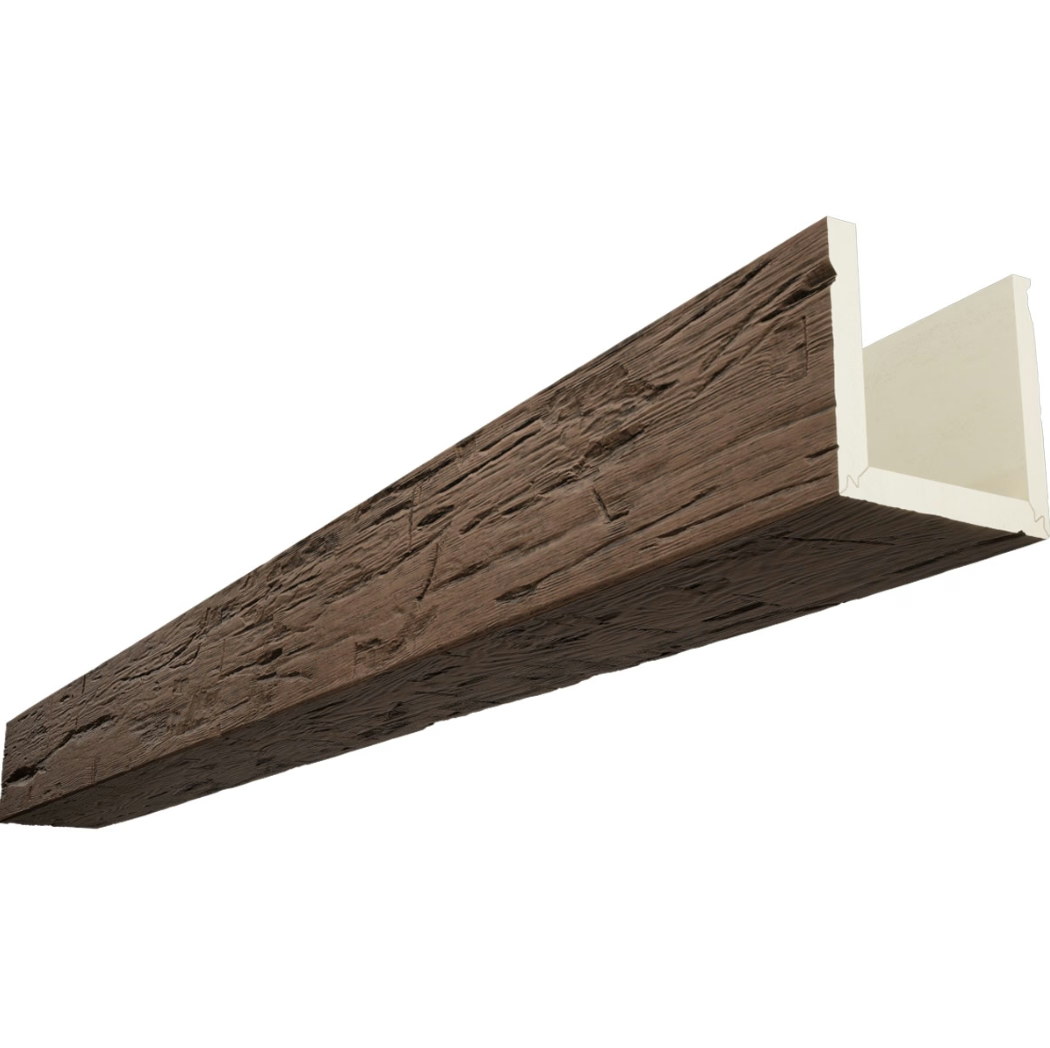
Most discussions about faux wood beams focus on the finished product itself: the texture, the color, the profile, the way it transforms a ceiling. Those details matter enormously. But for any beam that crosses an ocean, the question of how it gets from the factory to the job site is just as important. Export-ready packaging is the discipline that protects product quality from the moment a beam leaves the production line until the moment it is lifted into place by an installer.
A well-packaged shipment arrives ready to clear customs with minimal handling. A poorly packaged shipment arrives damaged, with disputes over responsibility and delays while replacement beams are produced and reshipped. The difference between these two outcomes usually comes down to packaging choices that were made weeks before the container was loaded.
Why Export Packaging Is a Distinct Discipline
Domestic shipping can rely on relatively simple packaging because the journey is short and the handling steps are limited. A truck pulls up to the factory, the load is secured, and the product travels directly to the construction site. International shipping involves many more steps, each of which introduces risk. The load is moved by forklift at the factory, trucked to a port, staged in a yard, lifted by crane into a vessel, transported across an ocean, lifted off the vessel, staged in another yard, trucked to a warehouse or directly to a site, and unloaded one final time.
Each of these steps can damage product that is not properly protected. Forklift tines can puncture unprotected surfaces. Stacking in a yard can press beams against hard edges. Crane slings can compress long members if they are not properly rigged. Even the vibration of ocean travel can loosen fasteners on poorly assembled crates, allowing internal components to shift and abrade each other.
Export-ready packaging is engineered to handle all of these stresses. The beams themselves are protected individually, the crates are engineered for stacking and crane handling, and the loading plan inside the container is designed to prevent shifting during transit.
Individual Component Protection
The first layer of export packaging is the protection of each individual beam. Polyurethane faux wood beams have a finished surface that has to remain pristine through the journey. A single abrasion mark can render a beam unsellable on a premium project, even if the underlying structure is intact.
Each beam is typically wrapped in a soft foam sheet that cushions the surface against neighbors. The foam also provides thermal insulation that helps protect the surface finish from rapid temperature changes during loading and unloading. For longer beams or beams with particularly delicate surface treatments, additional corner protectors may be added.
End caps and small accessories are packed separately. Reinforced cartons with foam inserts prevent these smaller items from shifting inside the larger crate. Cartons are labeled clearly with their contents so the receiving team can locate specific items without unpacking the entire shipment.
Outer Crate Engineering
The outer crate is the structure that holds everything together. Export-ready crates are built from timber that has been heat-treated or fumigated to comply with ISPM 15 regulations. This step is essential for shipments entering dozens of countries, including the United States, the European Union, Australia, and New Zealand. Skipping the fumigation step results in the shipment being refused at the destination port, with the importer responsible for either fumigation in transit or returning the container for treatment.
Crate construction uses screws or ring-shank nails rather than smooth nails, because smooth nails can loosen under vibration. Corner braces are added where crates will be lifted by crane. The base of the crate is reinforced to handle the weight of the product above, and the top is reinforced to handle stacking if the container is loaded floor to ceiling.
For oversized items that exceed standard crate dimensions, suppliers work with specialized crating companies that can build custom frames, braced pallets, or steel-reinforced containers. The added cost of custom crating is modest compared to the cost of a damaged shipment, and reputable suppliers discuss crating options during the quotation stage.
Container Loading Optimization
A 40-foot high-cube container has roughly 2,700 cubic feet of usable space, but that volume cannot be filled arbitrarily. The loading plan has to account for weight distribution, the dimensions of the individual items, and the order in which items will be needed at the destination site. Export-ready packaging includes a detailed loading plan that addresses each of these factors.
Weight distribution is critical because an unbalanced container can be dangerous on a vessel. Heavy items are placed low and centered. Lighter items are placed on top or around the heavier pieces. The total weight of the loaded container must stay below the maximum allowed by the shipping line, which is typically around 26 metric tons for a 40-foot container.
The order of items matters because the receiving team may need specific accessories first. End caps, brackets, screws, and small hardware are usually packed last so that they can be unpacked first. Beams that will be installed in sequence are packed in the order of installation. The loading plan reflects this logic and is shared with the receiving team in advance.
Void fills are used to prevent shifting during transit. Inflatable dunnage bags, wooden blocking, and foam inserts all serve to lock the cargo in place. Any cargo that can shift during transit is at risk of damage, and the cost of void fill is trivial compared to the cost of a damaged shipment.
Mixed Loads and Consolidation
Not every international shipment is a full container. Many buyers want less-than-container-load quantities to manage inventory or to support smaller projects. Export-ready packaging supports these orders by consolidating multiple shipments into a single container at the factory or at a consolidation warehouse.
Mixed loads require extra care because different products have different protection requirements. Beams might be packed alongside other building materials, with each product protected according to its own needs. The container is loaded so that heavier items are below lighter ones, and fragile items are not pressed against heavy ones.
Consolidation can reduce shipping costs substantially, particularly for buyers in landlocked countries or regions where direct sailings are infrequent. The savings come from sharing the fixed costs of a container across multiple shipments. Reputable suppliers offer consolidation as a standard service and can advise buyers on whether their order size makes sense for a dedicated container or a consolidated load.
Documentation That Travels With the Cargo
Packaging and documentation work together. An export-ready shipment includes a packing list that describes every crate and its contents, a commercial invoice that matches the packing list exactly, a certificate of origin for tariff treatment, a bill of lading issued by the shipping line, and a fumigation certificate for the wooden packaging.
The packing list is particularly important because it allows the receiving team to verify that everything arrived. Each crate is numbered, and the contents of each crate are itemized. If a crate is missing on arrival, the receiving team can identify it immediately and start the claims process.
For shipments that require additional documentation, export-ready suppliers prepare the paperwork in advance. FORM E certificates for China-ASEAN trade, EUR.1 certificates for European destinations, and specific certificates required by Gulf customs authorities are all examples. Material safety data sheets, fire rating certificates, and VOC emission reports are typically available on request.
Climate Considerations During Transit
Ocean containers experience a wide range of conditions during transit. A container leaving Shanghai in January may pass through equatorial waters where temperatures exceed 40 degrees Celsius inside the container. Even in milder climates, the daily temperature swing on a vessel deck can stress materials that are sensitive to thermal expansion.
Polyurethane faux wood is more thermally stable than most materials, but extreme conditions can affect the surface coating. Export-ready packaging addresses this risk through container selection. Standard containers are used for most shipments, but refrigerated or ventilated containers may be recommended for shipments passing through tropical waters or for products with particularly delicate finishes.
Desiccant packs inside the crates help control humidity. Even though faux wood is not as hygroscopic as real timber, moisture inside a sealed container can affect cardboard components and any exposed hardware. A few kilograms of desiccant per crate is a small cost that prevents larger problems.
Pre-Shipment Inspection
The last step before the container is sealed is a pre-shipment inspection. A quality control team verifies that every item on the packing list is present, that the crates are in good condition, and that the documentation is complete. Photographs are taken of the loaded container for the buyer’s reference. Any discrepancy is resolved before the container leaves the factory.
Pre-shipment inspections can also be arranged through independent third-party agencies for an additional layer of verification. Buyers who require this service typically specify it during the order stage. The cost is modest compared to the value of a full container, and the independent report gives the buyer confidence that the shipment matches the order.
Arrival at Destination
Once the shipment arrives at the destination port, the receiving team should arrange inspection as soon as the container is released. The outer crates are examined for visible damage, and any damage is photographed before the container is opened. The interior is inspected as it is unpacked, with each item checked against the packing list.
If damage is discovered, the receiving team should note it on the cargo receipt before the container is emptied. The supplier should be notified immediately with copies of the photographs and the cargo receipt. Most reputable suppliers resolve damage claims quickly when they are notified promptly and supported by clear documentation.
When the shipment arrives in good condition, the export-ready packaging makes the unpacking process straightforward. The team unloads the crates in the order specified by the loading plan, sorts the contents according to the packing list, and stages the materials for installation. The time saved at the destination easily justifies the investment in proper packaging at the origin.

Building Long-Term Export Relationships
Export-ready packaging is more than a one-time service. The best suppliers maintain packaging standards across many shipments and refine their approach based on feedback from buyers. Over time, the relationship between supplier and buyer becomes a well-oiled operation, with documentation that arrives before the cargo, loading plans that match the buyer’s receiving schedule, and packaging that is sized to optimize the buyer’s warehouse space.
For buyers who source faux wood beams regularly from the same supplier, packaging standards can be codified into a standing specification. The supplier uses the same crate dimensions, the same label format, and the same documentation template for every shipment. This kind of consistency simplifies receiving, reduces training time for warehouse staff, and builds trust between the parties.
The result is a supply chain that runs smoothly across thousands of kilometers. A faux wood beam that leaves a factory in one country can arrive at a construction site in another country ready to install, with all the supporting documentation already in the buyer’s hands. That outcome depends entirely on the packaging choices that were made before the container was loaded.
Technical References
ASTM standards cited in every specification
Test Data
Lab results from internal testing program
Updated 2026
Reviewed against current product specs