
The traditional wholesale supply chain for decorative building products adds margin at every handoff. The factory sells to an export agent, who sells to an importer, who sells to a regional distributor, who sells to a retailer or contractor. Each handoff adds 10 to 30 percent margin, and by the time the beam reaches the job site, the price has often tripled from the factory's original wholesale rate.
Buyers who source factory direct eliminate most of those handoffs. The savings can be substantial, but the structure of the deal matters as much as the headline price. A buyer who thinks they are buying factory direct but is actually buying from a hidden middleman will discover the markup after the order is placed.
How middleman markups accumulate in the beam supply chain
A polyurethane faux beam might cost the factory $25 to produce. The factory's wholesale price to its export agent might be $35. The export agent sells to an importer for $55. The importer sells to a regional distributor for $85. The regional distributor sells to a contractor for $140. The contractor bills the homeowner $200 plus labor. None of these prices are unreasonable in isolation; each entity adds value in the form of warehousing, financing, customer service, or local presence. The total markup from factory gate to end user, however, is substantial.
Factory direct purchasing removes most of these layers. The buyer communicates directly with the factory or its export sales team, pays the factory directly, and arranges shipping and customs on their own or through their own forwarder. The result is usually a price somewhere between the factory's cost and the factory's standard wholesale price, depending on volume and commitment.
What counts as factory direct in practice
The definition of factory direct is not as clear-cut as it sounds. Some factories operate their own export departments and handle international orders directly. These are unambiguously factory direct. Other factories sell exclusively through export agents that handle international logistics and customer service. Buying from such an agent is technically still considered factory direct in some markets because the agent works for the factory rather than independently.
A third model involves trading companies that own or contract the production line and sell under their own brand. These trading companies are not the factory itself, but they are close enough to the production process that prices are usually competitive with true factory direct. The savings versus an independent distributor are similar.
A fourth model, which is not factory direct at all, involves resellers who claim to be factory direct but actually buy from another distributor and mark up. These resellers are often easy to identify: their quotes are higher than the factory's published wholesale rate, they cannot answer technical questions about production, and their payment instructions route to a company name different from the one issuing the invoice.
How to verify factory direct status
The fastest way to verify factory direct status is to ask who issues the invoice and which bank receives payment. A true factory direct relationship involves an invoice from the factory's legal entity and payment to the factory's bank account. If the invoice comes from a different company than the one you have been communicating with, you are dealing with a middleman regardless of what their marketing says.
A second verification step is to ask for the factory's business license and export license. These documents include the legal name and address of the operating entity. Cross-check the address against online maps and the company registration against the local commerce bureau's database. A factory that hesitates to provide these documents is hiding something.
A third verification step is to look for evidence of past exports to your country. Most customs agencies publish import records that can be searched by HS code. A factory that has shipped polyurethane products to your country before is far less risky than one whose export history you cannot verify.
The savings breakdown on a typical order
Consider a 1000-piece order of 6-inch by 8-inch by 10-foot polyurethane faux beams in a standard walnut finish. The numbers below are illustrative based on typical 2026 market rates.
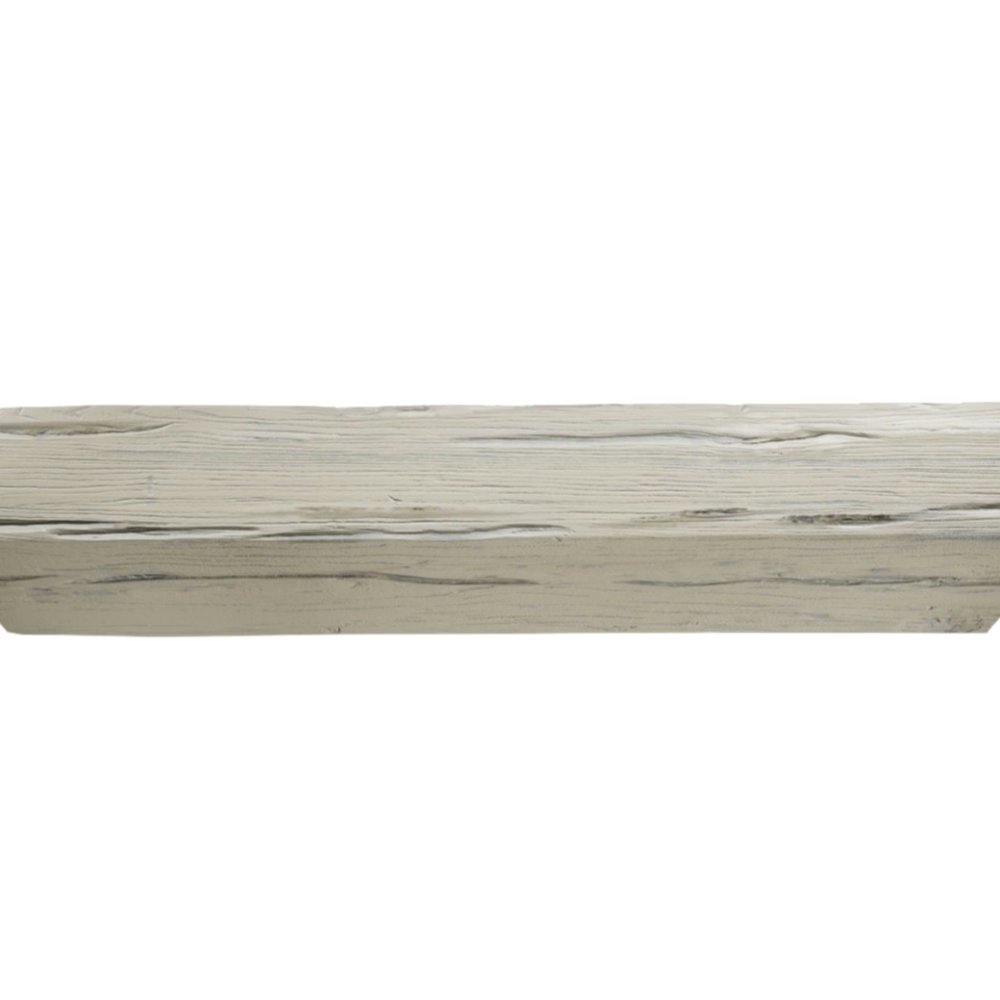
The factory's production cost for this beam is roughly $30 to $32. The factory's wholesale price to a serious direct customer is $65 to $85, depending on volume and finish. Through a U.S. distributor, the same beam retails for $160 to $220. The savings on a 1000-piece order at factory direct wholesale pricing versus distributor pricing is $75,000 to $135,000, even after accounting for international freight, customs, and inspection.
The savings are not pure profit. The buyer takes on responsibilities the distributor used to handle, including international shipping logistics, customs clearance, inbound receiving, QC, and after-sales support. These responsibilities cost money and time. A buyer who values their time at $100 per hour might spend 50 to 100 hours on logistics for a first container, which is $5,000 to $10,000 in opportunity cost. The savings still vastly exceed the cost, but the math is real.
Where the savings actually come from
The largest single source of savings is the elimination of the importer's margin. Importers of decorative building products typically work on 25 to 40 percent gross margin, and that margin is built into the wholesale price they charge. Removing this layer saves more than removing any other single layer.
The second largest source of savings is freight efficiency. A factory's freight forwarder typically negotiates better ocean rates than a small importer can negotiate on their own. The factory also has established relationships at the port of origin that speed up loading and reduce demurrage charges. These efficiencies add up to 10 to 20 percent of the freight cost.
The third source of savings is financing. Distributors and importers finance their inventory through bank loans or trade credit, and they pass this financing cost on to buyers. A factory direct buyer who pays a 30 percent deposit and 70 percent against bill of lading is essentially self-financing, which removes a layer of cost from the chain.
When factory direct makes sense and when it does not
Factory direct wholesale sourcing is ideal for buyers who can commit to volume, plan ahead, and handle some operational complexity. Importers, regional distributors, large contractors, and developers fit this profile. The model is not ideal for buyers who need small quantities, fast delivery, or extensive customization without volume commitment.
The break-even point for factory direct versus domestic wholesale is usually around 200 to 300 pieces for a single order, or 500 to 1000 pieces annually for ongoing business. Below those thresholds, the logistics overhead and minimum order quantities at the factory outweigh the savings. Above those thresholds, the savings scale rapidly.
Buyers who are uncertain about whether to commit to factory direct should consider a hybrid model. Source some product factory direct for the steady, high-volume portion of the business, and source specialty or small-quantity product from domestic wholesalers. This approach captures most of the savings while preserving flexibility for unusual orders.
Operational responsibilities the buyer must absorb
Going direct shifts several responsibilities from the middleman to the buyer. Understanding these in advance prevents surprises after the first order is placed.
Logistics is the most visible responsibility. The buyer must either hire a freight forwarder or work with the factory's forwarder to arrange origin trucking, ocean shipping, customs clearance, and destination delivery. Each step has its own documentation, its own timeline, and its own potential failure points.
Quality control is the second responsibility. Without a domestic distributor standing behind the product, the buyer must arrange pre-shipment inspection, incoming inspection, and any subsequent rework or replacement. This usually involves a third-party inspection service and a small internal team.
After-sales support is the third responsibility. End customers who have issues with the product will contact the buyer, not the factory. The buyer must have a process for handling complaints, processing replacements, and managing warranty claims. This is a real cost, and it should be budgeted separately from the unit price.
Finance is the fourth responsibility. International wire transfers, letters of credit, and currency exchange all add complexity and cost. A buyer who has not done this before should consult with their financial institution before placing the first order.
Building a successful direct wholesale relationship
Start with a clear understanding of your business needs. Volume, product mix, delivery windows, and quality standards should all be defined before approaching factories. A clear understanding produces better quotes and better matches.
Identify candidate factories through trade shows, online research, and referrals from industry contacts. Visit the most promising candidates in person or via video. Request pricing, samples, and references from each. Compare the options on the criteria that matter most to your business.
Place a small initial order with the factory you select. Use this order to validate the entire chain, including production, QC, freight, customs, and internal receiving. Once the chain works smoothly, scale up to a larger order that qualifies for the best wholesale pricing tier. From there, build the relationship through consistent orders, clear communication, and reasonable expectations on both sides.


Common pitfalls to avoid
The most common pitfall is choosing a factory purely on the lowest unit price. The cheapest quote often comes from a factory that cuts corners on raw materials, labor, or QC. The result is a product that arrives with quality issues that the buyer must absorb. A slightly higher unit price from a more reputable factory is usually a better value.
The second most common pitfall is failing to budget for hidden costs. Customs duty, broker fees, storage charges, inspection costs, and rework labor all add to the landed cost. A buyer who budgets only the factory's unit price and the freight quote is in for a surprise. Building a comprehensive cost model before the first order is essential.
The third pitfall is poor documentation. Verbal agreements about quality, lead time, and packaging are not enforceable. Everything should be in writing, including the agreed specifications, the inspection criteria, the payment milestones, and the warranty terms. A factory that resists putting commitments in writing is a factory that does not intend to honor those commitments.
The structural advantage of going direct
For trade buyers serious about building a long-term business in the faux beam market, factory direct wholesale sourcing is not just a cost optimization. It is a structural advantage that compounds over time. The relationship with the factory becomes a barrier to entry for competitors. The cost advantage funds better marketing, better inventory, and better service. The direct communication channel allows faster response to market changes and earlier access to new products.
The first order is the hardest. Once the relationship is established and the operational processes are in place, the second and tenth orders are far easier. The buyers who persist through the initial complexity capture the long-term advantage that justifies the effort. The buyers who give up after the first order return to the distributor channel and accept the permanent markup.
Going factory direct is not a silver bullet. It is a strategy that rewards the buyers willing to invest in the relationship, the operational capability, and the patience required to make it work. For those who do, the savings are real and the competitive advantage is durable.
Technical References
ASTM standards cited in every specification
Test Data
Lab results from internal testing program
Updated 2026
Reviewed against current product specs


