
Public building tenders have a reputation for being paperwork-heavy, and the fire classification section of a ceiling beam specification is often where that reputation gets reinforced. The bid documents reference specific testing standards, require particular classifications within those standards, and ask for documentation packages that go well beyond a simple certificate of compliance. Getting the documentation right upfront is the difference between a smooth submittal and a multi-week back-and-forth with the project team.
Fire-class rated PU faux wood beams have become a standard offering in the commercial beam market precisely because public tenders demand them. The factories that supply this segment have invested in the testing infrastructure, the quality control systems, and the documentation processes needed to satisfy the requirements. For buyers, the question is less about whether the product exists and more about how to specify it correctly.
How public tenders approach fire classification
Most public building tenders specify fire performance through reference to a national or international testing standard. The specific standard depends on the country and sometimes on the region within a country. The bid documents typically include a section in the materials specifications that reads something like: "All decorative ceiling beams shall be tested to [standard] and achieve a classification of [class] or better."
The phrase "or better" is important. It allows bidders to propose products that exceed the minimum performance, which can be a competitive advantage on technically scored tenders. A bid that proposes a Class A beam when the specification calls for Class B demonstrates stronger fire performance and may score higher on technical criteria even at a slightly higher price.
For international tenders, particularly those funded by multinational development banks or government aid programs, the documentation requirements can be especially detailed. Common requirements include third-party test reports from accredited labs, recent certification dates, material safety data sheets in the local language, and sometimes independent pre-shipment inspection reports. Some tenders also require factory audit reports demonstrating that the manufacturing facility has the quality systems in place to produce consistent, compliant product.
The documentation package that wins tenders
A complete documentation package for a public tender typically includes several specific items. The first is the test report from an accredited third-party laboratory. This should be the full report, not a summary, and should clearly identify the product tested, the test method, the results, and the lab's accreditation details.
The second item is a letter of compliance from the manufacturer. This letter confirms that the specific product being supplied for the project matches the formulation tested in the lab report. It should be on company letterhead, signed by a responsible officer, and dated within a reasonable timeframe of the order.
The third item is the material safety data sheet. The MSDS provides information about the chemical composition, handling precautions, and first aid measures for the product. For international tenders, the MSDS may need to be in the local language and may need to follow a specific format such as the GHS (Globally Harmonized System) format.
A certificate of origin is often required for customs clearance on imported materials. Some tenders also require an insurance certificate, a performance bond, or a manufacturer warranty document. The exact list varies by project, and reviewing the bid documents carefully to identify all required documents is essential.
Reading specifications across different standards
Public tenders in different countries specify different standards, and a beam supplier that wants to compete internationally needs to be fluent in all of them. The most common standards encountered in public tenders globally include ASTM E84, EN 13501-1, BS 476, GB 8624, and AS/NZS 1530.
Some bid documents will accept "equivalent" classifications across standards. A specification that reads "ASTM E84 Class A or EN 13501-1 B-s1, d0 or equivalent" gives the bidder flexibility. A specification that reads only "ASTM E84 Class A" without the equivalency clause restricts the bidder to beams tested specifically under that standard.
For large international tenders, the engineering team may specify multiple standards to allow competition from suppliers in different regions. A specification that accepts ASTM E84 Class A, EN 13501-1 B-s1, d0, BS 476 Class 0, or GB 8624 B1 is essentially asking for the highest performance classification under any recognized international standard. This is common in projects funded by international institutions that want to encourage competitive bidding.
What Class A actually means for a PU beam
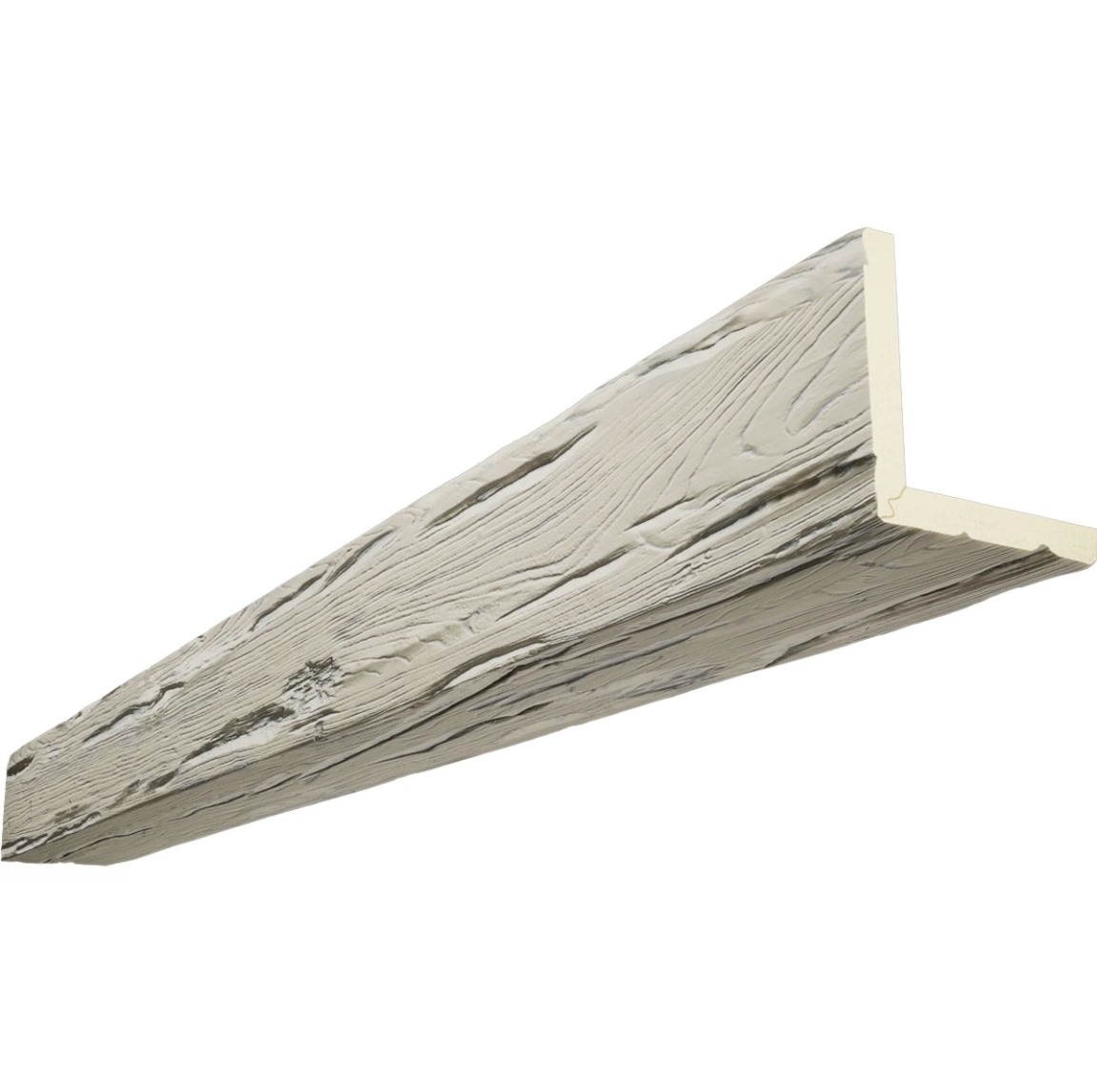
A Class A rating under ASTM E84, or its equivalent under other standards, means the beam achieves a flame spread index between 0 and 25 and a smoke developed index below 450. For PU foam beams, achieving this rating requires a carefully formulated fire retardant package integrated into the foam during production.
The chemistry involves halogenated or phosphorus-based retardants that interrupt the combustion chain reaction at the surface of the material. When exposed to flame, the treated foam forms a protective char layer that slows further combustion. The retardant also reduces the volatile organic compounds released during heating, which lowers the smoke density.
A well-formulated Class A PU beam will not ignite easily, will not propagate flame readily across its surface, and will produce relatively low smoke compared to untreated PU. It will still burn under sustained flame exposure, but the time to flashover is significantly extended compared to untreated foam. In a real fire scenario, those extra minutes can make the difference between a successful evacuation and a tragedy.
Common specification pitfalls
One common pitfall in public beam tenders is specifying fire performance for the beam alone without addressing the mounting system. A fire-rated beam screwed into untreated wood blocking may not perform the same way as a beam mounted on a fire-rated support. The system performance depends on the weakest link.
Another pitfall is specifying the wrong classification for the application. A specification that requires Class A for a low-occupancy storage area may be over-specified and unnecessarily expensive. Conversely, a specification that requires only Class C for a high-occupancy assembly space may be under-specified and fail inspection. Working with a fire engineer during the specification phase can help avoid both extremes.
A third pitfall is accepting a supplier's "equivalent" claim without verification. Some suppliers will assert that their beam meets a particular standard without providing the test report to back it up. This is particularly common in regions where enforcement is lax. The bid evaluation should always include a documentation check, and any "equivalent" claim should be substantiated with a current test report from an accredited lab.
Working with tender timelines
Public tenders often have firm submission deadlines, and missing a documentation requirement can disqualify an otherwise competitive bid. The beam supplier should be engaged early in the bid preparation process to confirm that the required documentation can be assembled in time.
For repeat bidders, maintaining a current documentation library is essential. Test reports should be refreshed every two to three years, and the supplier should have a system for tracking expiration dates and scheduling re-tests. A bid that includes an expired test report is likely to be disqualified on technical grounds.
Some public projects require pre-qualification of suppliers before bids are accepted. This often involves a factory audit, a quality systems review, and a sample evaluation. Getting pre-qualified takes time, sometimes months, and suppliers interested in public sector work should pursue pre-qualification proactively rather than waiting for a specific tender to come up.
The economics of fire-rated beams on tenders
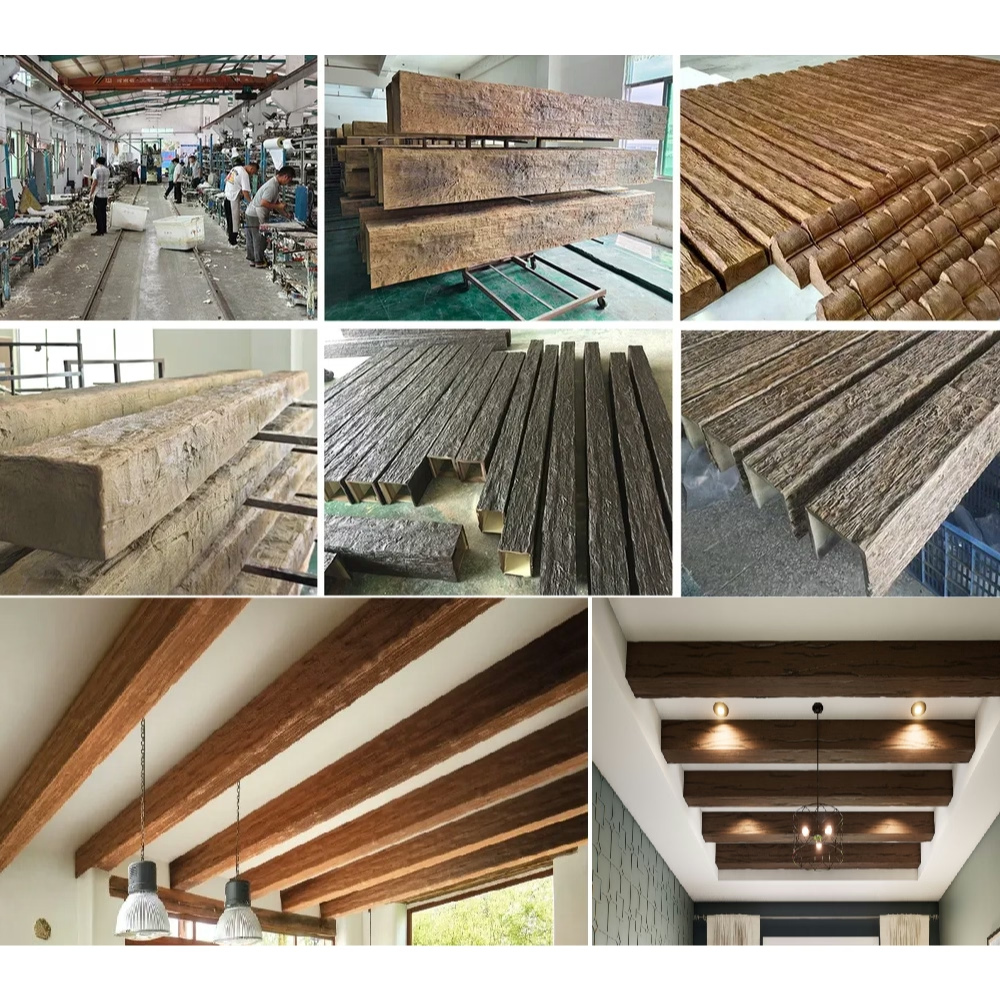
The price premium for fire-rated PU beams is typically 15 to 30 percent above non-rated equivalents. For large public tenders with hundreds of beams, this adds up to a significant cost difference. The premium reflects the more expensive raw materials, the additional quality control requirements, and the cost of maintaining current test reports.
Some tenders explicitly accept price premiums for fire-rated products as a value-engineering decision. The alternative — using non-rated beams and compensating with additional sprinkler density or alternative fire protection measures — can be more expensive overall and may not satisfy the fire engineer. A clear-eyed comparison of the alternatives usually favors specifying rated beams from the start.
For contractors evaluating bids, the question is not just the unit price but the total installed cost including any fire protection upgrades that would be required if non-rated beams were used. In most cases, the fire-rated beam is the lower total cost option once the system-level implications are considered.
Fire-class rated PU faux wood beams are a well-served product category in the commercial beam market. The manufacturers that supply this segment have the testing, documentation, and quality systems in place to support public tender work. The path to a successful bid is clear: engage the supplier early, verify the documentation, confirm the formulation match, and submit a complete package that addresses every requirement in the bid documents.
Technical References
ASTM standards cited in every specification
Test Data
Lab results from internal testing program
Updated 2026
Reviewed against current product specs


