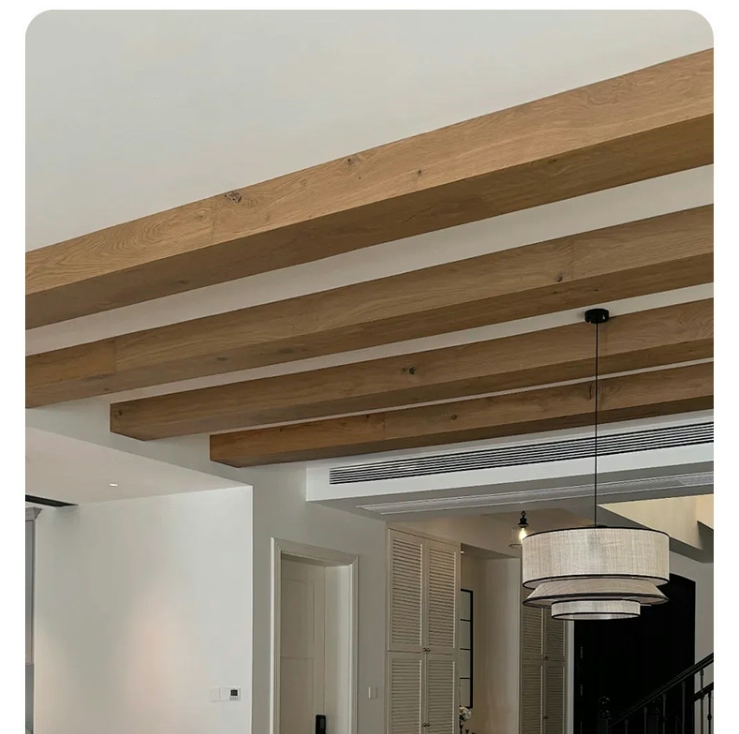
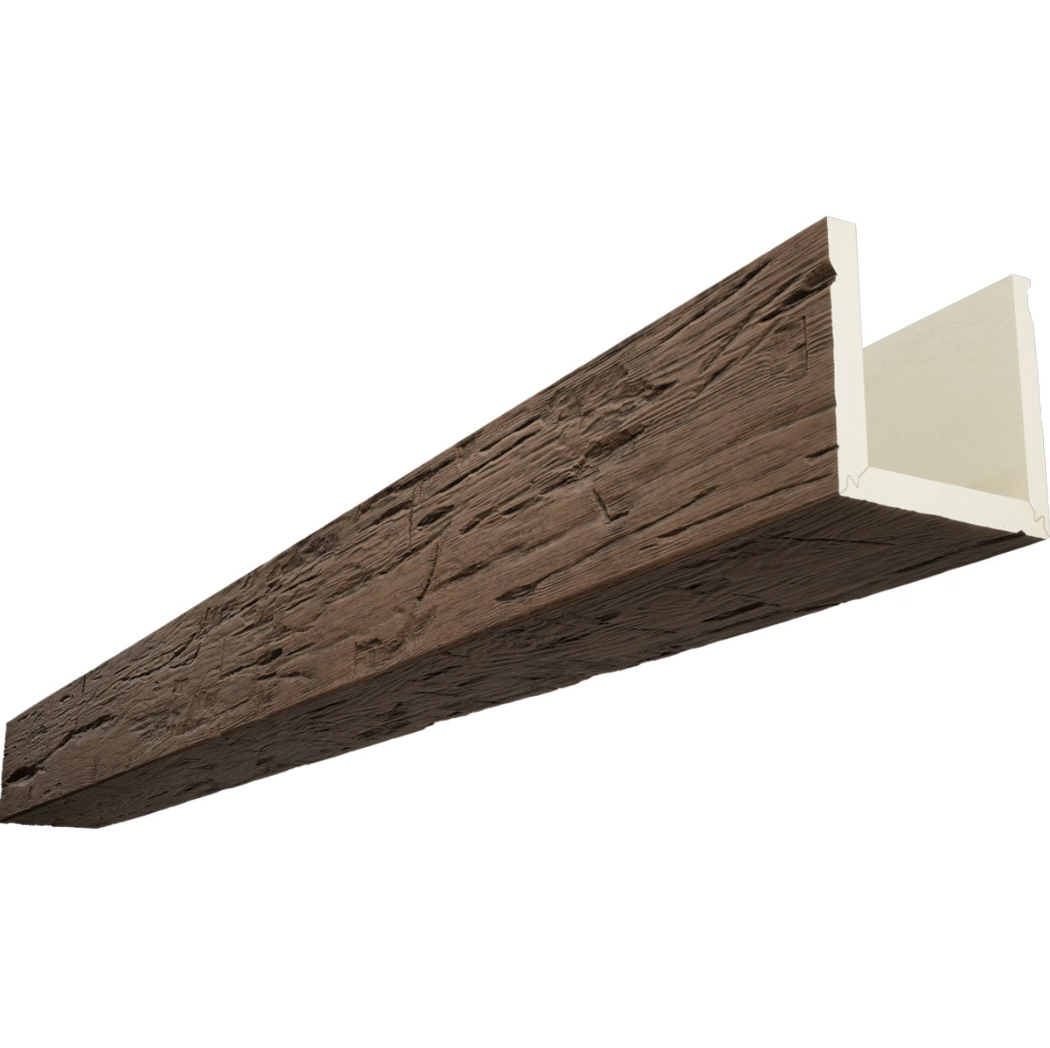
Procurement for public building tenders operates on a different rhythm than private commercial work. Bid windows are fixed, documentation requirements are explicit, and the evaluation criteria are spelled out in advance. The flexibility that often exists in private projects to substitute one product for another mid-stream is much narrower in public work, where changes typically require formal change orders and may trigger re-bidding.
For decorative ceiling beams, the practical implication is that the supplier selection and product specification need to be locked down before the bid goes out, not after. Contractors who wait until the bid is awarded to identify a beam supplier often find themselves scrambling to meet documentation requirements that should have been confirmed months earlier. Getting the supply chain right upfront is essential.
How public tender specifications treat ceiling beams
Most public tender documents include a materials section that specifies decorative ceiling beams in detail. The specification typically lists the acceptable materials (often "polyurethane, fiberglass, or composite"), the required fire classification, the finish requirements, the mounting details, and the quality assurance provisions.
The fire classification is usually the most critical specification. Public buildings tend to fall into higher-risk occupancy categories under most building codes, which means stricter fire performance requirements. A specification that reads "ASTM E84 Class A" or "EN 13501-1 B-s1, d0" is common for institutional and government projects.
Some tenders specify the classification without naming the test standard, which can lead to confusion. A specification that reads simply "Class A fire rated" without the ASTM E84 reference could be interpreted as ASTM E84 Class A, EN 13501-1 A2-s1-d0, or any of several other national classification systems. Clarifying the standard with the specifier before bidding is essential to ensure the proposed product actually meets the requirement.
Common documentation requirements in tender documents
Beyond the test report itself, public tenders often require several supporting documents. A certificate of compliance from the manufacturer confirms that the specific production run matches the tested formulation. A material safety data sheet provides chemical composition and handling information. A certificate of origin confirms where the product was manufactured, which can affect customs duties and trade compliance.
For projects funded by international development banks or aid programs, additional documentation may include environmental compliance certificates, labor practice attestations, and anti-corruption declarations. These are not beam-specific requirements but apply to all materials supplied under the project.
Some tenders also require physical samples to be submitted with the bid. A typical sample package includes one or two beam samples showing the proposed finish, a corner piece or transition fitting, and sometimes a small mockup of the mounting system. The evaluation committee reviews the samples for finish quality, dimensional accuracy, and overall suitability for the project.
Sourcing strategies that work for public tenders
The most reliable approach for public tender work is to identify one or two fire-retardant beam suppliers well in advance and build a working relationship before specific tenders come up. This gives the supplier time to understand the documentation requirements typical for the agency's projects, maintain current test reports on relevant products, and prepare sample packages that can be quickly customized for specific bids.
Pre-qualification is another important strategy. Some public agencies maintain lists of pre-qualified suppliers for specific product categories. Getting on these lists takes time and usually involves a factory audit, a quality systems review, and reference checks from previous projects. The investment pays off in faster bid turnaround and fewer documentation surprises.
For contractors who only occasionally bid on public work, partnering with a beam supplier that specializes in this segment is often more efficient than trying to navigate the documentation requirements independently. Specialist suppliers have the templates, the test reports, and the experience to assemble a complete bid package quickly. They typically charge a modest premium over commodity pricing, but the time savings and reduced bid risk more than justify the cost.
Pricing considerations on public tenders
Public tenders are typically awarded on a combination of price and technical score. The lowest price does not always win, particularly on technically complex projects. A bid that proposes a higher-priced but better-documented and more reliable beam may score higher overall than a bid that offers the lowest unit price but lacks complete documentation.
Pricing strategies for public tender work should account for the full cost of compliance. This includes not only the unit price of the beams but also the cost of documentation assembly, third-party inspection if required, sample provision, and any expedited shipping to meet the project schedule. Some of these costs are recoverable as project overhead; others need to be absorbed into the unit price.
Volume discounts are common in public work, particularly on large projects with hundreds of beams. Manufacturers are often willing to negotiate pricing for confirmed orders of significant size, and the savings can be substantial. Contractors who can guarantee volume across multiple projects may be able to negotiate framework agreements with preferred suppliers that lock in pricing for 12 to 24 months.
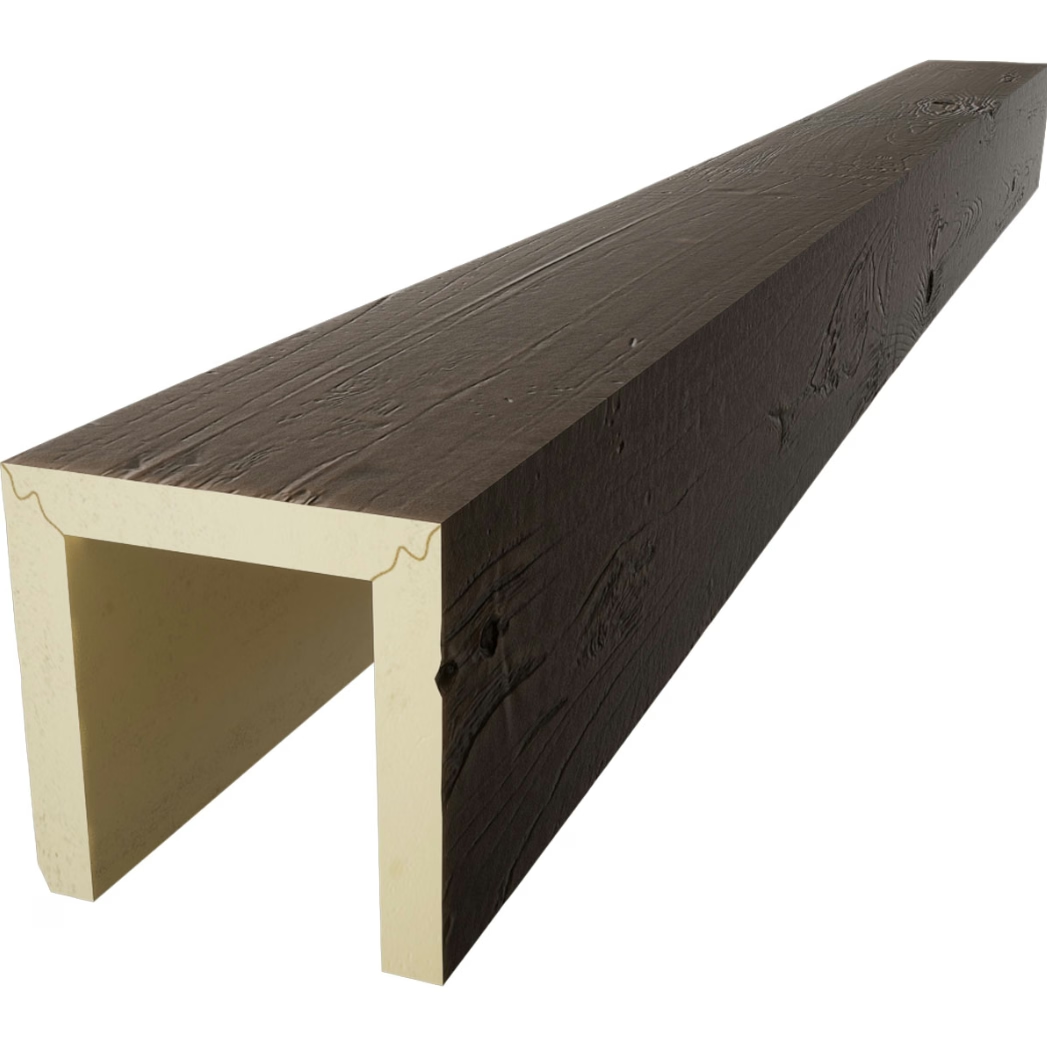
Common pitfalls in public tender beam procurement
One of the most common pitfalls is submitting a bid with documentation that does not quite match the specification. A test report from a non-accredited lab, a certificate that is past its expiration date, or a sample that does not match the technical data sheet can all lead to disqualification on technical grounds. The cure is careful document review before submission, ideally by someone who has bid on similar projects before.
Another pitfall is underestimating the production lead time for fire-retardant beams. The two to four week additional lead time compared to non-rated products can be significant on a tight public project timeline. Contractors who assume standard lead times may find themselves unable to deliver on schedule, triggering liquidated damages or other penalties. Building the extended lead time into the project plan from the start avoids this risk.
A third pitfall is failing to verify that the supplied product matches the tested formulation. A factory may have a current test report on a "FR-200" formulation, but if the production line is currently running a slightly different "FR-200B" formulation, the documentation may not technically cover the shipped product. Confirming the formulation match in writing before shipment is a small step that prevents a much larger problem at project acceptance.
Quality assurance during production and after delivery
For sensitive public projects, third-party inspection during production is a worthwhile investment. An inspector from a recognized agency like SGS, Bureau Veritas, or Intertek visits the factory during the production run, verifies that the formulation matches the tested product, checks the finish quality, and confirms that the packaging meets the shipping requirements. The inspection report becomes part of the project documentation and provides an independent verification that the delivered product is what was specified.
After delivery, the beams should be inspected again on site before installation. This is a standard quality control step on public projects and catches any damage that occurred during shipping. Beams with damaged finishes, incorrect dimensions, or visible manufacturing defects should be quarantined for review before installation proceeds.
Working with international public tenders
International public tenders add another layer of complexity. Documentation may need to be translated, legalized through consular processes, or apostilled for use in the destination country. Payment terms may involve letters of credit rather than straightforward wire transfers. Shipping terms may require DDP (delivered duty paid) rather than the more common FOB (free on board).
Suppliers experienced in international public tender work can navigate these requirements routinely. Those new to it should expect a learning curve and budget time accordingly. Engaging a customs broker and a freight forwarder familiar with the destination country's requirements is also worthwhile for first-time international public tenders.
Fire-retardant PU faux wood beams have proven themselves in public tender projects around the world. The product category is mature, the documentation is well understood, and the supply chain is reliable. The path to a successful public tender bid is straightforward: identify qualified suppliers early, build relationships before specific projects come up, maintain current documentation, and verify every detail before submission. With those pieces in place, the procurement process is manageable even for contractors new to public sector work.
Technical References
ASTM standards cited in every specification
Test Data
Lab results from internal testing program
Updated 2026
Reviewed against current product specs