
Public spaces occupy a particular niche in the decorative beam market. They need to feel welcoming and warm, like a place where people want to spend time. They also need to satisfy strict fire safety codes because the occupant loads are typically high, the users may include vulnerable populations, and the buildings are often subject to scrutiny from multiple regulatory authorities. The aesthetic and the safety requirement can feel like they are pulling in opposite directions, but they do not have to.
Fire-retardant safety grade PU faux beams are specifically designed for this kind of project. They carry the documentation that building inspectors need, the visual character that designers want, and the installation efficiency that contractors appreciate. Understanding how the safety grade designation differs from standard fire-retardant products helps specifiers choose the right product for each public space application.
What "safety grade" means in the beam industry
The phrase "safety grade" gets used in different ways by different manufacturers. In the most rigorous sense, it refers to a fire-retardant formulation that meets specific standards for both flame spread and smoke development, with additional testing for toxic gas emissions. The formulation is typically produced under stricter quality control than commodity fire-retardant products, with batch testing and traceability documentation.
Some manufacturers use "safety grade" to mean a product that has been tested to multiple international standards rather than just one. A beam that is rated ASTM E84 Class A in the US, EN 13501-1 B-s1-d0 in Europe, and GB 8624 B1 in China is more rigorously tested than a beam with only one rating, and the "safety grade" designation reflects that broader compliance.
The practical implication is that a safety grade beam can be specified on projects in multiple jurisdictions without requiring separate test reports or equivalency arguments. For international procurement or for projects that may be expanded or replicated in other markets, this is a significant advantage.
Public space types that benefit most
Libraries are a natural fit for fire-retardant faux beams. The reading rooms in modern libraries often feature high ceilings that can feel cavernous without overhead treatment. Faux beams break up the ceiling plane, improve acoustics by scattering sound reflections, and add visual warmth that makes the space feel more intimate and welcoming. The fire rating is essential because libraries are public assembly occupancies under most codes.
Civic centers and community halls use faux beams to soften large multipurpose spaces. A wedding reception, a public meeting, or a corporate event all benefit from the warmer aesthetic that timber-look ceilings provide. The fire rating allows the same space to be used for many purposes without code concerns.
Museums and cultural centers use decorative beams to create themed environments. A natural history museum might use reclaimed-timber-look beams in an exhibit hall, while a contemporary art museum might use clean-lined beams in a more modern finish. In both cases, the fire-retardant rating allows the design vision to be realized without code conflicts.
Religious buildings, including churches, temples, mosques, and synagogues, frequently feature exposed timber as a design element. For new construction or renovation projects where real timber would be cost-prohibitive or structurally impractical, fire-retardant faux beams provide a code-compliant alternative that preserves the visual character.
Hospitals and healthcare facilities
Healthcare facilities have particularly strict fire safety requirements due to the mobility limitations of some patients. Faux beams in healthcare settings are typically used in non-clinical areas such as lobbies, waiting rooms, cafeterias, and administrative corridors. The fire-retardant rating is essential, and the low-smoke characteristic of a well-formulated product is particularly valued in these environments.
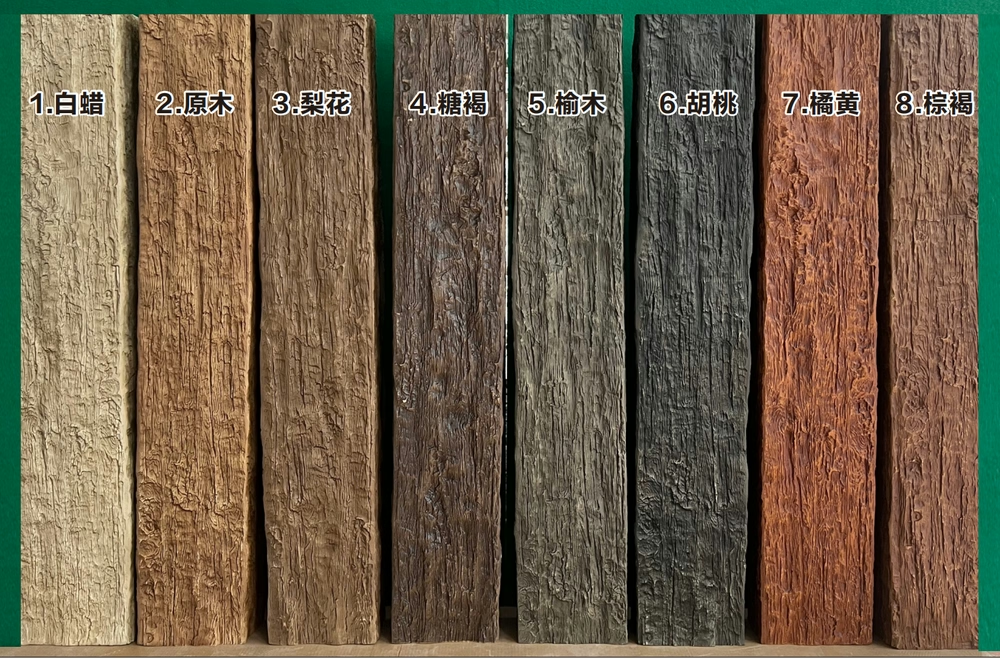
Healthcare design also tends to favor lighter, more contemporary finishes than some other public space types. Faux beam manufacturers typically offer a range of finishes from rustic reclaimed timber to clean contemporary oak, and the safety grade products are usually available across the full finish range. This allows designers to specify the appropriate aesthetic without compromising on the fire performance.
Installation considerations in public spaces
Public space installations often have logistical constraints that residential projects do not. Work may need to be done during off-hours to avoid disrupting occupants. Installers may need to coordinate with multiple trades working in the same space. The ceiling substrate may be unusual, particularly in renovation projects where the existing structure is being preserved.
Fire-retardant faux beams handle these constraints well. The lightweight construction means a two-person crew can handle most installations without heavy lifting equipment. The hollow shell design allows wiring and other services to be routed through the beams when needed. The pre-finished surface eliminates on-site finishing work, which reduces both the installation time and the disruption to building occupants.
For projects with very tight installation windows, some manufacturers offer pre-assembled beam modules that include the mounting hardware and the lighting integration. These modules arrive on site ready to be lifted into place and secured, reducing the on-site labor to a few hours per module. The premium for pre-assembly is offset by the labor savings and the reduced disruption to building operations.
Working with public sector procurement
Public sector procurement typically requires competitive bidding, even for materials supplied under larger construction contracts. The beam supplier needs to be able to provide the documentation package quickly when a bid opportunity arises, and the pricing needs to be competitive with other suppliers in the market.
Suppliers that specialize in the public sector segment of the beam market typically maintain template documentation packages that can be customized for specific projects. They also maintain pre-negotiated framework agreements with public agencies in some regions, which streamlines the procurement process for both the agency and the contractor.
For first-time public sector suppliers, getting on the approved vendor list of major agencies is a worthwhile long-term investment. The process typically involves submitting company information, financial statements, product documentation, and references from previous projects. Once on the list, future bids are faster to prepare and the agency has a baseline of confidence in the supplier's reliability.
Maintenance and lifecycle considerations
Public spaces typically have longer building lifecycles than private commercial spaces, and the materials used need to perform well over decades rather than years. Fire-retardant faux beams have a service life of 20 to 30 years or more in typical interior conditions, with the finish gradually aging rather than deteriorating.
Maintenance is minimal. Occasional dusting or wiping with a damp cloth is sufficient for routine cleaning. The closed-cell foam does not absorb moisture, so spills and stains can be cleaned without leaving permanent marks. The fire-retardant properties do not degrade with age under normal interior conditions, though they can be affected by prolonged exposure to high humidity or direct weathering, neither of which applies to typical interior public space installations.
For very long service life, some public agencies specify a periodic inspection of fire-retardant materials as part of their building maintenance program. The inspection is typically a visual check for damage, finish wear, or any sign of degradation. Beams that pass inspection continue in service. Beams that show significant wear or damage can be replaced individually without disturbing the surrounding installation, which is a significant advantage over solid timber replacements.
Fire-retardant safety grade PU faux beams represent the intersection of aesthetic ambition and regulatory compliance in public space design. They allow designers to specify the warm timber look that makes public spaces feel welcoming while satisfying the fire safety codes that protect the occupants. For agencies and contractors working on public sector projects, sourcing from manufacturers with current documentation and a track record in this segment is the most reliable path to a successful installation.
Technical References
ASTM standards cited in every specification
Test Data
Lab results from internal testing program
Updated 2026
Reviewed against current product specs


