
Industrial spaces used to be purely functional, with exposed steel trusses, fluorescent lighting, and concrete floors. That has changed. Manufacturers, distributors, and logistics companies have learned that the work environment affects productivity, and a more welcoming space tends to attract and retain better workers. As a result, industrial interiors are increasingly incorporating design elements that used to be reserved for offices and retail spaces.
Decorative ceiling beams are part of that trend. A factory break room with timber-look beams overhead feels different from one with bare metal decking. A distribution center office with warm overhead treatment reads as a place where the company has invested in its people. Even warehouse showrooms, where customers tour the facility and inspect the inventory, benefit from a ceiling that suggests quality and care.
For these applications, the beams need to do more than look good. They need to handle industrial conditions, meet fire safety codes that are often stricter than commercial standards, and hold up to the kind of incidental contact that happens in working environments. Flame resistant industrial grade polyurethane faux timber beams are designed specifically for this combination of demands.
What "industrial grade" means in the beam context
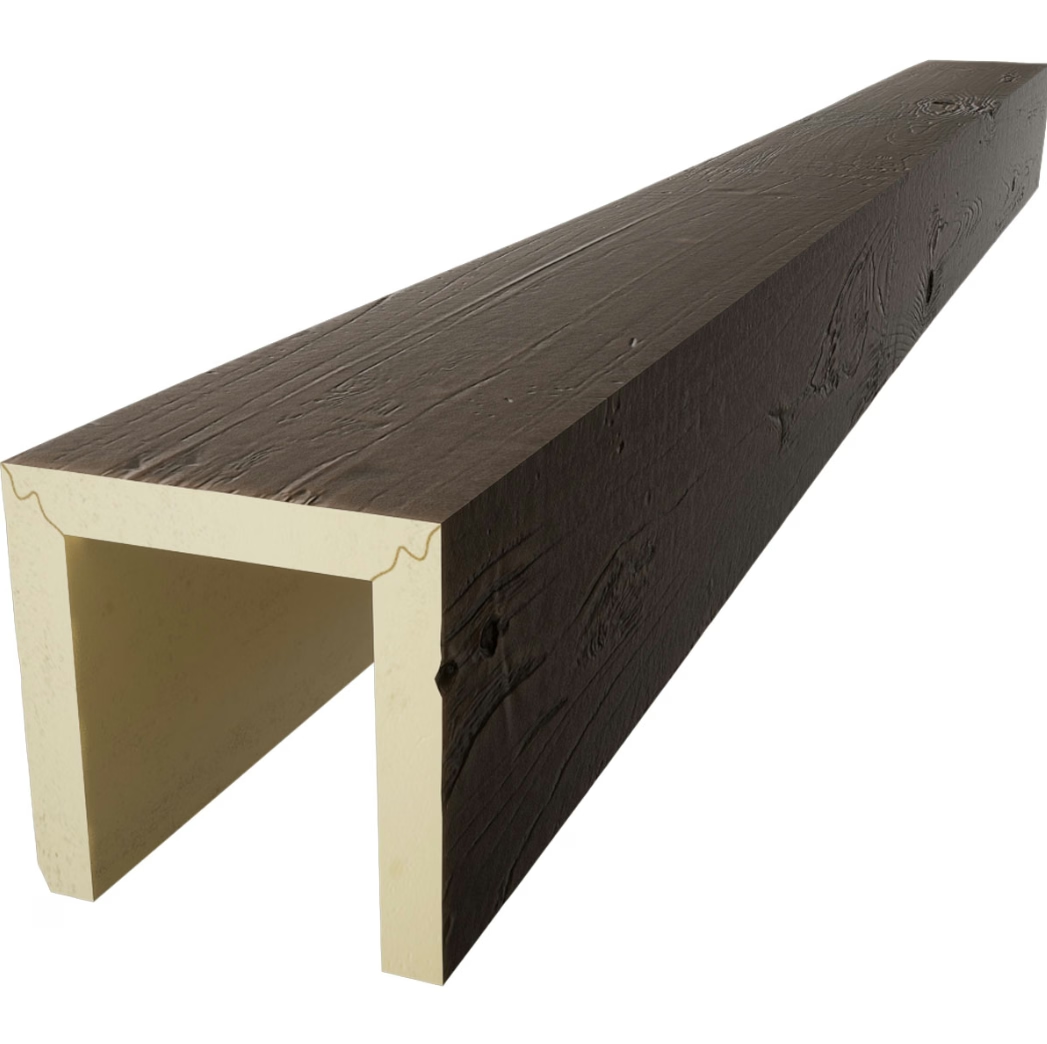
The phrase "industrial grade" is used loosely in many product categories, but in the PU beam industry it has specific implications. Industrial grade beams typically have a higher density foam formulation than standard decorative beams, with thicker shell walls and more robust internal structure. The result is a beam that resists impact damage, holds its shape under thermal cycling, and supports heavier loads than a standard residential-grade product.
The fire resistance is also typically a step above standard commercial fire-retardant products. Industrial occupancies often fall into the highest hazard categories under fire codes, with requirements for Class A flame spread and low smoke development. The foam formulation includes higher loadings of fire retardant additives to meet these stricter requirements.
The finish system on industrial grade beams is also more durable than on standard products. Industrial environments may have higher humidity, more dust, and more frequent cleaning than commercial interiors. The topcoat formulation is designed to resist these conditions without degrading or losing its protective properties.
Industrial applications for decorative beams
Factory and manufacturing facility offices are an obvious application. These spaces often have higher ceilings than commercial offices, and the industrial context suggests a heavier, more structural aesthetic. Faux timber beams fit naturally into this environment, providing visual weight and warmth without the maintenance requirements of solid timber.
Break rooms, cafeterias, and employee gathering spaces in industrial facilities are another common application. These are the spaces where companies try to create a more relaxed atmosphere for workers, and decorative overhead treatments help achieve that goal. The beams are typically installed in patterns that suggest structural timber framing, reinforcing the industrial aesthetic while providing the warmth of a residential-style finish.
Distribution center offices and conference rooms have become more common as logistics companies invest in their corporate infrastructure. These spaces often feature a blend of industrial and commercial design elements, with exposed structure and decorative finishes coexisting in the same room. Faux beams bridge the two aesthetics, suggesting both industrial heritage and design intentionality.
Warehouse showrooms, where customers visit the facility to inspect products or tour the operation, benefit from the same design treatments as retail showrooms. A ceiling that looks like solid timber overhead conveys quality and permanence, even in a working warehouse environment. The fire rating satisfies the code, and the lightweight construction makes installation practical even in buildings not designed for heavy ceiling loads.
Fire safety in industrial occupancies
Industrial occupancies are typically classified as Group F or Group H under most building codes, with the specific subclassification depending on the materials handled and the processes performed. The fire safety requirements for interior finishes in these occupancies vary based on the subclassification, but they tend to be stricter than for commercial or residential occupancies.
A standard manufacturing facility with low-hazard materials (Group F-1 or similar) typically requires Class B or Class A finishes in occupied areas. A high-hazard manufacturing facility handling flammable liquids or combustible dust (Group H or similar) may require Class A finishes throughout, including in non-production areas like offices and break rooms. The specific requirements depend on the local code and the nature of the industrial operation.
For industrial projects, working with a fire protection engineer during the design phase is essential. The engineer can advise on the specific fire performance requirements for the occupancy type, the appropriate beam classification, and any additional fire protection measures that may be needed. The beam specification should be coordinated with the engineer's recommendations from the start.
Installation considerations in industrial settings
Industrial settings present some installation challenges that are less common in commercial or residential work. Ceiling heights are often higher, requiring scaffolding or lift equipment to install beams at 20 or 30 feet. The ceiling structure may be exposed steel trusses rather than wood joists, requiring different mounting hardware and techniques.
For high ceiling installations, the beam weight becomes a more significant factor. Even lightweight PU beams can be challenging to maneuver at 25 feet on a scissor lift, and the installation crew needs to plan for safe handling. Pre-assembled beam modules that can be lifted into place as a unit are often more practical than installing individual components at height.
For exposed steel structure ceilings, the mounting approach typically involves beam clamps or welded attachments to the steel members. The PU beam shell is then secured to the structural supports with brackets or screws. The foam shell does not bear any structural load; it is a decorative cover over the actual support structure.
Maintenance in industrial environments
Industrial environments expose ceiling beams to conditions that would be unusual in other settings. Dust accumulation, temperature cycling, occasional impact from equipment, and more frequent cleaning all affect the long-term appearance of the beams.
Closed-cell PU foam does not absorb moisture, so humidity and occasional water exposure do not affect the substrate. The finish system is designed to resist dust accumulation and to allow cleaning without damaging the surface. A periodic wipe-down with a damp cloth is usually sufficient for routine maintenance.
For environments with very high dust levels, such as wood processing facilities or grain handling operations, the beams may require more frequent cleaning. The finish system should be specified to handle the specific cleaning chemicals used in the facility, and the manufacturer should confirm compatibility before installation.
For environments with significant temperature cycling, such as unheated warehouses in cold climates, the foam formulation should be verified for low-temperature performance. Standard PU foam can become more brittle at very low temperatures, which may affect impact resistance. Industrial grade formulations typically include additives that improve low-temperature performance.
Sourcing industrial grade beams
The sourcing process for industrial grade beams is similar to commercial grade sourcing but with additional considerations. The fire rating documentation is more critical, the impact resistance claims should be verified, and the finish durability should be confirmed for the specific environmental conditions.
Most PU beam manufacturers offer industrial grade as a premium option within their product lines. The premium reflects the higher raw material costs, the additional testing requirements, and the more rigorous quality control procedures. For projects where the industrial grade performance is necessary, the premium is justified by the longer service life and the reduced maintenance requirements.
For very large industrial projects, custom formulations are sometimes developed to meet specific requirements. A manufacturer might adjust the foam density, the fire retardant loading, or the finish system to address particular environmental conditions or performance targets. Custom formulations typically require additional testing and longer lead times, but they can be cost-effective for projects with unique requirements.
Flame resistant industrial grade polyurethane faux timber beams serve a specialized niche in the decorative beam market, but it is a niche that has grown significantly as industrial companies invest in their work environments. The products are well-engineered for the demands of industrial settings, and the manufacturers that supply this segment have the testing and documentation to support the most stringent applications. For designers and contractors working on industrial projects, specifying industrial grade beams from a manufacturer with relevant experience is the most reliable path to a successful installation.
Technical References
ASTM standards cited in every specification
Test Data
Lab results from internal testing program
Updated 2026
Reviewed against current product specs


