Large commercial projects carry a particular kind of risk that smaller residential jobs never face. The sheer volume of materials, the number of crew members involved, the compressed timelines, and the visibility of any mistake all combine to make the consequences of a wrong specification painfully expensive. Wholesale buyers who understand this dynamic use every verification tool available to them before committing to a full production run.
A physical mock-up installation sits at the top of the verification toolkit. It transforms the abstract specification into a real object installed in the actual space where the final product will live. Nothing else delivers the same level of confidence.
What a Mock-Up Installation Includes
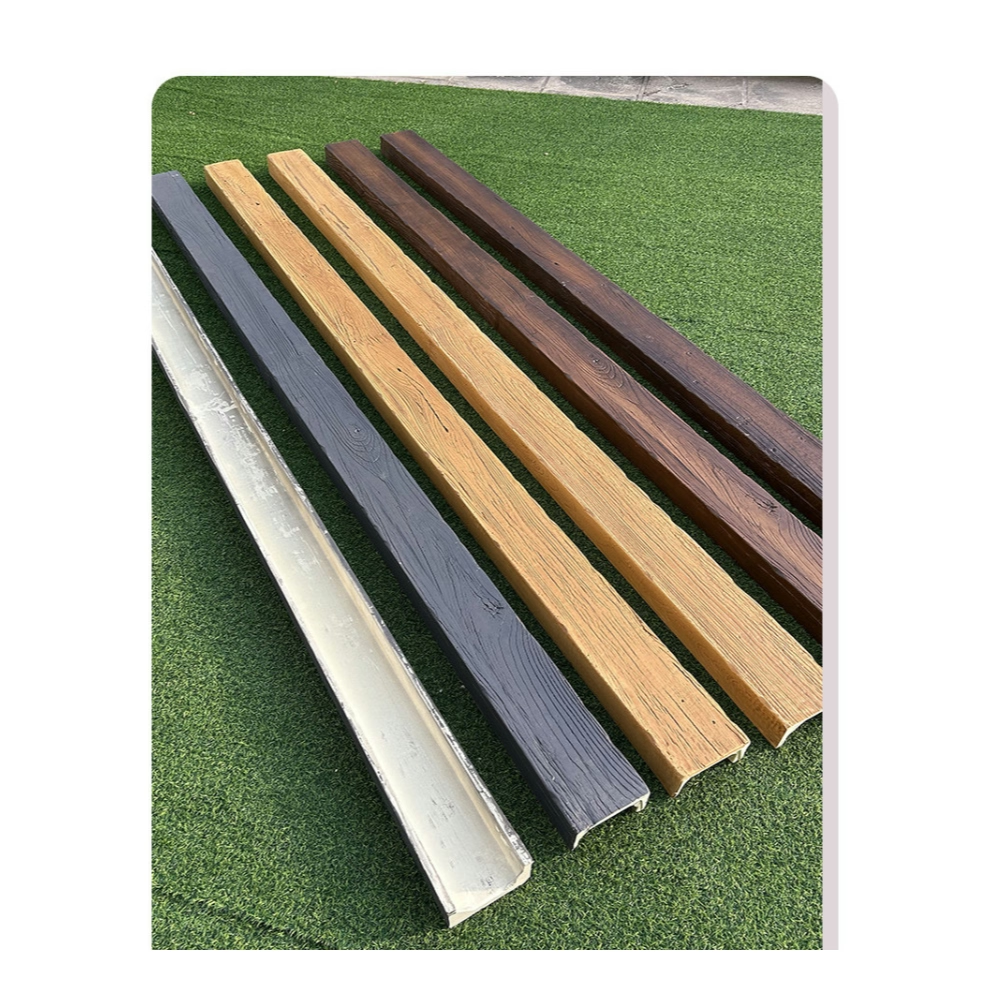
A mock-up, in the building products context, refers to a small-scale installation of the proposed product in the actual project location. For faux beams, this typically means installing one full beam section, or a representative portion of a beam run, in the room or area where the final installation will occur. The mock-up uses the same product, the same finish, the same mounting hardware, and the same installation techniques that the production order will specify.
The mock-up is not a temporary installation. It is built to the same standard as the final product and is usually incorporated into the finished ceiling once approved. This approach saves material because the mock-up becomes part of the order rather than scrap, and it gives the project team a fully finished reference section that demonstrates the installation standard for the crews who will complete the remaining work.
For projects with complex geometry, the mock-up may include a junction detail, a curve section, or a beam-to-beam intersection that represents the most challenging parts of the installation. Tackling these difficult details first allows the project team to refine the techniques before they are needed across the full ceiling.
Why Wholesale Buyers Benefit Most
Wholesale buyers placing bulk orders face a different calculation than retail customers. The order value is higher, the logistics are more complex, and the consequences of a problem are magnified across thousands of linear feet of product. A mock-up installation offers these buyers a way to validate the entire specification chain before committing to that scale of investment.
The mock-up confirms several critical factors simultaneously. The exact profile dimensions are verified against the installed position. The finish color is checked under the actual lighting conditions of the space. The texture density and grain pattern are evaluated at the viewing distances that guests or occupants will experience. The mounting method is tested against the actual ceiling structure, including any irregularities or obstructions that drawings alone do not reveal.
For international buyers, mock-ups serve an additional purpose. The sample provides confidence that the product specification matches what the buyer expected when the order was placed, despite the distance and time zone differences that make detailed technical communication more challenging. Seeing the product installed in the local environment bridges the gap between the buyer's expectation and the supplier's delivery.
The Process from Request to Approval
Requesting a mock-up installation typically begins with a conversation between the buyer's project team and the manufacturer's specification or project management staff. The conversation covers the project scope, the proposed timeline, the specific beam profiles involved, and the location where the mock-up will be installed.
Once the request is approved, the manufacturer produces one or two representative beam sections and arranges shipment to the project site. Shipping timelines for mock-up material are usually shorter than for full production runs, because the quantity is small and the manufacturer often has appropriate lengths in stock or can cut them quickly from production tooling.
Installation of the mock-up is typically performed by the project contractor or by a specialized installation crew arranged through the manufacturer. The installation follows the proposed method exactly, including the mounting brackets, the fasteners, the adhesive if used, and the seam treatment. The crew documents the installation with photographs and notes that become part of the project record.
After installation, the mock-up is reviewed by the project stakeholders, which usually includes the architect, the interior designer, the contractor, the client, and sometimes a representative from the local building authority if the project requires sign-off. The review focuses on whether the mock-up meets the specification and whether any adjustments are needed before the full order proceeds.
Common Issues Uncovered by Mock-Ups
The value of the mock-up process lies in catching problems while they are still small and inexpensive to fix. Several recurring issues surface during mock-up reviews, and each one illustrates why the verification step pays for itself many times over.
Ceiling irregularities are a frequent discovery. Drawings show flat ceilings, but actual construction often includes slight bows, dips, or waves that affect how a straight beam sits against the surface. The mock-up reveals whether shimming or scribing is needed, and how much adjustment the mounting system can accommodate. Without the mock-up, the installer discovers these issues during the full installation, when corrections are far more disruptive.
Lighting interactions are another common concern. The way a beam's texture catches light depends on the lighting fixtures in the space, their beam angles, and the color temperature of the lamps. A beam that looks perfect in the showroom can appear flat or overly busy under the specific lighting conditions of the project. The mock-up allows the design team to evaluate this interaction and adjust either the lighting design or the beam specification.
Color matching across the full ceiling run is sometimes inconsistent in a way that datasheets do not predict. The mock-up may reveal that the chosen finish appears slightly different at one end of the room than the other, depending on the natural light coming through windows or skylights. Adjusting the finish formula before full production is a simple change. Adjusting it after installation requires refinishing the entire ceiling.
Mounting details occasionally reveal structural issues. The ceiling structure may not be able to support the mounting method originally specified, requiring a different bracket or additional blocking. Discovering this during the mock-up gives the contractor time to install the necessary blocking before the full production arrives, which keeps the installation on schedule.
Cost Considerations for Mock-Up Programs
The mock-up installation itself is typically offered free of charge for qualifying wholesale orders, although the buyer usually pays for the material cost of the mock-up beams, which is credited against the full order when it is placed. This arrangement aligns the manufacturer's interests with the buyer's: the manufacturer wants the order to succeed, so they invest in the mock-up process to ensure that success.
Shipping costs for the mock-up material depend on the destination and the order's eventual shipping method. If the mock-up can be consolidated with the main shipment, the cost is minimal. If the mock-up must be sent separately to meet an early deadline, the shipping cost is higher but still usually modest given the small material quantity.
For very large international projects, some manufacturers offer on-site mock-up supervision, where a factory technician travels to the project location to oversee the installation of the mock-up and to train the local installation crew. This service carries an additional cost but provides a high level of quality assurance for projects where installation precision is critical.
From Mock-Up to Production Order
Once the mock-up is approved, the project moves into full production planning. The specification notes from the mock-up review are incorporated into the production order, along with any adjustments that the review identified. This documentation chain ensures that the production team works from the most current specification, not the original order that may have been revised during the mock-up review.
The mock-up beams themselves become the reference standard for the production run. Color matching, texture depth, profile accuracy, and finish quality are all evaluated against the approved mock-up. If the production run shows drift away from the mock-up standard, the production team catches it in quality control rather than at the project site.
This traceability from mock-up to production is one of the most valuable aspects of the mock-up process. It creates a clear quality benchmark that the entire project team can reference, and it gives the buyer a tangible standard to point to if any disputes arise during the project. The mock-up is no longer just a sample; it is the agreed-upon reference for the entire order.

Technical References
ASTM standards cited in every specification
Test Data
Lab results from internal testing program
Updated 2026
Reviewed against current product specs