French country style is less a fixed design and more a feeling. It is the look of a farmhouse in Provence that has been added to and repaired over four centuries, with original beams darkened by soot from the fireplace and softened by generations of beeswax. The look is warm, lived-in, and unpretentious, and it is one of the more difficult aesthetics to recreate in a new build.
Polyurethane faux beams have become the go-to solution for designers chasing this look in modern construction. The product can carry the color, texture, and slight irregularity of century-aged oak without the weight, the cost, or the engineering challenges of actual reclaimed French timber.

The essential visual vocabulary
A French country interior has three signature beam characteristics that designers try to capture. The first is a sense of age. The wood has darkened. The grain has softened. There may be visible checking along the faces and slight twisting along the length.
The second is a sense of scale. Beams in old French farmhouses are often massive by modern standards because they were structural members carrying the floor above. In a decorative application, this scale is suggested rather than reproduced, typically through 250 to 350 mm deep profiles that read as substantial without overwhelming the room.
The third is a sense of irregularity. Real old beams are not perfectly square or perfectly straight. They have hand-hewn edges, slightly varying widths along their length, and the kind of character that cannot be faked by a perfectly straight modern timber. Quality faux beams simulate this through molded surface texture and edge profile, not just color.
Profile and proportion choices
The most common profile for French country beams is a rough-hewn rectangle, often 200 to 300 mm deep and 150 to 200 mm wide. Heavier sections up to 400 mm deep work in great rooms with high ceilings.
Beam spacing varies with the room. A traditional French farmhouse might have beams every 1.2 to 1.8 meters across the ceiling. In a residential new build, designers often space them more widely, between 2 and 3 meters, to keep the look from feeling busy.
For vaulted or cathedral ceilings, the ridge beam is usually heavier than the cross beams. A 350 mm deep ridge with 250 mm cross beams creates a hierarchy that reads correctly. Corbels at the intersection point add a traditional touch.
In lower-ceiling rooms, a flush-mount beam installed tight to the ceiling rather than dropped below it gives the look of structural members without sacrificing headroom. Modern faux beams work for this because they are hollow and light enough to install directly against the ceiling plane.

Color and finish options
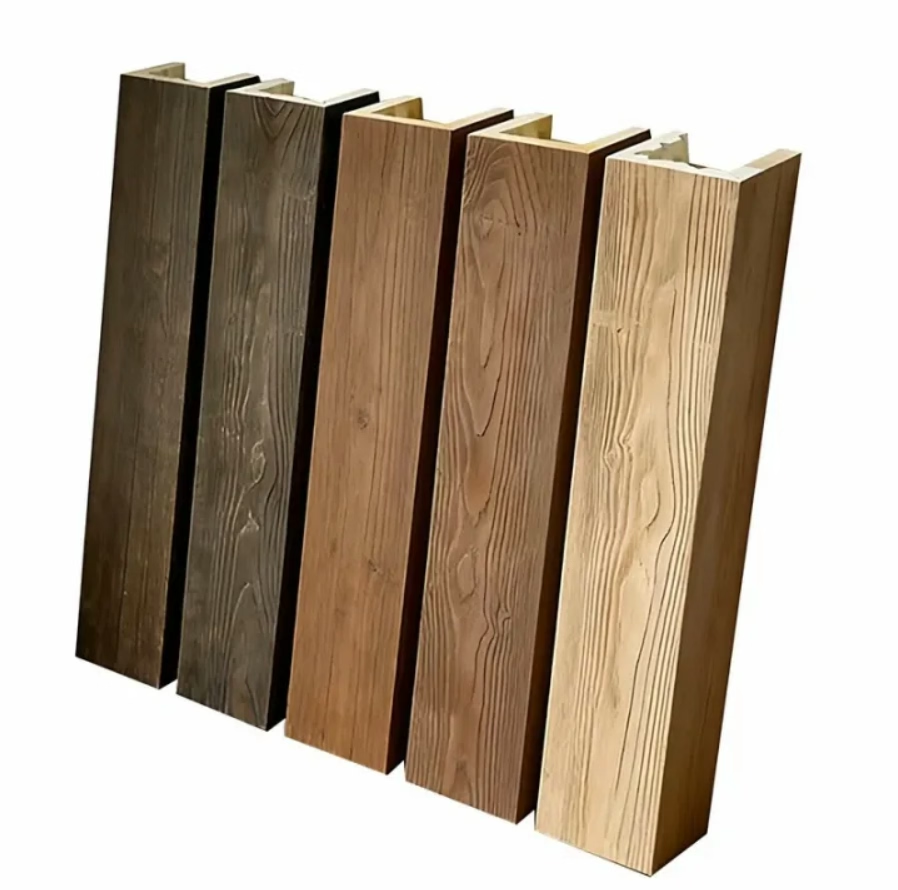
The classic French country palette runs in three families. The first is aged oak, ranging from warm honey brown to a slightly grayed mid-tone. The second is darker walnut or chestnut, often used in more formal country homes. The third is the painted beam, traditionally a soft cream, pale gray, or the warm off-white of limewash.
For most designers, the aged oak look is the safest choice because it works with both rustic and refined interiors. The faux beam should have visible grain pattern, some color variation along the length, and at least one or two areas where the grain looks more pronounced. A perfectly uniform color reads as plastic and breaks the illusion.
Darker walnut beams work well in libraries, dining rooms, and rooms with rich textile patterns. They need careful lighting because they absorb light and can make a room feel smaller if overused.
Painted beams suit country kitchens, bedrooms, and bathrooms where the beam is part of a lighter overall palette. The paint should look slightly worn, with hints of the underlying wood color showing through at the edges.
Pairing with other materials
French country design is built on material combinations. The classic pairings for faux beams include:
Limewashed or plaster walls in soft cream, pale gray, or chalky white. The matte wall surface contrasts with the slight sheen of a finished beam and lets the beam read as the warmer element.
Stone or stone-look floors in limestone, travertine, or locally sourced fieldstone. A faux beam over a stone floor is the visual signature of the style.
Wrought iron or aged brass hardware. Light fixtures, cabinet pulls, and door hardware should pick up the same metallic tone. Mixing too many metal finishes breaks the look.
Natural fiber textiles. Linen, burlap, cotton, and wool in oatmeal, ivory, and faded botanical prints. These soften the harder materials and reinforce the sense of age.
Avoid overly polished materials. High-gloss lacquers, chrome, and acrylic furniture all work against the French country aesthetic.
Specific room applications
In a country kitchen, the most common placement is a grid of cross beams across the ceiling above an island or a dining table. The beam material should harmonize with the cabinetry and the range hood material. A faux oak beam over a stone range hood is a textbook combination.
In a primary suite, faux beams above the bed create a sense of architecture and warmth. A simple treatment with two beams across the ceiling, often painted in a soft cream, is more elegant than a heavy grid.
In a dining room, beams running the length of the room above the table unify the space and create a clear gathering focus. A chandelier hanging in the middle of the beam grid, centered over the table, is the classic detail.
In an entry or foyer, a single heavy beam running across the ceiling at the transition from the entry to the main living space marks the moment of arrival. The beam should feel substantial and slightly oversized for the space.
Avoiding common mistakes
The most common mistake is overdoing the aging effect. Real French country timber is aged, but the aging is subtle. Excessive checking, fake worm holes, and contrived "distressing" reads as costume rather than character. The best faux beams have restraint in the surface texture.
Another mistake is mixing too many wood tones. The faux beams should match or closely harmonize with the wood floors, the cabinetry, and the furniture. Two wood tones in a room is usually plenty. Three or more starts to feel chaotic.
A third mistake is treating the beams as the only design element. They need the supporting cast of appropriate flooring, wall finishes, textiles, and hardware. Beams on their own do not create a French country interior. They are one of several elements that need to work together.
Installation in retrofit projects
French country style is often the goal of a remodel rather than a new build. In retrofit projects, the beams usually need to span across existing ceiling finishes without major demolition.
Faux beams are ideal for this because they install against the existing ceiling or soffit with light-gauge blocking rather than requiring structural modification. A typical 250×200 mm beam in polyurethane weighs around 6 to 8 kg per meter, so a 5-meter span installs easily with two installers and a few drilled anchors.
Electrical and lighting integration is straightforward. Low-voltage cabling for recessed lights between beams runs through a small channel cut into the back of the beam before mounting. Surface-mount conduits or wire mold painted to match the wall can handle most retrofit wiring without major drywall work.
Why faux timber wins for this style
Reclaimed French oak beams are extraordinary when you can find them and when the budget allows. They are also expensive, often $200 to $400 per linear meter installed for genuine antique material. They are heavy, sometimes 50 to 80 kg per meter, which limits where they can be installed. And they have variable quality that is hard to control.
A well-specified faux beam delivers 80 to 90 percent of the visual impact at a third of the cost and a tenth of the weight. For most residential projects, that is the right trade-off. The remaining 10 to 20 percent of authentic character is something only a purist would notice, and most homeowners are happier with the practical benefits.
For designers specifying French country interiors in 2026, polyurethane faux beams are the standard solution, and the available finishes have improved to the point where even close-up inspection rarely reveals the difference.

Technical References
ASTM standards cited in every specification
Test Data
Lab results from internal testing program
Updated 2026
Reviewed against current product specs

