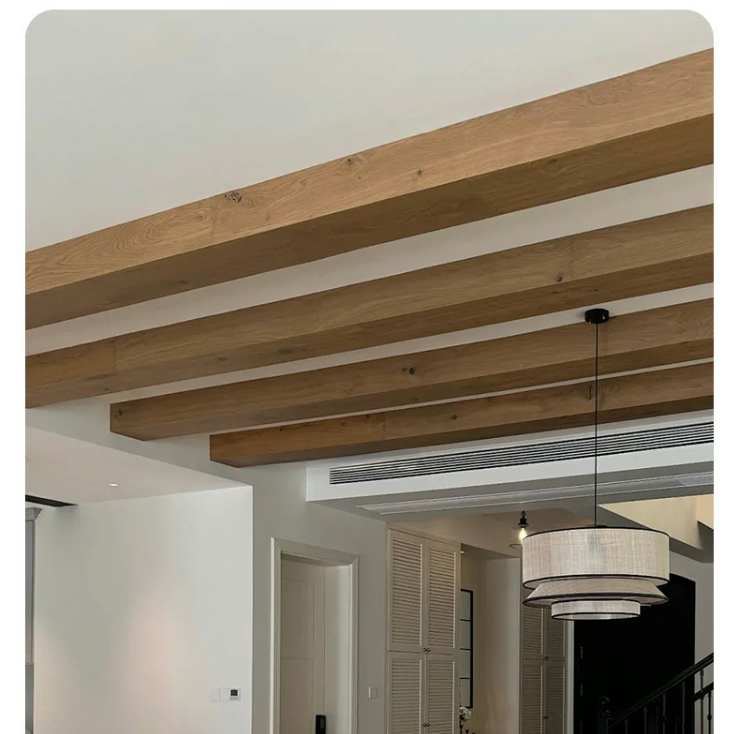
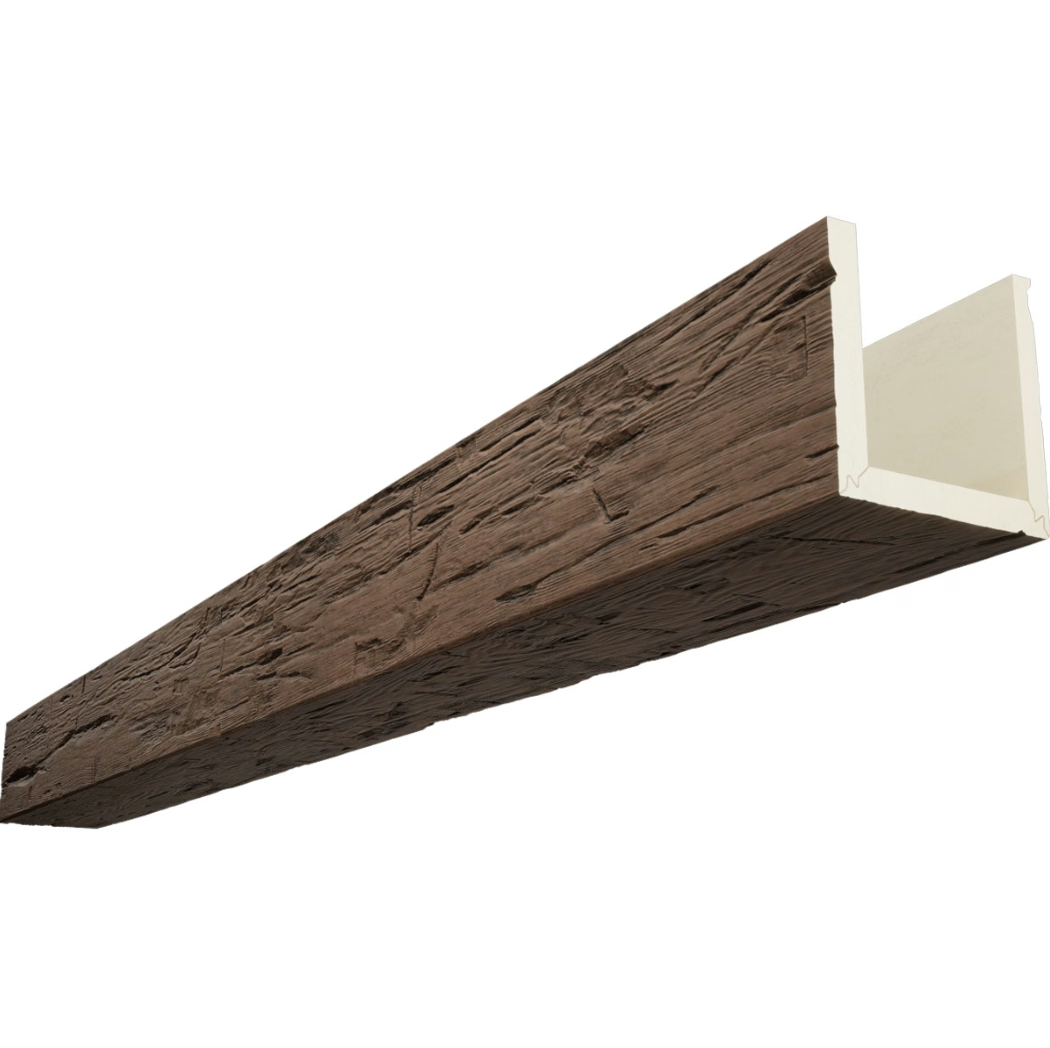
Commercial projects that need exterior-grade polyurethane faux beams typically order in volume. A hotel exterior, a resort porte-cochère, or a multi-building commercial development may need hundreds or thousands of linear meters. At this scale, full container load (FCL) purchasing unlocks meaningful price reductions that change the project economics.
This article walks through how FCL discounts typically work for exterior-grade beams, what a buyer can realistically negotiate, and how to maintain quality while pushing for the lowest unit cost.

Why exterior grade commands a premium
Before discussing discounts, it helps to understand why exterior-grade beams cost more than interior-grade products in the first place.
Exterior-grade polyurethane requires a different formulation. The skin includes higher levels of UV inhibitors and elastomeric additives that allow it to flex at low temperatures. The core uses a higher density closed-cell foam that resists water uptake. The pigment system is designed to chalk predictably rather than degrade.
These formulation upgrades cost more per kilogram than interior-grade materials. The skin is also thicker in most exterior products, which uses more material per linear meter.
Quality control is also tighter for exterior products. Suppliers typically test every production batch for density, skin adhesion, and accelerated weathering. This adds testing cost and production time.
A typical price differential between interior-grade and exterior-grade beams is 25 to 50 percent. The buyer should expect FCL discounts to apply to the exterior-grade base price, not to interior-grade pricing.
How FCL discount tiers typically work
Most suppliers structure their FCL discounts as a tiered system based on container quantity over a defined period, usually a calendar year. The tiers reset annually, so the buyer can plan purchases to maximize the discount.
A typical discount structure for exterior beams might look like:
1 to 4 containers per year: standard FCL pricing (already 8 to 15 percent below small-order pricing) 5 to 9 containers per year: additional 3 to 5 percent discount 10 to 19 containers per year: additional 5 to 8 percent discount 20 or more containers per year: additional 8 to 12 percent discount, with negotiation possible beyond this
The exact structure varies by supplier, but the principle is consistent. Larger commitments earn larger discounts. The buyer should ask for the discount schedule in writing before placing the first order.
Some suppliers offer additional discounts for:
- Multiple-year commitments (lock in pricing for two or three years)
- Cash payment or short payment terms (reducing supplier financing cost)
- Flexible delivery scheduling (allowing the supplier to optimize production)
- Forecast sharing (helping the supplier plan raw material purchases)

Negotiating beyond the published tier
The published discount tiers are the starting point for negotiation. There is almost always room to go further, especially for buyers who can offer the supplier something valuable.
What buyers can offer:
- Volume commitment with a guaranteed minimum
- Multi-year purchasing forecast
- Flexibility on production scheduling
- Willingness to provide reference or testimonial
- Repeat orders with consistent specifications (reduces supplier setup cost)
- Prompt payment (avoiding the supplier's financing cost)
What suppliers may be willing to add:
- Better discount tier than the published schedule
- Free or reduced-cost samples and product development
- Priority production scheduling during peak periods
- Extended payment terms for established relationships
- Exclusive territory or product rights for the buyer
The most successful negotiations trade value for value. The buyer offers something the supplier wants (volume, predictability, low financing cost), and the supplier offers something the buyer wants (better pricing, better terms, better service).
Quality control at volume
The biggest risk in pushing for lower unit cost is quality drift. As the supplier produces more units, the temptation to cut corners or use less expensive materials can grow. A disciplined quality control process prevents this.
The standard tools are:
Incoming material specification: the buyer provides a detailed specification document that the supplier's quality team uses to verify raw materials and finished products.
Pre-production samples: the supplier produces a sample batch before the full production run. The buyer approves the samples before the full run begins.
In-process inspection: the supplier inspects products at various stages of production, not just at the end. The buyer can request to see the in-process inspection records.
Pre-shipment inspection: a third-party inspector (or the buyer's own team) inspects a random sample of the finished goods before they are loaded into the container.
Container loading supervision: the buyer or their representative supervises the container loading to confirm correct quantities, packaging, and securing.
For multi-container orders, not every container needs the same level of inspection. A common approach is full inspection on the first container, reduced inspection on the second and third, and spot inspection on subsequent containers unless issues arise.
Packaging and freight considerations
Volume pricing often includes assumptions about packaging and freight that the buyer should verify.
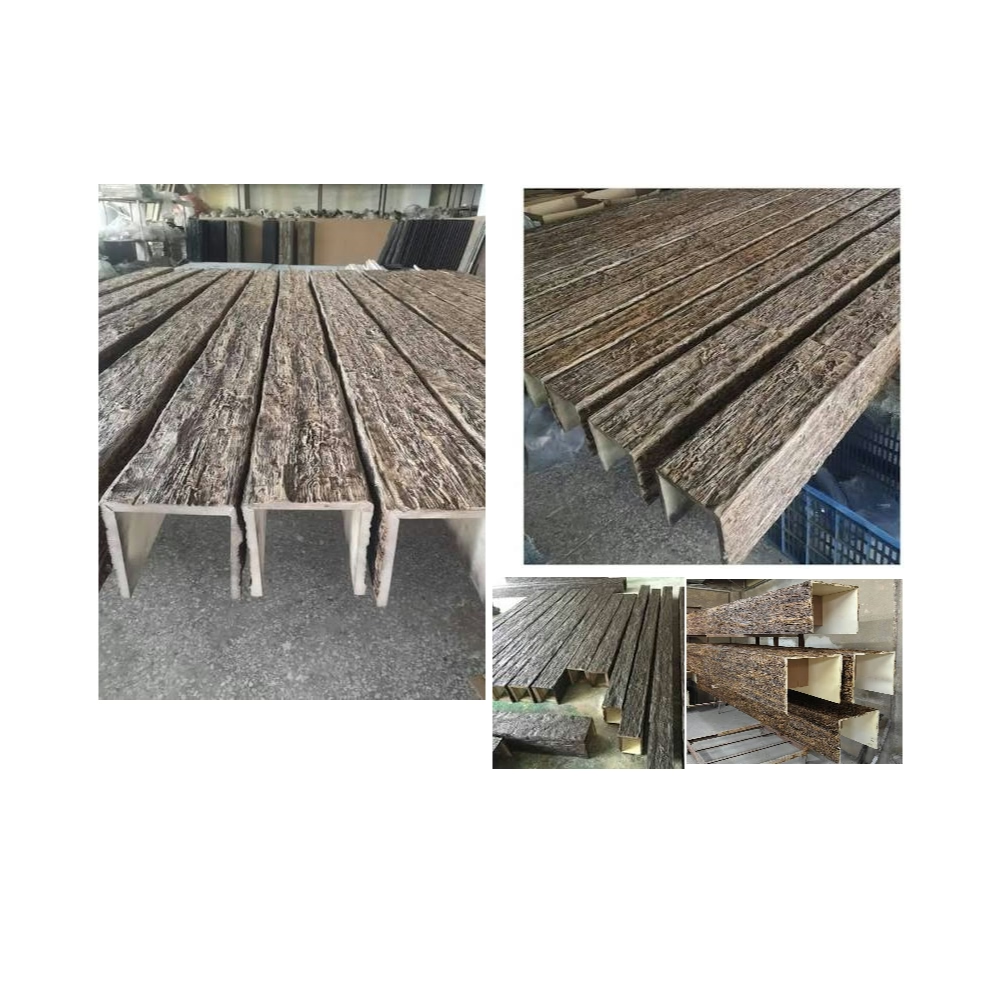
Packaging: at high volume, the buyer may be able to negotiate custom packaging that suits their warehouse handling. This might include specific pallet sizes, labeled bundles, or unique carton markings. The packaging cost should be confirmed as part of the unit price or as a separate line item.
Freight: FCL pricing typically assumes the buyer arranges their own freight. Some suppliers offer CIF or DDP pricing that bundles freight. The buyer should compare the supplier's freight cost to their own forwarder's quote. Sometimes the supplier's freight is competitive, sometimes it is not.
Consolidation: for buyers who purchase multiple products from the same supplier, consolidation in a single container can reduce overall freight cost. A 40HC with beams, brackets, and accessories from the same supplier may have lower freight cost per cubic meter than separate shipments.
Total cost rather than unit price
The lowest unit price is not always the lowest total cost. The buyer should evaluate the full cost of ownership including:
- Unit price of the beams
- Packaging cost
- Tooling or mold amortization (for custom products)
- Freight cost per cubic meter
- Insurance cost
- Customs duties and clearance fees
- Inland transport from port to warehouse
- Inspection cost
- Cost of any quality issues or claims
- Cost of working capital tied up in inventory
A supplier with a slightly higher unit price but better packaging, faster lead time, fewer quality issues, and more reliable documentation may actually have a lower total cost. The disciplined buyer evaluates the full picture.
Common discount structures to watch for
Some discount structures look attractive but include terms the buyer should understand:
Volume rebate: a discount paid after the volume is achieved, usually at year end. The buyer pays full price throughout the year and receives a rebate based on actual volume. This shifts some risk to the buyer.
Tier discount on order size: a discount based on a single order size. The buyer may be tempted to consolidate orders to maximize the discount, which increases inventory carrying cost.
Cumulative discount: a discount based on cumulative volume over time. This rewards ongoing relationships but requires consistent purchasing.
Loyalty discount: an additional discount for buyers who commit to the supplier as their primary source. This usually includes some exclusivity from the supplier in return.
The right structure depends on the buyer's business. A buyer with predictable steady volume benefits most from cumulative discounts. A buyer with project-based purchasing may prefer order-size tier discounts. A buyer who wants the lowest per-shipment price may prefer a volume rebate.
Working with new versus established suppliers
For a new supplier relationship, the buyer should expect to start at the standard FCL pricing tier and grow into better tiers over time. Asking for the highest discount on the first order is unrealistic and may signal to the supplier that the buyer is shopping purely on price.
For an established supplier relationship with a track record, the buyer has leverage to push for better terms. The supplier has invested in the relationship and does not want to lose a good customer to a competitor.
The transition from new to established typically takes 6 to 12 months and 3 to 6 container orders. After this, the buyer can reasonably ask for the next discount tier and additional benefits like better payment terms.
A final note on long-term value
For commercial buyers who need exterior-grade faux beams in volume, the lowest unit price is rarely the right goal. The right goal is a reliable supply of consistent quality product at a competitive total cost, with a supplier relationship that improves over time.
The discount tiers are a framework for getting there, but the discipline of evaluating total cost, maintaining quality standards, and building a long-term relationship matters more than squeezing the last percentage point on unit price.
For buyers who approach FCL purchasing this way, exterior-grade faux beams are a reliable and cost-effective material for commercial projects at any scale.

Technical References
ASTM standards cited in every specification
Test Data
Lab results from internal testing program
Updated 2026
Reviewed against current product specs