A standard beam length works in most rooms, but not all. The great room with a 7.4 meter span. The basement with an unusual ceiling height. The historic renovation where the original beam dimensions are documented and need to be matched. For these projects, custom-sized faux wood beams are the right answer.
Polyurethane is well suited to custom sizing because the manufacturing process can adjust to almost any dimension without major retooling. This article walks through how custom orders work, what they cost, and how to get the result you want.

What "full custom size" actually means
There are several levels of customization in the faux beam market. Understanding the difference helps the buyer communicate clearly with the supplier.
Stock sizes: standard profiles in standard lengths (usually 3, 4, 5, 6 meters) and standard finishes. Available from inventory or with short lead times.
Modified stock: standard profiles cut to a custom length from a stock blank. Most suppliers offer this service with a short additional lead time and a small cutting charge.
Custom dimensions: profiles or lengths outside the standard range. May require special tooling or production scheduling. Higher cost and longer lead time than modified stock.
Full custom: a unique profile, finish, or combination that requires new tooling or a custom mold. The highest cost and longest lead time, but complete design freedom.
For most projects, "full custom size" means modified stock or custom dimensions rather than full custom with new tooling. The distinction matters for both cost and lead time.
Common custom sizing scenarios
The most frequent reasons for custom beam orders:
Non-standard length: the room dimensions do not match standard beam lengths. Common in older homes with unusual room sizes, in custom new builds with specific architectural features, and in renovation projects where existing conditions dictate the dimensions.
Non-standard profile: the design calls for a profile that is not in the supplier's standard range. This may be an unusual depth-to-width ratio, a custom edge profile, or a specific architectural style.
Matching existing timber: a renovation project where the new faux beams need to match the dimensions and appearance of existing structural timber that is staying in place.
Specific architectural requirements: a designer has specified beam dimensions based on a structural engineer's drawing or a specific architectural style.
Custom for a feature element: a one-off beam for a stairwell, an entry feature, or a vaulted ceiling transition.
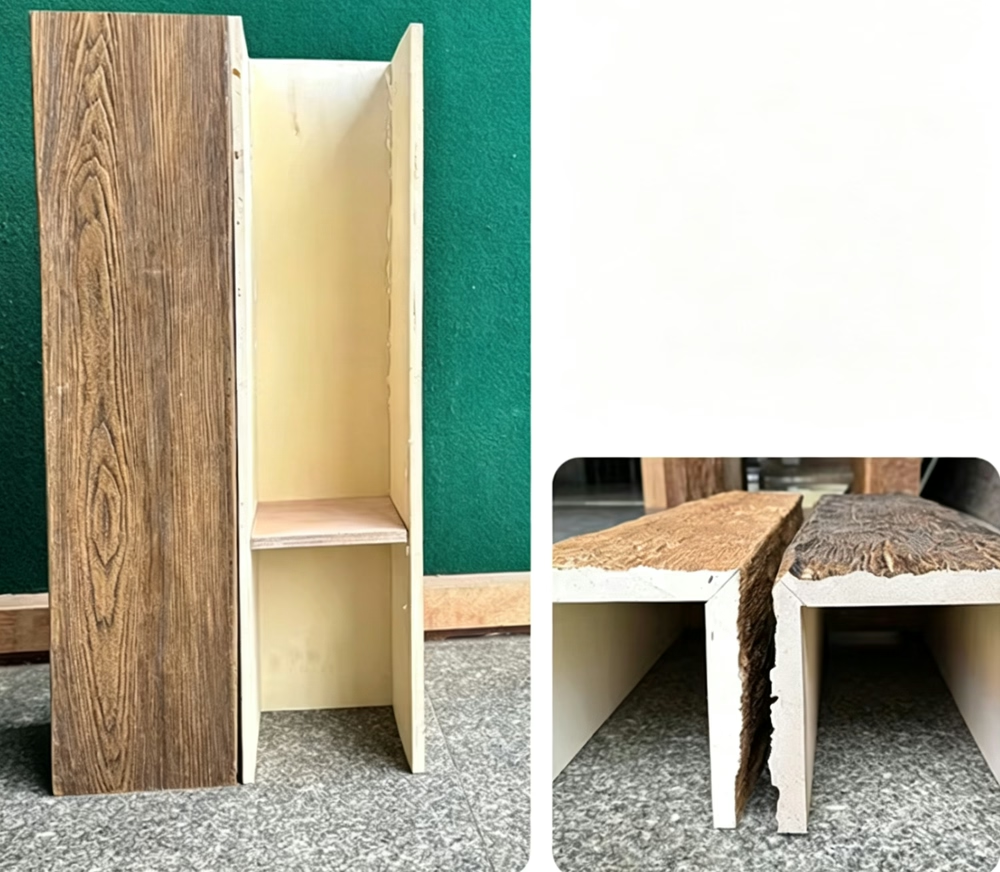
The custom order process
The standard process for a custom beam order:
- The buyer provides dimensions and any reference images or drawings
- The supplier confirms feasibility, price, and lead time
- The supplier produces a sample or a CAD drawing for approval
- The buyer approves the sample or drawing
- Production begins against a deposit
- The supplier produces the order and ships
- The buyer inspects and accepts the goods
For complex custom profiles, a physical sample is essential. Color and finish should be evaluated against a control sample under consistent lighting. A CAD drawing is helpful for confirming dimensions but does not replace a physical sample for surface texture and color.
For simple custom orders (just length, standard profile and finish), the sample step may be skipped if the buyer is familiar with the supplier's standard range.
Tooling and mold costs
For profiles that match an existing mold, there is no tooling cost. The supplier simply adjusts the cut length or produces a non-standard length in the existing mold.
For profiles outside the existing range, a new mold may be needed. Mold costs vary significantly by profile complexity and mold size.
A simple rectangular profile in a new size may cost $500 to $1,500 for the mold. A complex hand-hewn profile with detailed surface texture may cost $2,000 to $5,000 or more. Very large or unusual profiles can cost more.
The mold cost is usually amortized over the first production run or charged separately. For repeat orders, the mold cost is not charged again.
For projects with multiple custom profiles, the buyer should consider whether the mold cost can be shared across profiles that share certain features. Some suppliers offer mold modification rather than full new tooling, which reduces the cost.
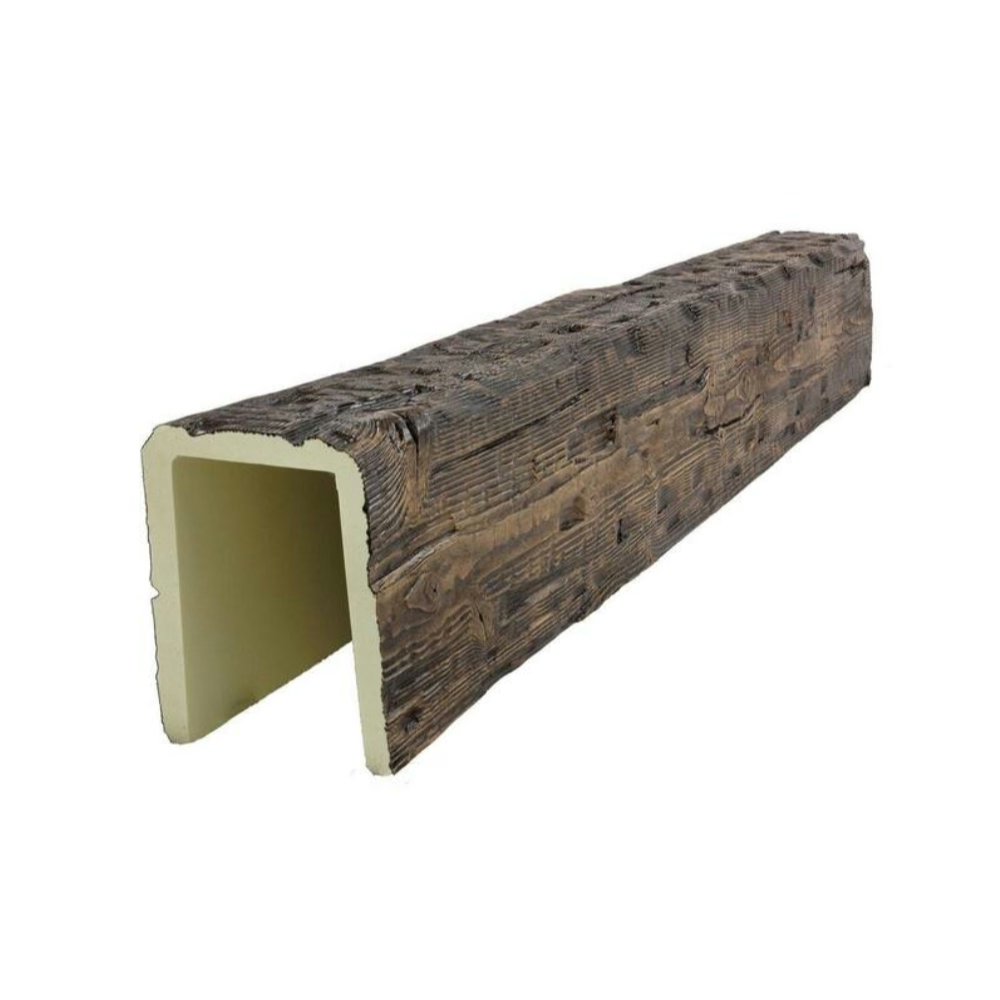
Lead times for custom orders
Custom lead times depend on the complexity of the customization:
Length-only changes from stock blanks: 7 to 14 days.
Custom dimensions using existing molds: 15 to 25 days.
New profile requiring new mold: 30 to 60 days.
Multiple custom profiles in one order: 45 to 90 days.
The buyer should plan custom orders well in advance of the installation date. Rush production is sometimes possible but usually comes at a significant cost premium.
Cost implications
Custom sizing adds cost in several ways. The buyer should understand the cost components:
Unit price premium: custom-sized beams usually cost 10 to 30 percent more per unit than standard sizes. The premium reflects the production inefficiency of running a non-standard order.
Tooling cost: for new profiles, a one-time tooling charge. May be amortized over the first order or charged separately.
Setup cost: a one-time charge for setting up the production line for the custom order. May be included in the unit price for larger orders.
Freight cost: custom-sized beams may pack less efficiently than standard sizes, increasing the freight cost per unit. This is particularly true for very long or very short beams.
Minimum order quantity: some suppliers require a minimum order quantity for custom work. The buyer should confirm this before specifying custom.
The total cost premium for a custom order typically runs 20 to 50 percent above the standard size price. The buyer should weigh this against the value of having the exact size needed.
Quality considerations for custom orders
Quality standards for custom orders should be the same as for standard orders. The buyer should not accept lower quality for a custom product just because it is more complex to produce.
Key quality criteria:
Dimensional accuracy: the custom dimensions should meet the specification within the agreed tolerance. For architectural applications, tight tolerance (1 to 2 mm) is usually required.
Surface finish: the custom beam should match the finish specification exactly. For finishes that match a standard product, the finish should be visually identical.
Structural integrity: the beam should be free of voids, delamination, or other defects that affect strength or appearance.
Consistency across multiple beams: in an order of multiple custom beams, the dimensions and finish should be consistent across all pieces.
The buyer should request samples or control references for any custom work, and should plan a quality inspection before the full production run.
Working with installers
Custom-sized beams often require installer involvement earlier in the process than standard beams. The installer needs to confirm the dimensions, the install sequence, and any site-specific requirements before the beams go into production.
A pre-installation site visit by the installer and the supplier's technical representative is a good practice for complex custom orders. This confirms the dimensions, identifies any installation challenges, and ensures the beams will fit as expected.
For retrofit projects where the existing structure may not be perfectly square, the installer should measure the actual site dimensions rather than relying on the drawings. A small discrepancy discovered during installation can mean a beam needs to be sent back for adjustment.
When custom is the wrong choice
Custom sizing is not always the right answer. The buyer should consider alternatives:
Modified stock: a standard profile cut to a slightly custom length may be available at much lower cost than a full custom order.
Multiple beams: instead of one 7-meter beam, two beams with a joint over a support may work. The joint can be hidden with a corbel or a decorative element.
Field adjustment: a slightly longer beam that is trimmed on site to fit may be cheaper than a custom-cut beam from the factory. The trimmed end is hidden in a joint or against a wall.
Standard sizes with creative layout: a 5-meter and a 3-meter beam with a feature connector may work in a 7.4-meter space at much lower cost than a single custom beam.
The right choice depends on the project. A custom order is justified when the design intent requires a specific dimension and no acceptable alternative exists.
A practical approach to custom beam orders
For most projects, the right approach to custom beam orders is:
- Confirm the design intent and the specific dimensions needed
- Discuss the project with the supplier early to identify the most cost-effective approach
- Get a sample or CAD drawing approved before production
- Order slightly above the required quantity to allow for any damage or measurement errors
- Plan a pre-installation site visit to confirm dimensions
- Build in a buffer in the project schedule for the custom lead time
For projects where the design depends on having exactly the right beam dimensions, custom sizing is the only way to achieve the result. The cost and lead time premium is the price of design integrity.

Technical References
ASTM standards cited in every specification
Test Data
Lab results from internal testing program
Updated 2026
Reviewed against current product specs


