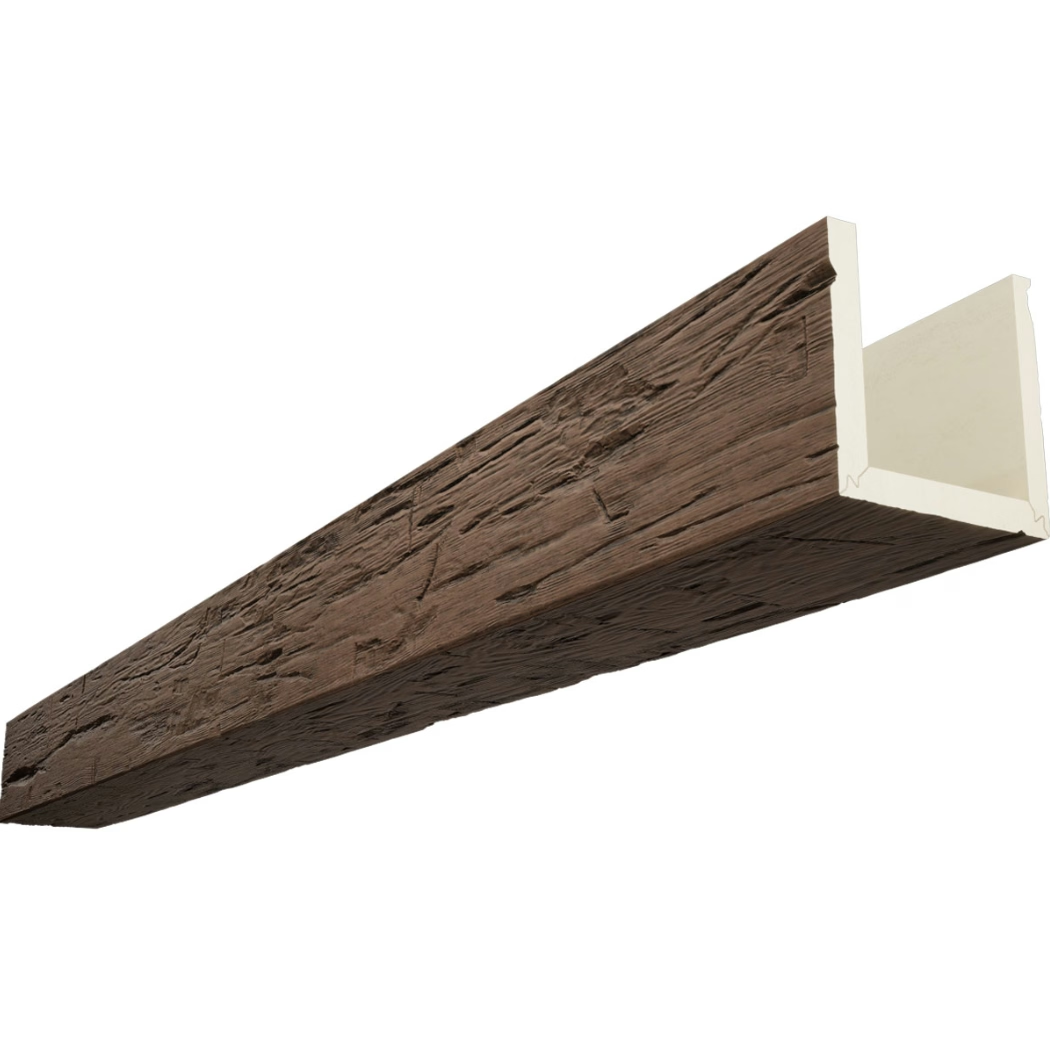
There's a difference between products built for the retail DIY market and products built for working contractors. The retail product is optimized for lowest possible price in a friendly box on a store shelf. The professional product is optimized for what actually happens on a job site — speed of install, consistency between pieces, finish that holds up in the field, and durability that won't generate a callback six months later.
Professional-grade faux wood ceiling beams sit firmly in that second category. They're not always the cheapest option at the supplier, but they tend to be the most cost-effective option by the time the project is wrapped.
What contractors need from a beam product
Contractors think about a product holistically. The unit price is one factor among many. Others include:
Install speed — every minute on a ladder is money. A beam that's faster to install than the competing product pays for its price premium many times over the course of a project.
Finish quality — a beam that arrives with a consistent factory finish saves the contractor from on-site finishing work, which saves labor and eliminates the variables of finishing in imperfect field conditions.
Long-term performance — a beam that holds up for twenty years means the contractor never gets a callback. A beam that fails in three years means the contractor is back on site at no charge rebuilding the relationship with the client.
Available sizes and profiles — a product line with broad selection lets the contractor handle varied project needs from the same supplier. Fewer suppliers, fewer invoices, fewer phone calls.
Lead time and reliability — a product that's in stock and ships on schedule is a product the contractor can count on. Out-of-stock surprises mid-project destroy margins.
Professional-grade beams balance all five of these factors rather than optimizing only on the first.
Speed differences that matter on the job
A typical residential contractor doing a beam project wants to install one beam per hour or faster. That includes layout, mounting hardware installation, beam lifting, securing, and finishing any visible seam.
Stock faux beams can usually hit that pace after the installer learns the system. Professional-grade beams typically improve the pace further through design details:
Pre-installed blocking plates — many pro-grade beams ship with internal blocking plates already positioned at the recommended bracket locations. The installer doesn't have to measure, mark, and secure blocking on site.
Pre-drilled mounting holes — compatible with the manufacturer's recommended bracket system, these eliminate the field drilling step entirely. Faster install, more precise alignment.
Color-matched joining — pro-grade beams ship with color-matched joiner sleeves that make section joining fast and visually clean. Less field finishing time.

Section lengths — the longest available section length per piece directly reduces the number of joins required. Pro-grade products often run to 20 or even 24 feet per section.
The cumulative effect across a multi-beam project is significant. A two-day install becomes a one-day install, which lets the contractor book the next job sooner.
Consistent finish between pieces
Color variation between beams is the single biggest source of customer complaints about faux beam installations. The customer sees one beam in their home that doesn't quite match the next one over, and the visual breaks the spell.
Pro-grade beams are manufactured in batches with very tight color control. Every batch is checked against the master reference, and pigments are adjusted in the production run to stay within tolerance. The result is that batches of professional-grade beams match each other within a fraction of a shade.
Cheaper beams often skip this level of quality control, and the installer finds out the variation the hard way when two adjacent beams look obviously different.
Batching matters for bigger projects
A large project that needs twenty or thirty beams presents a particular challenge — the installer needs every beam to look like it belongs in the same building. If ten of the beams come from one manufacturing batch and the other fifteen come from a later batch with slightly different colorant batches, the building has two visually distinct sets of beams.
Professional-grade manufacturers handle this by running the entire order as a single batch when possible, or by color-matching across multiple batches to maintain continuity. Either way, the goal is consistent appearance across the entire order, which is what the contractor and the client both want.
Field finishing vs. factory finish
Some lower-end faux beams ship with a primer coat that needs a finish coat applied on site after installation. The intent is to let the installer touch up field cuts and to apply the final color in the actual lighting conditions of the room.
In practice, on-site finishing rarely produces results equal to factory finishing. Field conditions aren't controlled, dust gets into the finish, drying conditions vary, and the contractor is spraying or brushing on a ladder rather than in a spray booth.
Professional-grade beams typically ship with the complete finish system already applied — primer, color coat, and clear topcoat, all done under factory conditions. The installer might still do touch-ups on field cuts, but the heavy lifting is done at the factory where it can be done right.
Service and support that professionals need
When a contractor has a question during a project, they need answers fast. Professional-grade suppliers typically maintain customer service that understands contractor workflows — what to do when an order short-ships, how to handle a damaged piece, how to recommend alternative sizes when the spec is just slightly off.
That service layer matters disproportionately. A beam supplier that returns calls and helps resolve problems saves the contractor hours of troubleshooting per project. The relationship matters as much as the product in many cases.
Warranty and standing behind the product
Professional-grade beams typically carry longer and more comprehensive warranties than retail products. Five years is the minimum, ten to fifteen is common, and premium lines can carry twenty-year or limited lifetime warranties on the finish and structure.
The warranty terms matter partly for what they cover but mostly for what they signal. A manufacturer willing to back its products for fifteen years against finish failure has done significant testing to be confident in that promise. A manufacturer offering only one year is signaling that they're not sure how the product holds up beyond that point.
For contractors, the longer warranty is also a sales tool. Being able to tell a client "this beam has a fifteen-year warranty" is a meaningful conversation-closer that distinguishes a contractor from a competitor offering a similar-looking product with shorter backing.
What contractors shouldn't compromise on
A few details in this category are worth pushing back on clients about rather than compromising. Bracket quality, finish consistency between pieces, and proper installation hardware should be specified properly even if it adds cost. The savings from cutting these corners are small relative to the long-term pain if they fail.
Professional-grade products exist because there's real value in doing a job right. Contractors who specify them consistently find that their projects look better, run faster, and generate fewer callbacks than projects done with the cheapest available options. That reputation compounds over a career.
Technical References
ASTM standards cited in every specification
Test Data
Lab results from internal testing program
Updated 2026
Reviewed against current product specs