
Some interior spaces demand precision environmental control that standard building specifications cannot satisfy. Museum galleries maintain temperature and humidity within narrow ranges that protect delicate artifacts. Data centers cool electronic equipment while maintaining conditions that prevent condensation and static discharge. Art restoration studios require environments where minute humidity variations don't affect delicate work. These controlled interior environments place demands on all building materials, including ceiling treatments, that standard interior specifications do not address.
The challenge for materials in controlled environments involves consistency rather than extreme performance. While exterior materials must withstand dramatic environmental variations, controlled interior materials face the opposite challenge: maintaining properties unchanged despite continuous operation of environmental systems that create stable conditions. Materials that perform adequately in standard interiors may behave unpredictably in controlled environments where their subtle responses to environmental factors become significant.
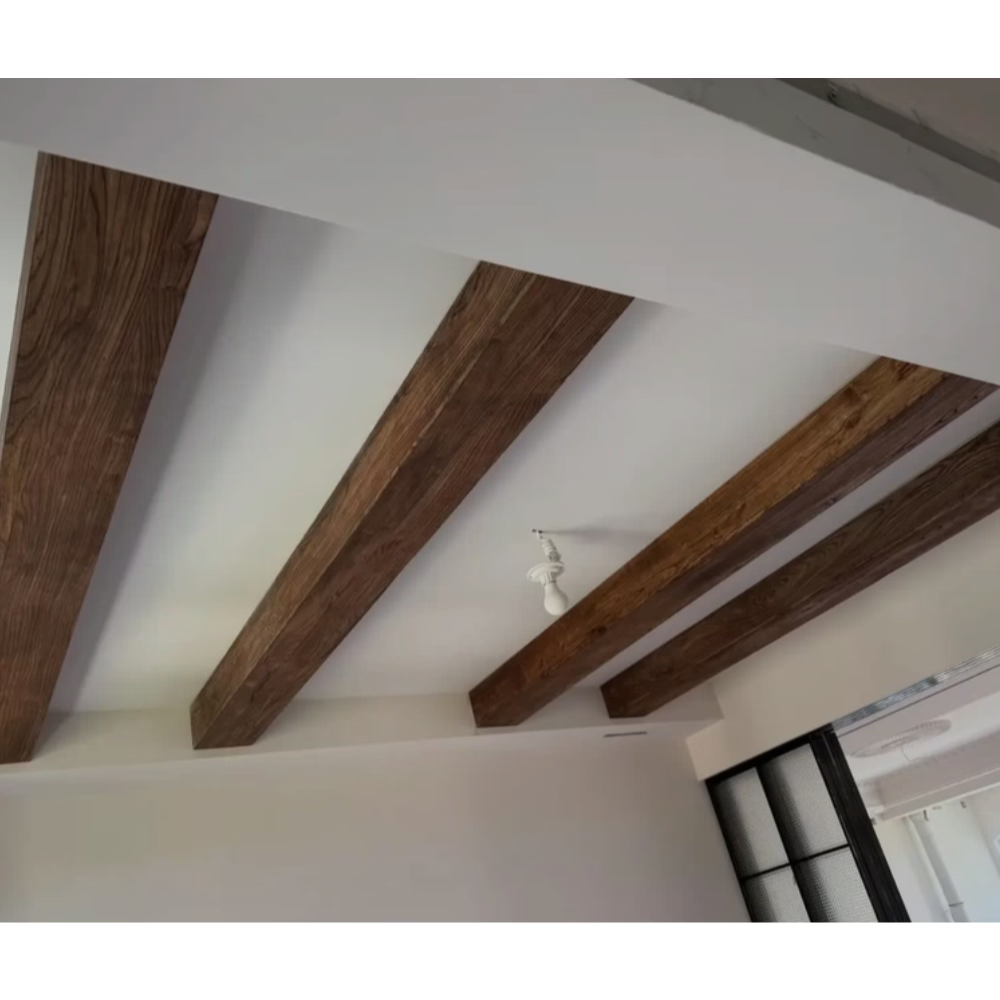
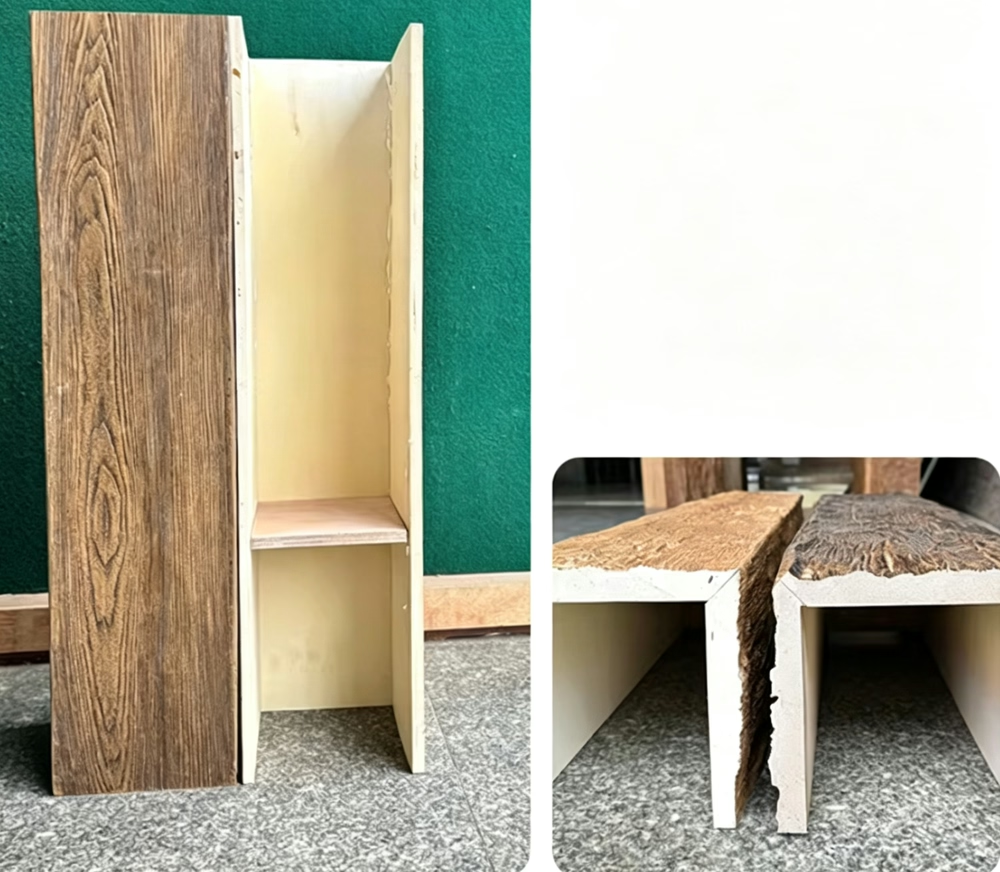
Indoor-only grade polyurethane faux timber beams offer particular advantages in controlled environment applications. The material's inherent stability, minimal response to humidity and temperature variation, and consistent surface properties align well with the precision that these applications require. Understanding these advantages helps architects and engineers select appropriate ceiling treatments for their most demanding interior projects.
Controlled Environment Categories
Museums and galleries represent perhaps the most demanding controlled environment category for ceiling materials. Artifact preservation requirements drive temperature specifications typically ranging from 65 to 75 degrees Fahrenheit with humidity maintained between 40% and 60% relative humidity. These conditions prevent artifact deterioration while creating challenges for materials that respond to even minor environmental fluctuations.
Light sensitivity affects material selection for museum applications beyond the obvious concerns about UV damage. Some materials emit volatile compounds that affect sensitive artifacts over time. Others may outgas or degrade in ways that introduce contaminants into the controlled environment. Polyurethane beams with appropriate emissions certifications address these concerns for museum applications.
Archive facilities and libraries share museum requirements for environmental precision. Document preservation demands humidity control that prevents the paper brittleness that excessive drying causes or the mold growth that elevated humidity encourages. Ceiling materials in these spaces must perform reliably within the narrow ranges that preservation standards specify.
Data Center Considerations
Data center environments present unique material challenges that affect ceiling specification decisions. The continuous operation of cooling systems creates stable but specific temperature and humidity conditions. The high density of electronic equipment generates localized heat loads that may create temperature gradients within the space. Static electricity concerns affect material selection in ways that standard interior specifications do not address.
Electrostatic discharge prevention in data centers favors materials with appropriate surface resistance characteristics. Some materials can accumulate static charge that discharges into sensitive equipment or creates safety hazards. Quality polyurethane's surface properties provide appropriate static dissipation characteristics that prevent dangerous charge accumulation.
Cable management integration affects beam specification in data center environments. The extensive cabling that data centers require often runs overhead in cable trays that beam installations should accommodate. Beam spacing and profile selection should consider cable routing needs without compromising the aesthetic objectives that beam installations pursue.
Healthcare Environment Controls
Healthcare facilities maintain environmental conditions that serve multiple purposes simultaneously. Patient comfort, infection control, equipment operation, and regulatory compliance all influence environmental specifications. These overlapping requirements create conditions that ceiling materials must accommodate without contributing to problems in any category.
Operating rooms and procedure rooms maintain the most stringent environmental controls in healthcare facilities. Positive pressure ventilation, precise temperature control, and stringent air quality requirements protect patients during surgical procedures. Ceiling materials in these spaces must not contribute particles, volatiles, or biological contamination to the controlled environment.
Laboratory spaces within healthcare facilities require similar precision for different reasons. Scientific equipment demands stable conditions for accurate operation. Research involving biological materials, chemical reagents, or sensitive instruments cannot tolerate environmental variations that might affect results. Ceiling materials in these spaces should support rather than compromise environmental precision.
Office Building Environmental Control
Modern office buildings maintain comfortable conditions for knowledge workers whose productivity depends partly on environmental quality. HVAC systems provide temperature control, humidity management, and fresh air ventilation that create productive working environments. These conditions, while less demanding than museum or data center specifications, still affect how ceiling materials perform.
Open plan offices present acoustic challenges that affect material specification. The noise generated by numerous simultaneous workers creates conditions where ceiling treatments contribute meaningfully to acoustic comfort. Polyurethane beams can incorporate acoustic absorption characteristics that improve the acoustic environment while providing the aesthetic benefits that wood appearance creates.
Private offices and meeting rooms require different acoustic treatments than open plan areas. The separation between spaces and the activities occurring within them create varying acoustic requirements that beam installations should address. Design approaches that consider these differences produce better acoustic outcomes than uniform treatment throughout.
Temperature Stability Advantages
Polyurethane's response to temperature variation differs from wood in ways that benefit controlled environment applications. The material's thermal coefficient of expansion runs far lower than wood, meaning dimensional changes with temperature are minimal. This stability prevents the joint movement, surface checking, and appearance changes that temperature cycling creates in natural timber.
Thermal mass affects how materials respond to sudden temperature changes. Heavy materials with high thermal mass change temperature slowly, creating lag between environmental system operation and actual material temperature. Lighter materials reach equilibrium more quickly, responding predictably to system adjustments. Polyurethane's lower thermal mass provides this responsive behavior that controlled environments often prefer.
Heat transfer characteristics affect how beams interact with lighting and other overhead equipment. The thermal insulation properties of polyurethane prevent condensation on beam surfaces when room air contacts cooler surfaces. This condensation resistance proves valuable in spaces where humidity levels approach dew point conditions.
Humidity Response Characteristics
The humidity stability of polyurethane eliminates dimensional changes that affect natural materials in controlled environments. Wood absorbs and releases moisture with changing humidity, creating expansion and contraction that manifests as joint gaps, surface distortion, and finish damage. Polyurethane experiences none of these humidity-related changes, maintaining dimensions and appearance regardless of humidity conditions.
Moisture absorption affects some materials through weight gain, swelling, and property changes. The closed-cell structure of quality polyurethane prevents moisture penetration entirely, eliminating these concerns. This characteristic proves particularly valuable in museums and archives where even minor dimensional changes in ceiling materials might affect artifact positioning or display systems.
Condensation resistance in controlled environments prevents the water droplet formation that creates maintenance problems and potential contamination concerns. The surface temperature of polyurethane beams, affected by both room air temperature and radiation effects from surrounding surfaces, remains unlikely to fall below dew point in properly controlled environments. The non-porous surface also prevents any condensation that might form from penetrating or staining the material.
Air Quality Compatibility
Clean room standards for controlled environments address particulate contamination, airborne molecular contamination, and biological contamination. Ceiling materials in clean room applications must not generate particles, volatiles, or other contaminants that would affect the environmental cleanliness these spaces require.
ISO clean room classifications define maximum contamination levels that materials must help maintain. Polyurethane beams with smooth, non-shedding surfaces and low emissions characteristics support clean room classifications from ISO Class 7 through ISO Class 5 depending on other environmental controls. Higher classification requirements may demand specialized clean room products.
Airborne molecular contamination controls address chemical vapors that affect sensitive processes including semiconductor fabrication and some medical device manufacturing. The outgassing characteristics of polyurethane formulations determine their suitability for these applications. Low-outgassing formulations are available for contamination-sensitive environments.
Specification and Installation Excellence
Successful controlled environment beam installation requires attention to details that standard applications might overlook. Sealing at penetrations, joints, and transitions prevents uncontrolled air leakage that would compromise environmental control. The precision that controlled environments require demands precision in installation execution.
Support systems should not penetrate environmental barriers or create thermal bridges that affect temperature distribution. The engineering of beam support in controlled environments should consider these factors alongside standard structural requirements. Coordination between architectural, mechanical, and structural engineering ensures that support systems support rather than compromise environmental control.
Commissioning and verification testing confirms that beam installations perform as specified in the controlled environment context. Post-installation testing verifies that appearance, dimensional stability, and emissions characteristics all meet requirements. This verification provides documentation that controlled environment operators require.
Technical References
ASTM standards cited in every specification
Test Data
Lab results from internal testing program
Updated 2026
Reviewed against current product specs


