Interior design at its highest level is the art of eliminating the accidental and ensuring that every element of a space contributes purposefully to the overall experience. In this pursuit, the materials chosen for a project must do more than look appropriate in isolation — they must integrate seamlessly with every other material and element in the space, perform consistently across the full scope of the installation, and remain stable and beautiful throughout the life of the project. This level of material performance is what separates a design that feels effortless from one that feels assembled from unrelated components, and it is the standard against which every product in a high-quality interior design specification should be evaluated.
Hollow polyurethane faux ceiling beams have earned their place in sophisticated interior design specifications precisely because they meet these demanding requirements with remarkable consistency. Unlike natural timber, which introduces inherent variability in grain pattern, color, moisture content, and dimensional behavior, polyurethane beam production is governed by processes that deliver predictability without sacrificing the visual warmth and textural richness that make timber-look materials desirable in the first place. This predictability is not uniformity — modern polyurethane beam products achieve convincing authenticity — but rather the assurance that what is specified will be delivered and that what is delivered will perform as expected over time.


Consistency as a Design Tool
The consistency of hollow PU faux ceiling beams is perhaps their most underappreciated quality from a design perspective. When a designer specifies a particular beam profile and finish for a project, the expectation is that every beam delivered will match the sample or specification exactly. With natural timber, this expectation is fundamentally unachievable because each piece of timber is unique, shaped by the specific growth conditions, grain orientation, and seasoning history of the individual tree. The variation between timber pieces may be subtle or pronounced, but it is inherent and cannot be eliminated regardless of how carefully the material is selected.
Polyurethane beam production changes this equation entirely. The manufacturing process uses precision-engineered molds that reproduce the exact profile and surface texture of the original design with each casting. Color is formulated in controlled conditions and applied consistently across all beams in a production run, ensuring that beams installed at opposite ends of a large room or across multiple rooms in a comprehensive project will match with precision. This consistency means that designers can work with absolute confidence in the visual outcome, knowing that the ceiling installation will match their specification throughout the project.
The dimensional consistency of hollow PU beams is equally important for the quality of the finished installation. Natural timber beams, even when carefully manufactured and kiln-dried, will exhibit some degree of dimensional variation as they respond to the humidity conditions of the building. This movement can manifest as gaps at joints, slight misalignment at intersections, or visible changes in beam spacing as humidity levels fluctuate through seasonal cycles. Polyurethane beams maintain their exact dimensions regardless of ambient conditions, ensuring that joint details remain tight and beam spacing remains consistent throughout the life of the installation.
Profile Precision and Design Freedom
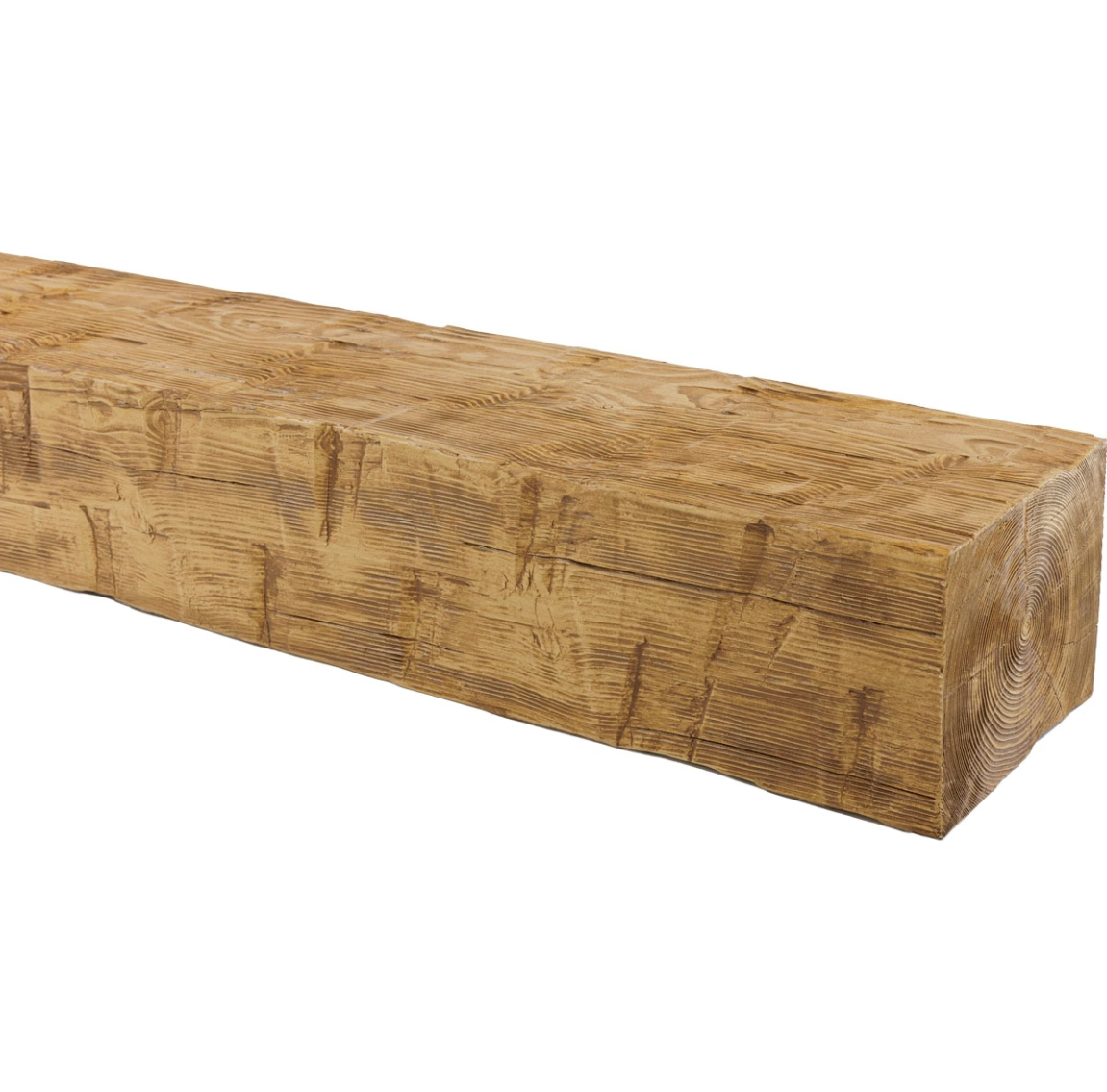
The design vocabulary available in hollow PU faux ceiling beams encompasses a range of profile shapes that would be difficult or impossible to achieve in natural timber. Complex profile curves, compound angles, and intricate detailing can be molded into polyurethane with a precision that exceeds what can be reliably achieved through machining or hand-shaping of natural timber. This manufacturing flexibility translates directly into design freedom, allowing interior designers to specify beam profiles that are precisely tailored to the specific proportions and design character of the space.
Contemporary interior design often favors clean geometric profiles with crisp edges and consistent section dimensions. These profiles are technically demanding to produce in natural timber because the material's natural properties — grain direction, growth irregularities, and drying behavior — can cause subtle but perceptible deviations from the ideal geometric form. Polyurethane's consistent material properties allow for the production of beams that are geometrically precise, with sharp edges, uniform surfaces, and exact section dimensions that read as precisely resolved rather than merely approximate.
The ability to specify custom beam profiles is another dimension of the design freedom that hollow PU beams offer. While manufacturers maintain ranges of standard profiles that cover the most common design requirements, bespoke profiles can be developed for projects with specific aesthetic requirements that cannot be satisfied by standard products. The tooling cost for custom profiles is typically reasonable and is amortized across the beam quantities required for the project, making custom profile development accessible even for projects of moderate scale.
Finish Selection and Application Quality
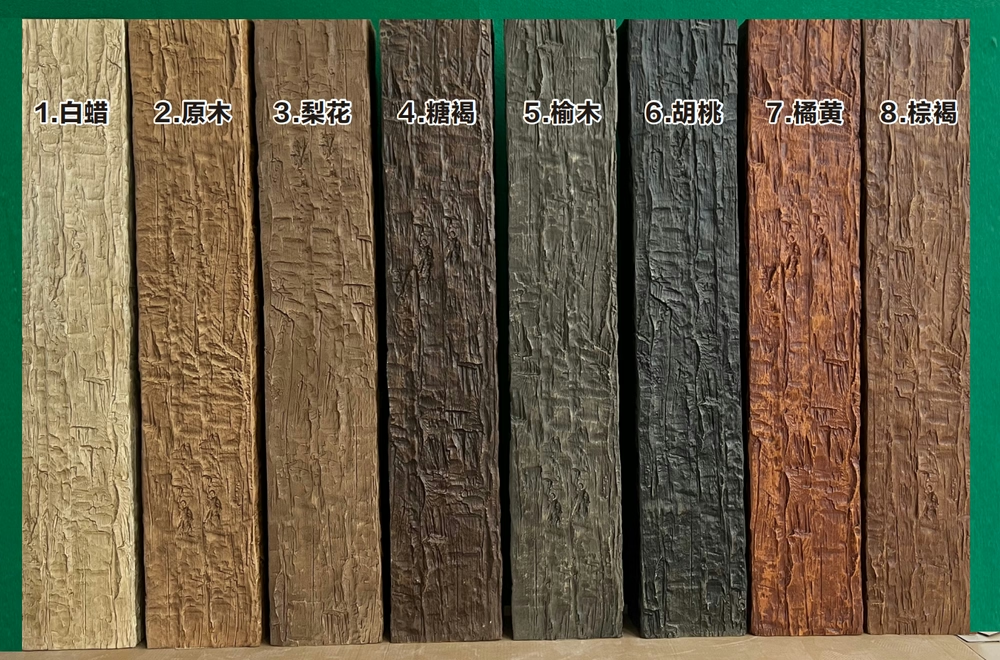
The quality of finish achievable on hollow PU faux ceiling beams encompasses both the factory-applied options available as standard or semi-custom products and the site-applied finishes that allow for full customization. Factory finishes are applied under controlled conditions using formulations specifically designed for polyurethane surfaces, producing a result that is more consistent and durable than typical site-applied finishes. The color depth, grain reproduction, and surface texture of factory-finished beams represent the current state of the art in faux timber technology.
Site finishing of polyurethane beams is possible when project requirements call for colors, effects, or integration with existing finishes that are not available in the standard product range. Unlike some synthetic materials that present adhesion challenges for site-applied coatings, polyurethane accepts paint, stain, and clear finishes with excellent results. The key to successful site finishing is surface preparation: light sanding to create a clean, slightly abraded surface followed by appropriate priming ensures that subsequent coats adhere properly and produce an even, durable finish. Water-based stains and paints are generally preferred for environmental and health reasons, though oil-based products can also be used successfully with appropriate ventilation and drying time.
The relationship between beam finish and the other finishes in the space is one of the most critical considerations in interior design specification. A beam finish that works in isolation may appear discordant when installed adjacent to other materials, and the only reliable way to verify this relationship is through on-site sample evaluation. Most manufacturers and suppliers will provide beam samples for this purpose, allowing designers to place the samples in the actual project space and assess how the finish interacts with the lighting conditions, adjacent materials, and overall design palette of the completed space.
Integration with Lighting and Environmental Systems
Flawless interior design extends beyond the visible surfaces to encompass the integration of environmental systems that maintain comfort and functionality within the space. Lighting, ventilation, acoustic treatment, and climate control all require integration with the ceiling, and the beam installation must accommodate these requirements without compromising the visual quality of the design. Hollow PU beams provide particular advantages in this integration because their construction creates space and access routes for services that would be more difficult to accommodate in solid beams or conventional ceiling systems.
Recessed lighting integration is perhaps the most common service accommodation requirement in contemporary interior design. The hollow interior of polyurethane beams provides a natural housing for recessed fixture wiring and mounting hardware, allowing fixtures to be positioned with precision relative to the beam layout. The beam shell itself can serve as a housing for low-profile LED fixtures, creating a seamlessly integrated lighting solution that appears to emerge from the beam rather than being retrofitted around it. This level of integration is not achievable with solid timber beams without significant on-site modification and custom fabrication.
Ventilation grilles and air distribution outlets can also be integrated with hollow beam installations in ways that maintain the visual continuity of the ceiling treatment. Rather than installing separate grilles in the ceiling plane adjacent to beams, the beam itself can incorporate the air distribution opening, with the grille positioned within the beam's lower face or end face in a configuration that appears deliberate rather than compromised. This integration requires early coordination between the beam specification and the mechanical engineering of the building, but the result is a ceiling that appears resolved and intentional rather than a series of competing elements assembled without full consideration of their interrelationships.
The Flawless Ceiling as Design Achievement
The flawless ceiling — one where beam installations, lighting integration, service accommodation, and surface finishes combine to produce an effect that appears effortless and resolved — is a meaningful design achievement that occupants and visitors perceive even if they cannot analytically explain what they are responding to. This perception of flawlessness is the product of countless small decisions, each of which must be correct for the overall result to succeed. Hollow PU faux ceiling beams contribute to this achievement by removing variability from one significant component of the ceiling system, allowing designers to focus their attention on the other elements where their creative decisions have the greatest impact.
Technical References
ASTM standards cited in every specification
Test Data
Lab results from internal testing program
Updated 2026
Reviewed against current product specs


