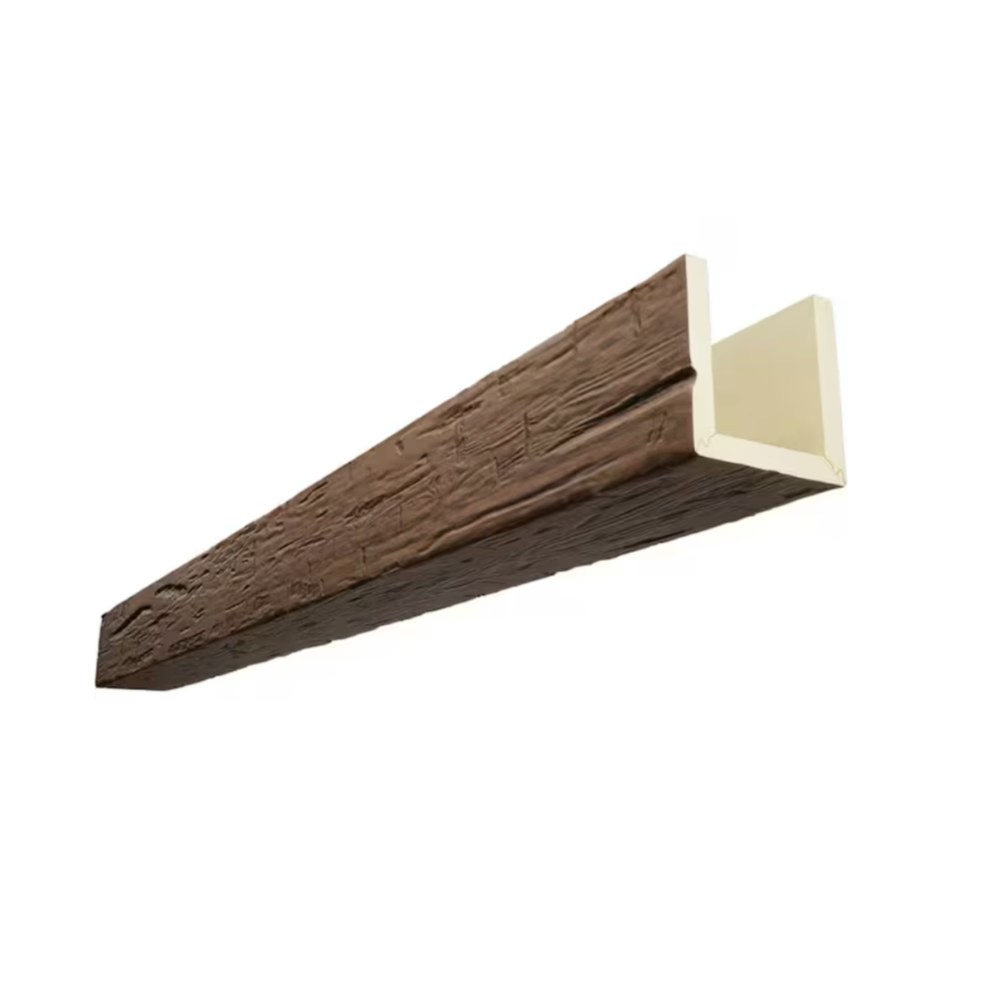
The architecture of interior spaces increasingly acknowledges that change is not an exception but a constant. Commercial tenants relocate or restructure; residential families evolve through different life stages; design trends cycle through phases that can date spaces built around specific stylistic moment. Ceiling beams, once considered permanent architectural elements, now participate in this conversation about adaptability. Sectional beam systems represent one response to these realities, offering construction approaches that accommodate modification without requiring complete reinstallation.
The Sectional Approach Explained
Sectional beam construction differs from both traditional single-piece fabrication and fully modular component systems. Sectional beams are fabricated as shorter lengths that join together to create full-span installations. These sections can be standard lengths for conventional applications or custom-fabricated for specific spatial requirements.
The section joints distinguish this construction approach from single-piece beams. Rather than attempting to eliminate evidence of beam segmentation, sectional construction typically incorporates joints as designed features. These joints may employ hidden connectors that maintain wood-continuity appearance, or they may reveal hardware or decorative elements that celebrate the sectional nature of the construction.
This honest acknowledgment of construction creates design opportunities that seamless approaches cannot offer. Visible joints can incorporate wood species contrasts, metal inlays, or deliberate offset patterns that add visual interest to beam surfaces. The construction becomes part of the design rather than something to be concealed.
Structural Considerations in Sectional Design
Sectional beam systems must address structural requirements that affect both engineering and appearance. The joints between sections must transfer loads appropriately, maintaining structural integrity throughout the beam span. This requirement influences joint design, which must be both strong and repeatable across multiple connections.
Connection engineering varies by manufacturer and beam type. Some systems employ concealed metal plates that bridge joints internally; others use decorative visible connectors that contribute to aesthetic goals while providing structural function. The choice between these approaches depends on design intent, load requirements, and the visual importance of joints in the overall composition.
Span limitations in sectional systems may differ from single-piece alternatives. The need to transfer loads across joints can limit maximum spans; understanding these limitations prevents specification errors that might require redesign or compromise. Quality manufacturers provide clear span charts that indicate safe loading for different beam configurations.

Deflection behavior under load requires attention in sectional systems. The deflection of individual sections and the deflection at joints both contribute to overall beam performance. Quality systems are engineered to ensure that deflection remains within acceptable limits throughout the beam, including at joints, preventing the appearance of movement or settling that would compromise aesthetics.

Installation Advantages
Sectional construction offers practical advantages during installation that affect project costs and timelines. Shorter beam sections are easier to transport, handle, and position than full-length beams, reducing labor requirements and simplifying site logistics.
Access through doorways, elevators, and stairwells becomes possible with sectional construction when full-length beams would be impractical. This accessibility enables beam installation in buildings where traditional delivery and handling would be impossible or prohibitively expensive. The ability to assemble beams on-site from transported sections opens possibilities that single-piece alternatives cannot address.
Alignment during installation benefits from the precision that sectional systems require. The need to achieve clean joints between sections enforces attention to positioning that may be less critical in traditional installations. This precision typically results in cleaner overall alignment when the installation is completed.
Field Assembly Requirements
Sectional beam installation requires field assembly that single-piece installations do not demand. This assembly work adds steps to the installation process but does not necessarily increase total time when handled efficiently. Experienced installers develop routines that streamline the assembly sequence.
Joint preparation before assembly ensures clean results. Checking section fit, cleaning connection surfaces, and verifying alignment before fastening prevents problems that might require correction after assembly. This preparation investment pays dividends through reduced adjustment and rework.
Fastening at joints requires appropriate hardware and techniques for each system design. Some systems employ mechanical fasteners; others use adhesive bonding; still others combine both approaches. Understanding the specific requirements of the system being installed prevents errors that might compromise joint quality or structural performance.
Design Applications
Sectional beam systems serve diverse design applications where their specific characteristics provide advantages. Understanding these applications helps designers identify situations where sectional approaches suit project requirements.
Long-span applications often benefit from sectional construction that allows on-site assembly of beam lengths that would be impractical to transport complete. The ability to join sections at mid-span or other appropriate locations provides design flexibility that traditional approaches cannot match.
Irregular ceiling geometries—angled walls, curved surfaces, complex intersections—can be addressed with sectional construction that allows components to be cut and joined as needed. The field assembly capability of sectional systems accommodates variations that would require custom fabrication with traditional approaches.
Renovation projects frequently suit sectional approaches, particularly when complete removal of existing ceiling treatments is impractical. Sections can be assembled in accessible areas and maneuvered into position where complete beams would be impossible to install.
Maintenance and Service Access
Ceiling beams sometimes require access for maintenance or service purposes. Sectional construction can facilitate this access when properly designed, providing points of disassembly that allow sections to be temporarily removed.
Service access design should be considered during initial specification. Systems that allow section removal without affecting adjacent sections provide the greatest flexibility for future access. Understanding the disassembly sequence before installation ensures that access capability is preserved.
Reassembly after service access requires the same attention to detail as original installation. Proper realignment, secure fastening, and finish repair where needed ensure that beams restored after access maintain the quality of the original installation.
Evaluating Sectional Systems
Not all sectional beam systems offer equivalent quality or capability. Careful evaluation during specification ensures that selected systems will perform adequately over their expected lifespan.
Joint quality determines much about sectional beam performance. Joints should be tight, strong, and visually clean. Visible gaps, visible fasteners, or inconsistent alignment indicate quality issues that will affect both structural performance and aesthetic appearance.
Finish consistency between sections affects overall beam appearance. Sections that appear noticeably different—different grain patterns, different colors, different surface textures—compromise the visual unity that beam installations should achieve. Quality systems maintain consistency across sections produced from the same materials and processes.
Connection hardware quality determines long-term joint performance. Hardware that corrodes, loosens, or fails over time threatens the structural integrity of the entire beam. Quality systems employ hardware designed for the specific loads and conditions that beam installations encounter.
Making the Sectional Decision
The choice between sectional and alternative beam approaches depends on specific project requirements, constraints, and priorities. For many applications, sectional construction offers advantages that justify its consideration alongside traditional alternatives.
Projects with challenging access conditions benefit most from sectional approaches. When site logistics prevent single-piece installation, sectional construction may be the only viable option. This practical advantage often outweighs other considerations when alternatives are eliminated.
Budget constraints sometimes favor sectional construction despite higher per-linear-foot costs. The reduced handling and installation labor that shorter sections require can offset material cost premiums, particularly in situations where access difficulties complicate traditional installation.
Design intent may favor sectional construction when joints contribute to the overall aesthetic. Spaces where the honest expression of construction aligns with design goals benefit from approaches that incorporate joints as design features rather than concealing them as necessary evils.
The decision framework should consider these factors in light of specific project conditions. When sectional advantages align with project requirements, the approach offers capabilities that other construction methods cannot match.
Technical References
ASTM standards cited in every specification
Test Data
Lab results from internal testing program
Updated 2026
Reviewed against current product specs