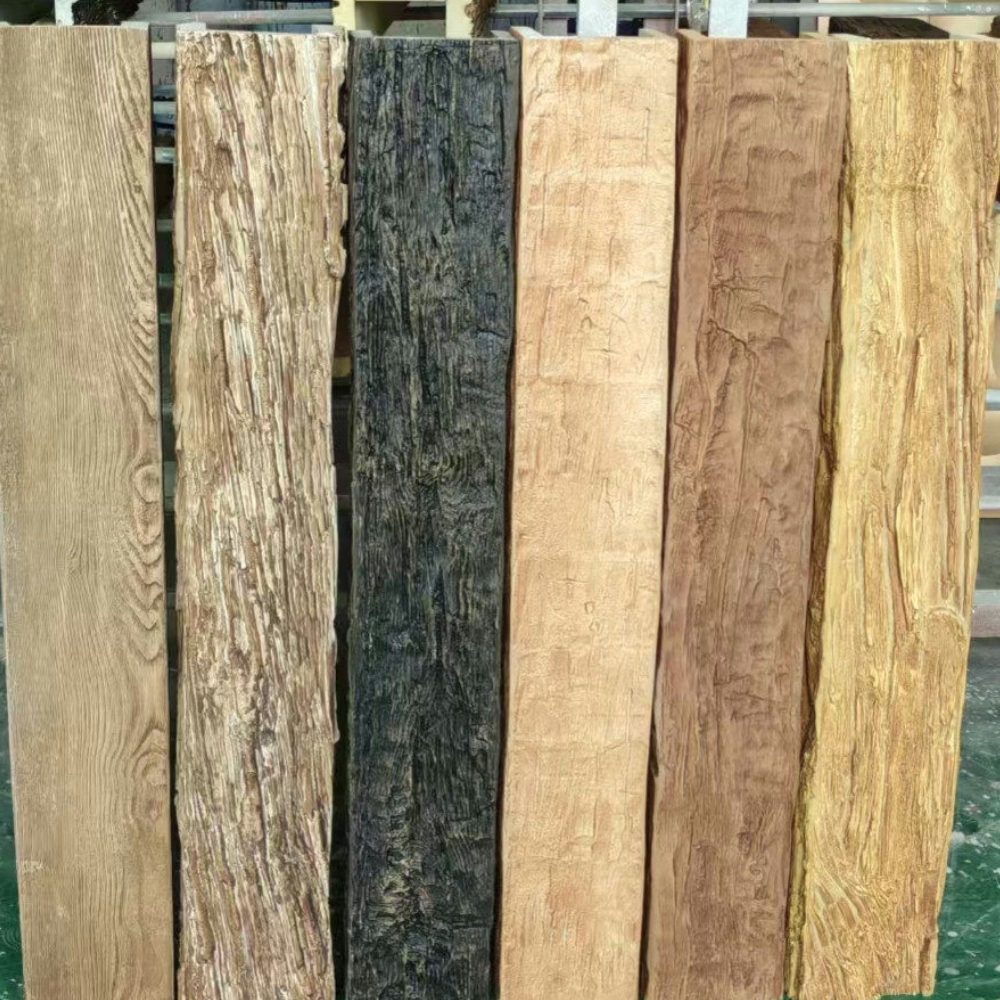
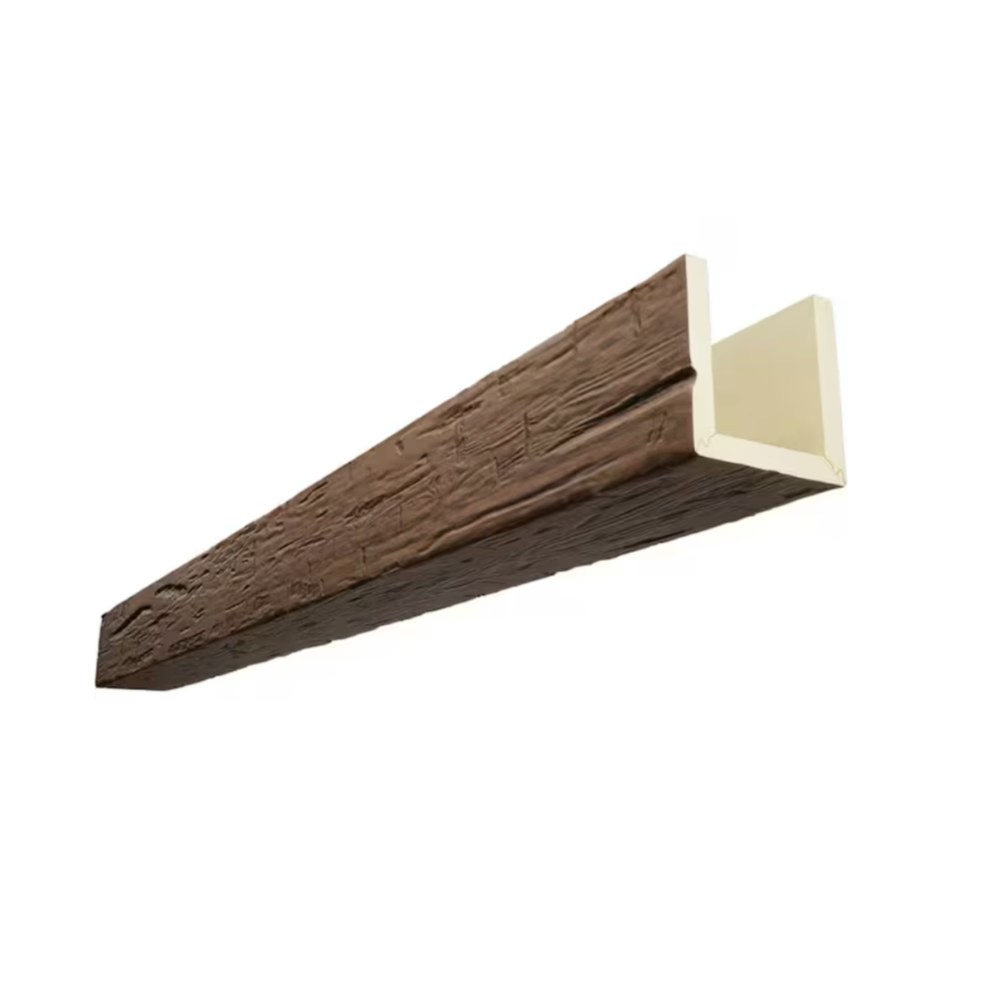
When architects first envision a grand arch or vault ceiling, they often wrestle with a fundamental tension: the desire for warm, natural wood aesthetics against the structural and logistical challenges of bending solid timber across wide spans. Multi-segment large radius curved PU faux wood beams resolve this tension elegantly, offering the beauty of aged wood without the weight, expense, or installation headaches that come with real curved lumber.
The approach behind multi-segment construction is deceptively simple. Instead of trying to steam-bend or laminate a single piece of wood into a sweeping curve, manufacturers create several straight or slightly angled segments that, when assembled in sequence, produce a smooth, continuous arc. Each segment connects to the next through precision-engineered joints, and the seams are finished so seamlessly that the finished beam appears to be carved from a single, continuous piece. The result is a structural element that follows the natural geometry of arches and vaulted ceilings while carrying all the visual warmth that makes wood such a prized material in architecture.

Why Curved Beams Matter in Vault Ceiling Design
Vaulted and arched ceilings have experienced a sustained surge in popularity across both residential and commercial design over the past decade. From soaring entryways in boutique hotels to intimate reading alcoves in renovated brownstones, the sense of vertical space and openness created by vaulted ceilings adds a dimension of grandeur that flat ceilings simply cannot match. Yet once that architectural shell is in place, designers face the challenge of making the space feel finished rather than bare. Exposed structure, whether concrete, steel, or bare drywall, tends to feel industrial and cold without something to ground the eye and introduce warmth.
This is where curved faux wood beams become invaluable. A sweep of warm-toned, wood-grained beams tracing the ridge line of a vault brings an organic quality that humanizes even the most ambitious architectural forms. In a grand foyer with a barrel-vaulted ceiling, for example, a series of parallel curved beams can create rhythm and visual structure without overwhelming the space. The eye follows the curves upward, experiencing the full height of the room while the wood texture adds a sense of craft and natural beauty.
Multi-segment curved beams are particularly well-suited to elliptical arches, which appear frequently in Georgian and Palladian-inspired architecture. An elliptical arch presents a continuously changing radius, which makes it extremely difficult to accommodate with standard straight beams or single-piece curved timber. By breaking the arch into a series of shorter segments, each with its own slight curvature, manufacturers can approximate the ellipse with remarkable precision. The joints between segments are positioned to fall along natural visual break points, often aligned with decorative beam collars or running perpendicular to the curve where the light casts the least obvious shadows.
Engineering Multi-Segment Curved Beams
The manufacturing process for multi-segment curved PU faux wood beams involves several carefully coordinated steps. The raw material, high-density polyurethane foam, is poured into molds that define both the outer wood-grain texture and the internal structural profile. Once cured, each segment is CNC-machined to exact dimensional tolerances, ensuring that when two segments meet, the joint is tight and consistent. The wood-grain pattern on each segment is designed to continue seamlessly across joint lines, which requires careful pattern mapping during the mold creation phase.
One of the key advantages of PU as a substrate is its dimensional stability. Unlike real wood, which expands and contracts with changes in humidity and temperature, polyurethane holds its shape indefinitely under normal interior conditions. This stability is critical for curved installations, where even slight movement in a beam segment could accumulate across multiple joints and eventually create visible gaps or misalignment. With PU faux wood beams, installers can confidently position segments and expect the result to remain exactly as installed for years to come.
The segments themselves are lightweight, typically weighing a fraction of equivalent solid wood beams. This weight advantage simplifies every phase of installation. Workers can maneuver segments by hand in spaces where solid timber curved beams would require mechanical lifting equipment. The reduced load on ceiling structures is also a significant benefit, especially in renovation projects where existing ceilings may not have been designed to support the weight of heavy timber.
Design Possibilities Across Interior Styles
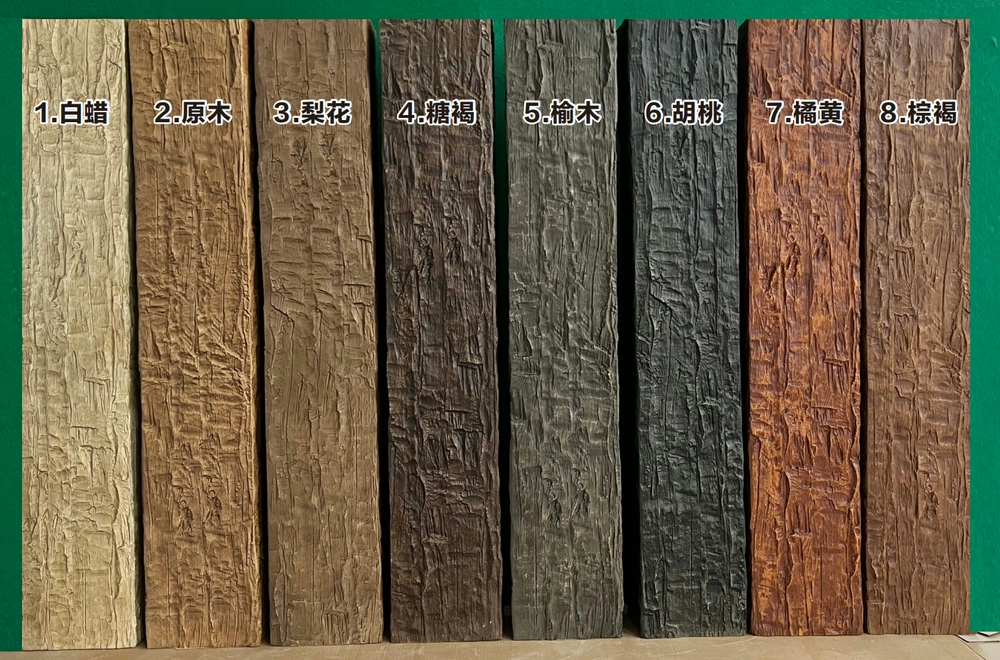
The aesthetic range available in multi-segment curved PU faux wood beams spans from authentically rustic to crisply contemporary. A weathered oak finish, with its deep grain lines and subtle color variation, complements mountain lodges, wine cellars, and farmhouse-style kitchens. A smooth, honey-toned maple finish reads more transitional, working equally well in modern farmhouses and mid-century revival interiors. For projects that call for something bolder, dark espresso finishes with pronounced grain texture bring drama to hotel lobbies and high-end restaurant ceilings.
In commercial settings, curved beams frequently serve as both aesthetic elements and functional dividers. A row of sweeping arched beams can define zones within a large open floor plan without resort to walls or partitions. In a restaurant, for instance, curved beams tracing the ceiling above a dining area create an intimate sense of enclosure while maintaining visual connectivity with the rest of the space. The warmth of the wood finish makes the dining environment feel more welcoming than exposed concrete or standard acoustic tile ceilings.
Multi-segment curved beams also open possibilities for decorative schemes that would be prohibitively expensive with real timber. A spiral arrangement of beams around a domed ceiling, for example, could create a stunning centerpiece in a hotel atrium. The lightweight nature of PU makes such ambitious configurations feasible without requiring custom steel support structures. Similarly, wave-pattern beam arrangements that undulate across a ceiling plane are achievable with PU segments in ways that would challenge even master woodworkers using solid material.

Installation Best Practices
Successful installation of multi-segment curved beams begins with accurate measurement and template creation. For complex vaulted ceilings, installers typically create a full-scale template using lightweight cardboard or paper strips that conform exactly to the ceiling surface. This template is then used to mark the precise positions for each beam segment, including any necessary shimming to accommodate irregularities in the existing structure.
Mounting methods depend on the ceiling construction and the weight of the beam configuration. In new construction, structural blocking can be installed at predetermined points to accept concealed mounting brackets. In renovation projects, adjustable hanger systems allow beams to be suspended from existing ceilings using lag screws into ceiling joists or concrete anchors. The goal in every case is to create a secure, invisible connection that supports the beam without showing any hardware.
Finishing the joints between segments requires attention to both structural and visual continuity. Structural adhesive applied at the joint interface provides a permanent bond, while hideously concealed screws through overlapping flanges can add mechanical reinforcement where loads are a concern. Once the adhesive has cured, a thin bead of color-matched caulk or wood filler applied along the seam renders it invisible from normal viewing distances. The final step involves texturing any exposed cut ends of the foam to match the surrounding wood-grain surface, ensuring that even close inspection reveals no evidence of the segment-based construction.
Selecting the Right Curved Beam Configuration
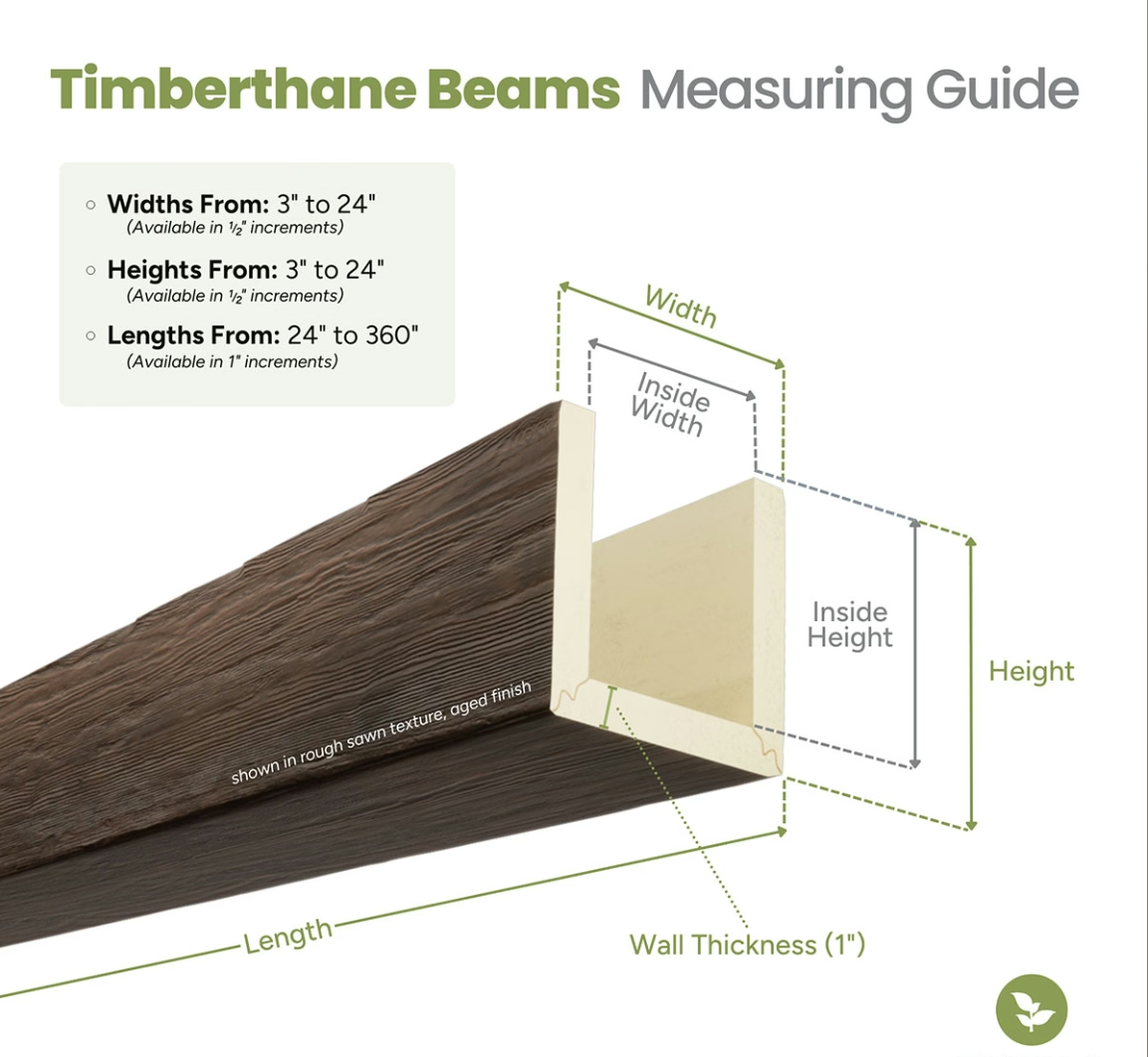
Not all vaulted ceilings require the same beam configuration, and understanding the options helps designers and buyers make informed choices. For barrel vaults — those with a constant-radius curve resembling the inside of a pipe — standard constant-radius segments can be repeated around the curve to create a smooth, uniform appearance. The number of segments per beam depends on the radius of the vault and the desired visual scale of the individual beams.
For elliptical vaults, manufacturers typically offer custom-machined segments that progressively change their curvature from one end of the beam to the other. These segments are numbered during production to ensure they are installed in the correct sequence, as the curvature at one end may differ noticeably from the curvature at the other. Custom fabrication adds lead time and cost compared to standard profiles, but the result is a beam that truly conforms to the architectural intent of the space.
Radius is another critical dimension. Larger radii produce gentler, more sweeping curves that work well in expansive spaces with high ceilings. Smaller radii create tighter arcs that suit smaller rooms or architectural features like window niches and decorative portals. Most manufacturers offer standard radius options ranging from approximately one meter up to several meters, with custom radii available for particularly demanding projects.
Maintenance and Long-Term Performance
One of the practical benefits of PU faux wood beams in any configuration, curved or straight, is their minimal maintenance requirement. The polyurethane surface resists moisture absorption, which eliminates the primary vulnerability of real wood beams — their susceptibility to rot, mold, and insect damage in humid environments. In kitchens, bathrooms, or covered outdoor installations where humidity fluctuates, this resistance translates directly into longevity.
The surface finish, typically a factory-applied latex or acrylic coating, can be refreshed or recoated as needed without removing the beams. Minor scuffs and scratches can be touched up with a matching paint product, while deeper damage may require surface sanding followed by priming and repainting. Because the underlying foam is homogeneous and consistent throughout, repairs do not expose a different material or color beneath the surface.
For curved beams specifically, the absence of wood's natural tendency to split or check along grain lines provides additional peace of mind. Real timber curved beams can develop hairline cracks over time as the wood adjusts to environmental conditions. These cracks are not only cosmetically undesirable but can also compromise the structural integrity of the beam over many years. PU faux wood beams are immune to this failure mode, maintaining their appearance and structural soundness indefinitely under normal interior conditions.
Cost Considerations and Value
When evaluating multi-segment curved PU faux wood beams for a project, the cost comparison with alternatives is almost always favorable. Real timber curved beams require either steam-bending — a specialized and expensive process — or the construction of laminated beams from many thin strips of wood glued together under pressure. Both approaches involve significant material waste, skilled labor, and extended lead times. In contrast, PU beam segments are produced efficiently from molds, with consistent quality and relatively short production cycles.
The installation cost differential is equally significant. The lightweight nature of PU reduces labor time and eliminates the need for mechanical lifting equipment in most cases. The dimensional accuracy of CNC-machined segments speeds up fitting and alignment, further reducing on-site labor. When all factors are considered — material cost, fabrication, finishing, shipping, and installation — PU faux wood beams typically deliver a installed cost that is substantially lower than equivalent solid wood curved beams, often by a margin of forty to sixty percent.
For B2B buyers sourcing products for large-scale commercial projects, this cost advantage can be the deciding factor that makes ambitious ceiling designs financially viable. A hotel chain renovating dozens of properties can achieve brand-consistent, high-quality ceiling aesthetics across all locations without the logistical complexity and cost variability of sourcing genuine curved timber from specialty mills. The consistency of PU products also simplifies quality control, as each beam segment meets the same dimensional and finish specifications regardless of when or where it was produced.
Technical References
ASTM standards cited in every specification
Test Data
Lab results from internal testing program
Updated 2026
Reviewed against current product specs