The moment a timber beam is installed outdoors, the clock starts on its degradation. Rain, humidity, insect activity, UV radiation, and temperature cycling all attack natural wood simultaneously. Even pressure-treated lumber, which resists insect damage and surface decay more effectively than untreated wood, eventually succumbs to checking, splitting, and structural compromise when exposed to years of outdoor conditions. For architects and designers working on exterior applications, this reality has traditionally meant either accepting the maintenance burden and finite lifespan of real timber or abandoning the warm aesthetic of wood entirely. Polyurethane resin faux wood beams have introduced a third path that resolves many of the traditional compromises.
The Challenge of Natural Wood Outdoors
Natural wood exists in a state of dynamic equilibrium with its environment. The cell walls of wood fibers contain hydroxyl groups that attract and hold water molecules. When humidity rises, the wood absorbs moisture and swells. When conditions dry out, the moisture is released and the wood shrinks. This swelling and shrinking cycle, repeated thousands of times over the life of an installed beam, creates internal stresses that manifest as checking along the grain, splitting at the ends, and gradual dimensional instability.
Beyond moisture movement, outdoor wood faces biological threats. Termites, carpenter ants, and various wood-boring beetles can compromise structural integrity in a matter of years in untreated timber. Fungal decay, which requires only moderate moisture and suitable temperatures, attacks the cellulose and lignin that give wood its strength. Even species naturally resistant to decay, such as cedar and cypress, have limits to how long they perform reliably in wet outdoor exposure.
UV radiation from sunlight breaks down the lignin that bonds wood fibers together at the surface, causing graying, chalking, and gradual erosion of the surface texture. For decorative beams where appearance matters, this surface degradation requires regular cleaning, staining, or painting to maintain the intended aesthetic.

How PU Resin Outperforms Natural Wood Outdoors
Polyurethane resin is fundamentally different from organic wood in its response to outdoor conditions. The material is essentially non-porous, with a closed-cell structure that does not allow water to penetrate. This single property addresses most of the failure modes that affect natural wood. Without moisture penetration, the swelling and shrinking cycle cannot occur. Without accessible cellulose, fungal decay organisms have nothing to metabolize. Without the hydroxyl groups that attract and hold water, the dimensional instability that leads to checking and splitting is eliminated entirely.
UV resistance is built into outdoor-grade polyurethane formulations through the addition of UV stabilizers and inhibitors during the manufacturing process. These additives absorb or block UV radiation before it can break down the polymer chains that give the material its strength and surface integrity. The result is a beam that maintains its color, surface texture, and structural properties through years of sun exposure without the graying and chalking that plague natural wood.
Temperature cycling, which causes problems for many materials as they expand and contract at different rates, has minimal effect on properly formulated polyurethane beams. The material has a relatively low coefficient of thermal expansion, meaning that even significant temperature swings produce only small dimensional changes. These changes are within the tolerance of the mounting systems and do not create the kinds of stresses that cause cracking or joint failure.
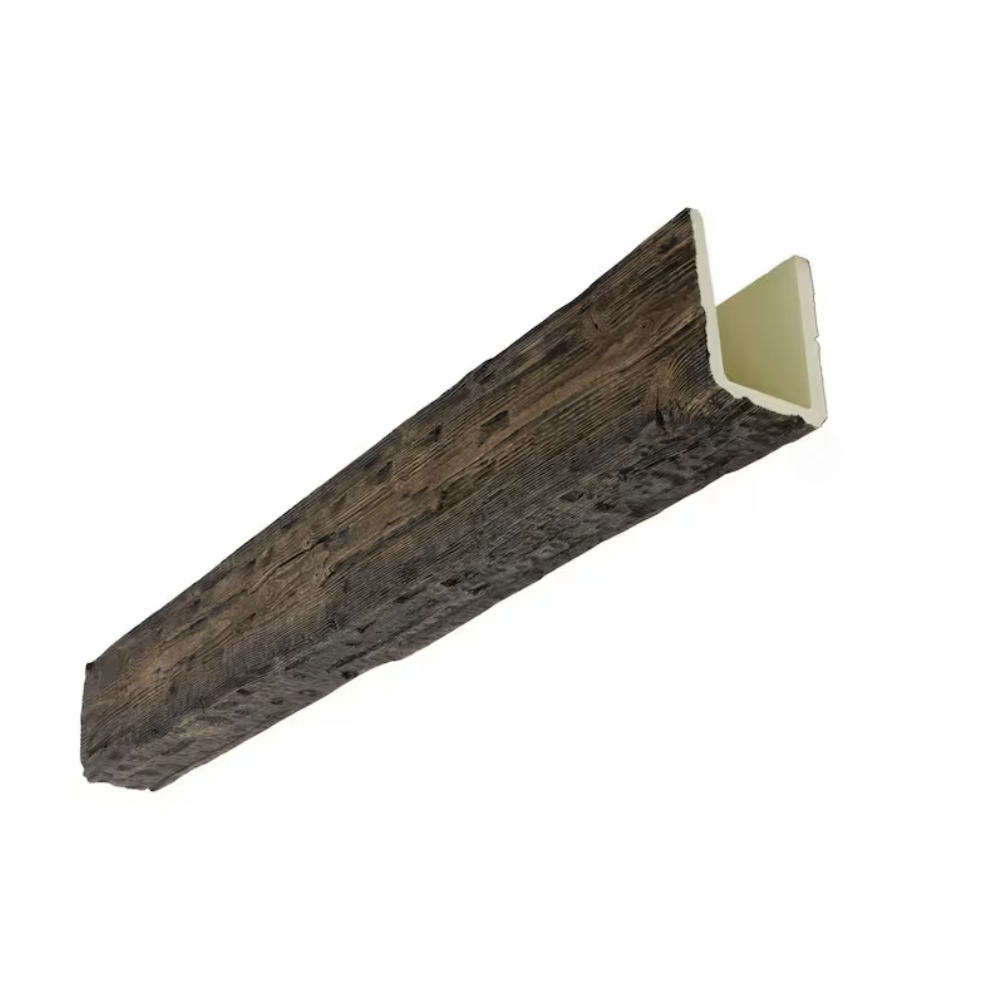
Common Outdoor Applications for PU Faux Wood Beams
Pergola structures represent one of the most popular applications for outdoor faux wood beams. A pergola over a patio or garden pathway creates a defined outdoor living zone while maintaining an open, airy feel. Using faux wood beams for the overhead lattice and main structural members means the pergola retains the warm, natural aesthetic of wood without the annual maintenance that real timber requires.
Porch ceilings and fascias are another frequent application. The underside of a covered porch is an ideal location for decorative beams, adding architectural interest to what is otherwise a flat surface. In humid climates, where porch ceilings are constantly exposed to moist air and occasional direct rain splash, polyurethane beams eliminate the mold, rot, and paint failure problems that plague painted wood in these conditions.
Gable ends and dormer facades offer opportunities to add character to the exterior envelope of a building. Faux wood beams can frame a gable window, accent the peak of a dormer, or simply run along a fascia line to add visual interest to a roof edge. The ability to maintain a consistent appearance across all exposures, from the shaded north side to the sun-baked south elevation, is a significant advantage over natural wood, which weathers differently depending on orientation and exposure.
Eaves and soffits in contemporary exterior designs sometimes incorporate exposed beam elements for a clean, modern aesthetic that references traditional craftsmanship. Polyurethane beams work well in these applications and can be finished to match or contrast with adjacent cladding materials as the design requires.

Finishing Options for Exterior PU Beams
One of the practical advantages of polyurethane beams for exterior use is their compatibility with a wide range of finishing approaches. The material can be painted with standard exterior-grade acrylic or urethane-based paints without any special priming, provided the surface is clean and dry. This allows designers to match beam colors to trim, siding, or other architectural elements using the same paint system already specified for the project.
Stain finishes, including semi-transparent stains that reveal the underlying grain texture, can also be applied to polyurethane beams. These finishes typically require a compatible primer or base coat formulated for use on polyurethane surfaces, but the range of available colors and opacity levels is broad enough to satisfy most design requirements.
For projects where the natural appearance of aged or weathered wood is desired, some manufacturers offer pre-finished beams with paint systems designed to weather naturally over time, developing the patina of naturally aged timber while retaining the structural protection of the underlying polyurethane.
Structural Considerations for Outdoor Installations
While polyurethane faux wood beams are not typically structural load-bearing members — meaning they are not expected to carry the roof or floor loads of a building — they may be exposed to wind loads, snow loads, or incidental impacts that require appropriate design attention. The mounting system for exterior beams should be engineered to resist the anticipated lateral and uplift forces for the location and height of the installation.
Fasteners and mounting hardware for exterior applications should be corrosion-resistant. Stainless steel screws and brackets are recommended for coastal environments where salt spray accelerates corrosion of ordinary steel. The polyurethane beam itself will not corrode, but metal mounting components must be selected with the environment in mind.
Thermal movement in exterior applications, while small in absolute terms, should be accommodated in the design of long beam runs. Expansion joints or slotted mounting holes that allow for thermal movement without inducing stress in the beam or the mounting system are appropriate details for beams spanning long distances in climates with significant seasonal temperature variation.
Lifecycle Cost Advantages for Exterior Projects
The initial installed cost of polyurethane faux wood beams is typically higher than pressure-treated dimensional lumber of equivalent size, but the lifecycle cost calculation frequently favors polyurethane when all factors are considered. Natural wood beams require regular inspection, periodic cleaning, and reapplication of protective finishes every two to five years depending on climate and exposure. These maintenance costs compound significantly over a twenty or thirty-year period.
Polyurethane beams in most exterior applications require only periodic cleaning — typically an annual wash with mild detergent to remove accumulated dirt and biological growth — and occasional inspection of mounting hardware. The material does not need to be stained, sealed, or painted to maintain its weather resistance, only its appearance if a painted finish is specified.
For commercial properties such as restaurants with outdoor dining areas, hotels with courtyard amenities, or retail centers with outdoor plazas, the reduced maintenance requirement of polyurethane beams translates directly to lower ongoing maintenance budgets and less disruption to operations from maintenance activities.
Technical References
ASTM standards cited in every specification
Test Data
Lab results from internal testing program
Updated 2026
Reviewed against current product specs


