The building materials industry has long operated on a model where manufacturers develop products and buyers choose from among available options. This model works efficiently for commodity products where the primary selection criteria are price and availability, but it creates friction for anyone whose requirements fall outside what manufacturers have chosen to produce. When a project needs a beam profile that does not exist, a finish color that no manufacturer offers, or a dimensional tolerance that no catalog product meets, the standard model forces a choice between compromising the design and paying dramatically higher costs for custom work.
Original Design Manufacturing represents a different model — one where the buyer's requirements drive the product development rather than the other way around. For buyers of polyurethane faux beams, ODM relationships mean access to a full range of customization capabilities that can produce any beam product a project requires, in any quantity that makes economic sense to produce.
What ODM Actually Means for Beam Buyers
The term ODM is sometimes used loosely to describe any custom manufacturing relationship, but its specific meaning in the context of beam products involves several distinct elements. The manufacturer takes responsibility for the product design based on the buyer's specifications. The resulting product is unique to that buyer — tooling is created or modified specifically for the buyer's product, and the design is typically owned by the buyer rather than shared with other customers or used by the manufacturer for other projects.
This ownership structure has practical implications. A distributor who commissions an ODM beam product owns that design. The manufacturer cannot sell the same design to other buyers, cannot use images of the product in marketing materials without permission, and cannot produce the same profile or finish for any other customer. The buyer gets exclusivity alongside the customization, which is the combination that makes ODM attractive to brands building differentiated product lines.
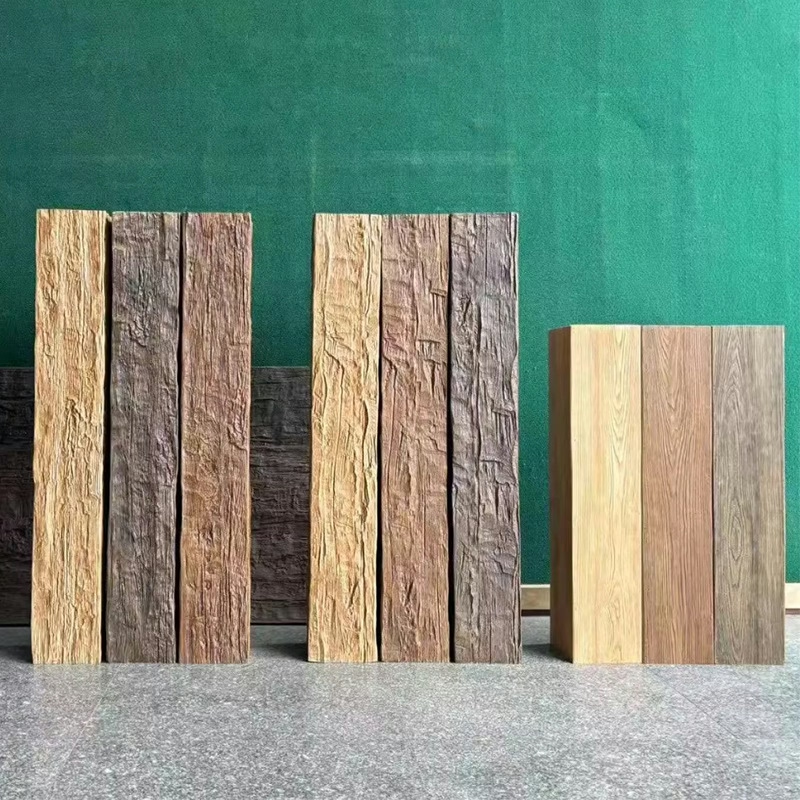
The scope of ODM customization in the polyurethane beam context is broader than many buyers initially expect. Every aspect of the product is open to specification: the cross-sectional profile, the surface texture, the color and finish, the dimensional tolerances, the physical properties (weight, density, fire rating), the packaging and labeling, and even the material formulation within the range of available polyurethane compounds.

Profile Customization Beyond Standard Shapes
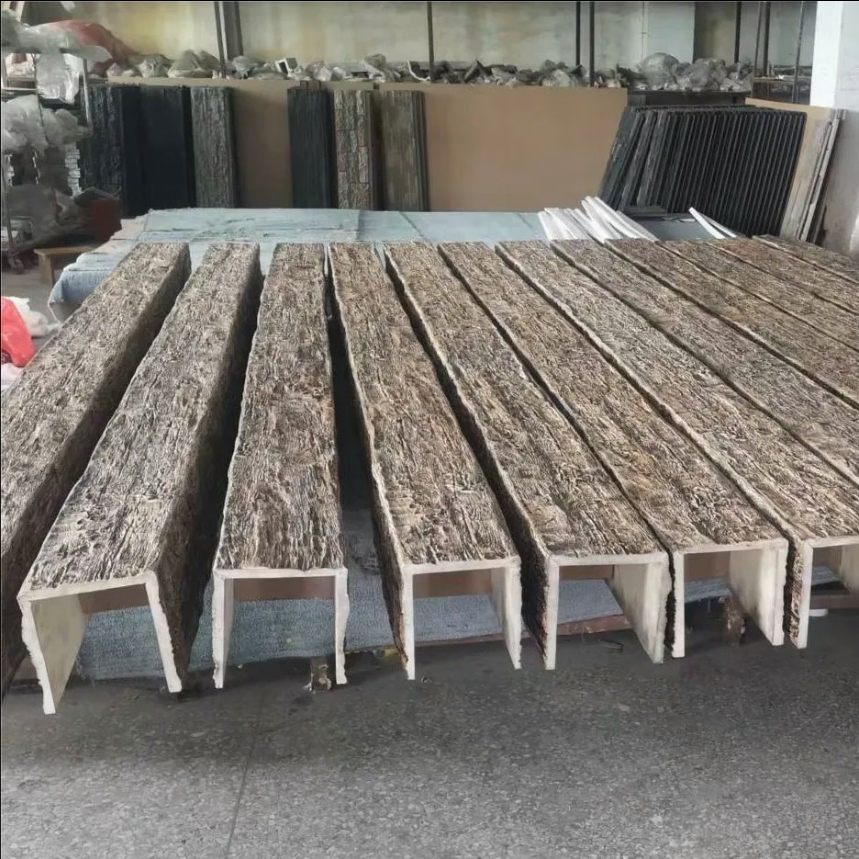
Standard beam profiles are typically variations on a handful of basic shapes — rectangular, T-beam, box beam, and occasionally circular or half-round for specialty applications. These shapes serve the majority of applications well, but they represent a tiny fraction of the geometric possibilities that molding technology enables.
ODM profile customization can produce beams with any cross-sectional geometry that can be described in two dimensions, including shapes with undercuts, complex curves, integrated molding details, and multi-axis profiles that would be impossible to produce by machining. The limiting factor is not manufacturing capability but rather the designer's ability to specify and the project's ability to accommodate the resulting product.
Compound profile elements — where the beam face includes crown molding, paneling details, or decorative carvings — are particularly well-suited to ODM production. These complex profiles are expensive to produce in wood because each machining operation must be set up and executed precisely, with accumulated tolerance errors potentially causing fit problems. In polyurethane molding, the entire profile is reproduced from the master tool in a single operation, with consistent quality across all units.
Material Property Customization
Beyond aesthetics, ODM customization allows the physical properties of the beam to be specified for the application's requirements. Standard polyurethane beams are formulated for general-purpose interior use, with adequate UV resistance and reasonable impact resistance for typical handling and installation.
Applications with more demanding requirements can specify enhanced formulations. Exterior applications benefit from UV-stabilized compounds that resist surface degradation from prolonged sun exposure. High-traffic commercial areas may need impact-modified formulations that resist denting and chipping from accidental contact. Fire-rated applications in regulated occupancy types require formulations that meet specific flame spread and smoke development ratings.
ODM manufacturers can also adjust the density and weight of beams within the constraints of the polyurethane material system. Lighter beams are easier to handle and install but may have reduced impact resistance; denser beams are more robust but more costly to ship. The optimal specification depends on the specific project's handling requirements, installation conditions, and performance expectations.
Packaging and Branding for Distributors
ODM customization extends to the commercial aspects of the product as well. Distributors commissioning ODM beam products can specify packaging design, labeling, and documentation that carry their own brand identity. This includes everything from the physical packaging in which beams ship to the documentation that accompanies the product — installation guides, care instructions, warranty documentation, and product photography releases.
The ability to control the complete customer experience — from unboxing to installation — is particularly valuable for premium brands competing on service and quality rather than price. A beautifully packaged beam product with clear, professional installation documentation creates a different impression than a beam shipped in plain bulk packaging with a photocopied instruction sheet.
The Economics of ODM Beam Products
ODM manufacturing involves upfront costs — tooling development, prototype production, and formulation development — that are amortized across the production run. For very small orders, these setup costs can make ODM pricing significantly higher than catalog equivalents on a per-unit basis. The economics become favorable when the order volume is large enough to spread these costs across enough units, or when the customization value — brand exclusivity, design fidelity, reduced installation labor — justifies a price premium.
Buyers evaluating ODM options should consider both the per-unit cost and the total cost of ownership. A custom beam that costs more per unit but eliminates the need for field modifications, reduce installation time, or enables a higher project value may be less expensive overall than a cheaper catalog alternative that requires compensating measures.
The minimum order quantities and pricing tiers for ODM beam products vary by manufacturer and are influenced by the complexity of the customization. Simple profile modifications with modest tooling requirements may have surprisingly accessible minimums, while highly complex custom profiles requiring precision multi-piece tooling may require substantial commitments. Discussing requirements openly with potential manufacturing partners early in the evaluation process is the best way to understand the economic viability of a specific ODM concept.

Building Long-Term Manufacturing Partnerships
The most successful ODM relationships in the beam industry are partnerships that extend beyond a single project. When a buyer and manufacturer develop mutual familiarity with each other's capabilities, requirements, and quality standards, subsequent engagements become more efficient and the results more consistently meet expectations.
Designers and brands that anticipate ongoing product development — seasonal collections, geographic market expansions, related product categories — benefit from establishing ODM manufacturing relationships early and investing in the communication infrastructure that supports them. Shared quality standards, established approval processes, and clear documentation practices reduce the friction of each subsequent product development cycle and allow the partnership to move quickly when opportunity arises.
Technical References
ASTM standards cited in every specification
Test Data
Lab results from internal testing program
Updated 2026
Reviewed against current product specs


