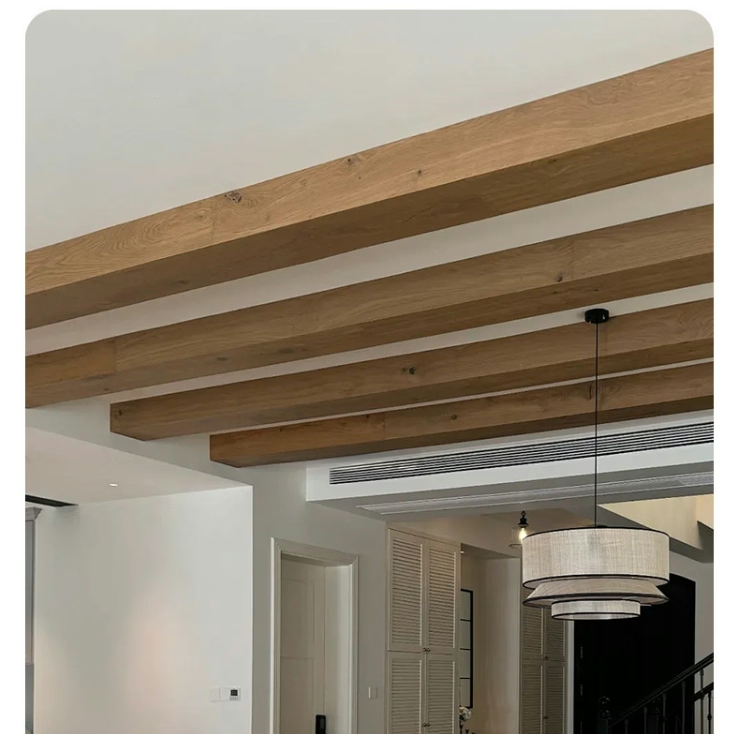
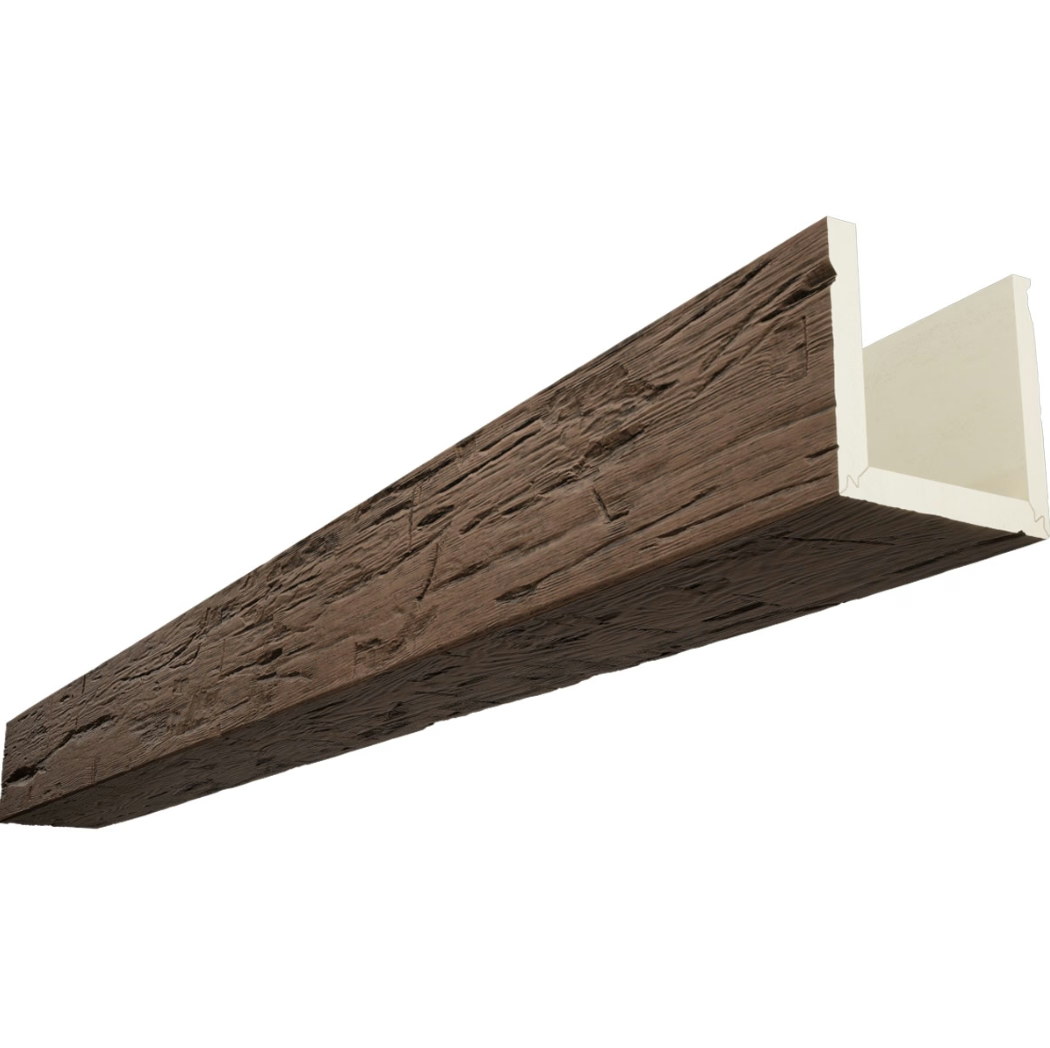
The construction industry operates on schedules that leave little room for uncertainty. Projects have deadline-driven demand for materials that must arrive on site, in the correct quantities, and conforming to the specified quality standards. When decorative beams are a project requirement, the traditional approach of specifying custom millwork in natural wood carries inherent schedule risk: custom woodwork has long lead times, can be delayed by wood movement or machining errors, and may require on-site adjustment that consumes schedule margin. OEM custom polyurethane beams address these concerns through manufacturing precision and supply chain predictability that align with professional construction practice.
Scaling Custom Beams to Project Size
One of the practical strengths of OEM custom polyurethane beam production is its scalability. The same tooling and manufacturing process that produces a handful of prototype beams for a small residential project can produce hundreds or thousands of beams for a large commercial development. The per-unit cost decreases as volume increases, and the production schedule can be adjusted to match the project's construction timeline.
For small residential projects — a homeowner's addition, a renovation, a single custom home — the OEM engagement focuses on producing exactly the beams the project requires. The design team and the homeowner work with the manufacturer to define the specifications, a prototype is produced and approved, and a small production run delivers the beams needed for the project. The investment in custom tooling is amortized across a modest quantity, making the per-beam cost higher than catalog products but acceptable given the value of getting exactly what the project requires.
For large commercial projects — a hotel, a multi-unit residential development, a commercial office building — the economics of OEM custom production become very favorable. The tooling investment is spread across a large quantity of beams, driving per-unit costs down toward or below catalog product pricing while delivering a custom product that serves the project's specific requirements. A hotel brand developing ten properties over five years, for example, can establish a custom beam specification once and produce to that specification for all ten properties, achieving brand consistency at costs that compare favorably with purchasing standard catalog products for each project.
Coordinating with Construction Schedules
The OEM manufacturing process for custom beams integrates with construction schedules through a structured timeline that begins well before the beams are needed on site. The design and prototyping phase — during which specifications are developed, reviewed, and refined — typically requires four to eight weeks depending on the complexity of the customization and the responsiveness of the review process. The production phase, during which the approved prototype specifications are used to produce the full order, requires an additional four to eight weeks depending on order size and the manufacturer's current production load.
For commercial projects with construction schedules driven by financing and tenant commitments, these lead times must be accommodated in the procurement timeline. The most effective approach is to initiate the beam specification process during the design development phase, before the construction documents are finalized. This allows the beam specifications to be incorporated into the construction documents and the project schedule, ensuring that beam delivery is aligned with the construction sequence.
The manufacturing precision of OEM custom beams provides a degree of schedule certainty that custom millwork in natural wood cannot match. Polyurethane beams are produced to specified tolerances by a process that does not involve drying, wood movement, or material variability. Once a prototype is approved, the production run will deliver beams that match the prototype exactly. There is no risk of dimensional surprises, no field modification required to make catalog products fit, and no delay from machining errors or wood movement in transit.

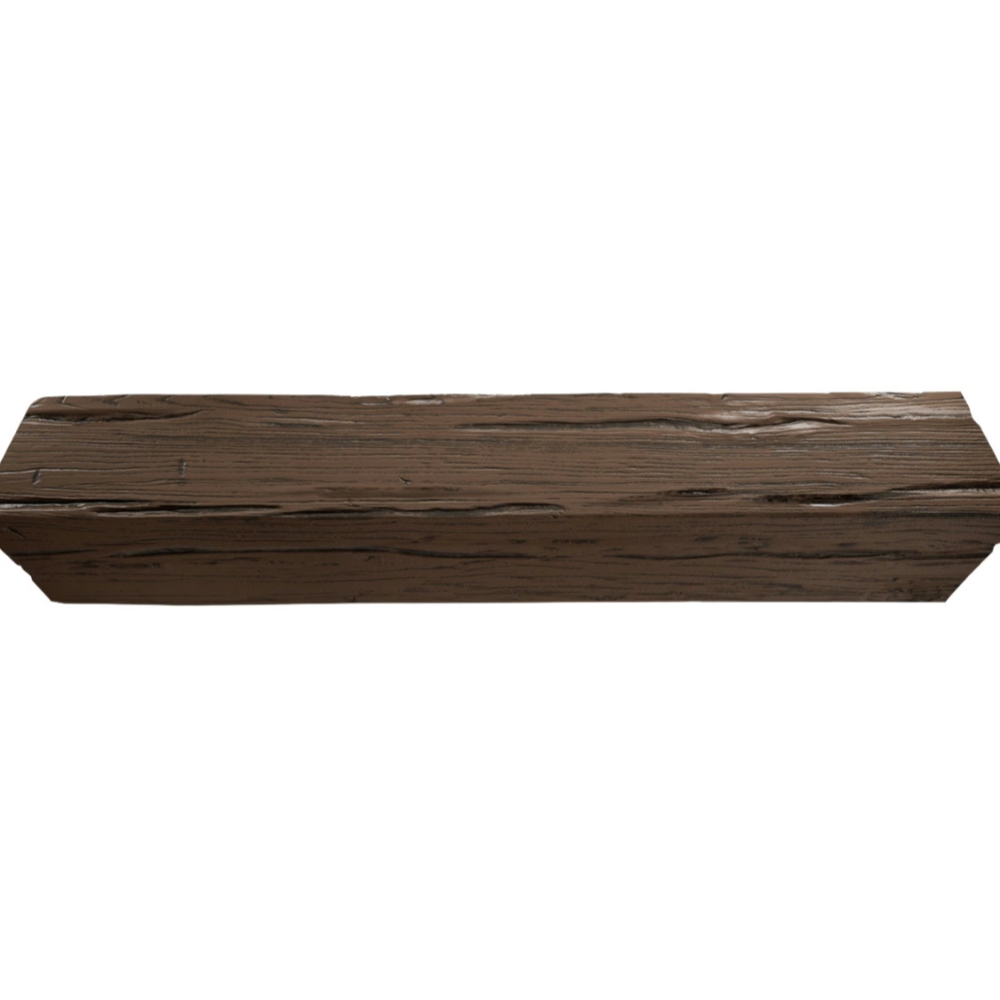
Design Integration with Building Information Modeling
Contemporary building projects increasingly use Building Information Modeling (BIM) as the primary coordination tool for design and construction documentation. In a BIM workflow, all building elements — structural, mechanical, electrical, and architectural — are modeled in three dimensions, allowing clash detection and spatial coordination before construction begins.
Custom beam design integrates naturally with BIM workflows. The beam manufacturer can receive digital model data directly from the project's BIM platform, using the model geometry to generate the beam specifications directly rather than requiring translation from two-dimensional drawings. This direct digital handoff reduces the risk of miscommunication between the design intent and the manufacturing specification.
For projects with complex ceiling geometries — curved surfaces, irregular angles, integrated building systems — BIM integration with beam manufacturing is particularly valuable. The model data captures the exact spatial conditions, and the beam manufacturer uses this data to produce beams that fit precisely within the modeled environment. The result is a beam installation that aligns with the BIM model, satisfying the coordination requirements of the construction process and delivering a finished result that matches the design intent.
Specifying Beams for Building Code Compliance
Building codes establish minimum performance requirements for materials used in construction, and decorative beams may be subject to these requirements depending on their application and location within the building. Understanding the applicable code requirements and specifying beams that satisfy them is an essential part of the design and procurement process.
Fire rating requirements are the most common regulatory consideration for decorative beams. In many occupancy types — hotels, assembly spaces, educational facilities — interior finish materials, including decorative beams, must meet specific flame spread and smoke development ratings. Standard polyurethane beams typically achieve certain fire ratings, but projects with more stringent requirements may need custom formulations with enhanced fire retardance.
The applicable standard varies by jurisdiction. In the United States, ASTM E84 (or UL 723) establishes the test method for flame spread and smoke development on building material surfaces. In Europe, the equivalent is the Euroclass system defined in EN 13501. Projects in other markets may use different standards entirely. The beam specification must be developed with awareness of the applicable standard for the project's location.
OEM manufacturers can provide beams in fire-rated formulations that meet the applicable standard for the project. The fire rating should be documented with test reports from an accredited testing laboratory, and these reports should be included in the project's submittal package to demonstrate code compliance.

Supply Chain Reliability for Construction Projects
Construction projects depend on material supply chains that are reliable and predictable. Delays in material delivery cascade through the construction schedule, displacing subsequent trades and ultimately affecting project completion dates. The supply chain reliability of OEM custom beams depends on several factors that can be managed through proper procurement practice.
Establishing firm production commitments with the manufacturer before production begins protects the project's place in the production schedule. A written purchase order that specifies quantities, delivery dates, and pricing provides the contractual basis for the manufacturer's production commitment. For large projects with multi-phase delivery, the purchase order should establish the schedule for phased deliveries that align with the construction sequence.
Maintaining communication with the manufacturer throughout the production period allows early identification of any issues that might affect delivery timing. A manufacturer who encounters material shortages, equipment issues, or other production challenges will usually have some advance warning, and early communication allows the project team to adjust plans before the delay becomes critical.
Finished goods inventory at the project site should be protected from damage, moisture, and excessive heat or cold that might affect the beams before installation. Most polyurethane beams are relatively insensitive to typical on-site conditions, but prolonged exposure to direct sun on a dark finish or contact with standing water should be avoided.

Post-Installation Performance
The long-term performance of custom beams in building applications depends on proper installation and appropriate material selection for the installation environment. With these factors properly addressed, custom polyurethane beams deliver decades of service with minimal maintenance.
The dimensional stability of polyurethane is particularly valuable in building applications where beams may be exposed to HVAC systems, temperature differentials between conditioned and unconditioned spaces, or humidity variations across seasonal cycles. Unlike natural wood, which responds to these conditions with expansion, contraction, and potential warping, polyurethane maintains its dimensions and appearance regardless of environmental fluctuations within the specified operating range.
For building operators and property managers, the low-maintenance nature of polyurethane beams represents a practical advantage over natural timber. Annual inspection and refinishing — the maintenance cycle for natural timber beams in most building environments — is not required for polyurethane. Periodic cleaning to remove accumulated dust and dirt is typically all that is needed to maintain the beam's appearance over its service life.
Technical References
ASTM standards cited in every specification
Test Data
Lab results from internal testing program
Updated 2026
Reviewed against current product specs