The popular imagination tends to associate custom manufacturing with large-scale commercial projects — hotels, office towers, restaurant chains. While these projects do represent a significant portion of the custom beam market, they are not the whole story. Individual homeowners, independent designers, and small contractors also have needs that fall outside what any catalog can serve, and they benefit equally from the ability to specify exactly what they want rather than choosing from among available options.
A single-beam project might involve matching an existing beam in a historic property, creating a feature beam for a unique architectural feature, or producing a custom corbel and beam combination that cannot be found in any combination of standard products. The quantity is one; the design requirement is specific. OEM custom production, including single-unit and small-quantity production runs, serves these needs.
When One Beam Is Enough
Several situations arise in practice where a project needs exactly one beam, or a very small number of beams, that cannot be met by standard catalog products.
In historic renovation and restoration projects, matching the existing beams is often the primary requirement. A century-old farmhouse with original timber beams may need one or two replacement beams where decay or structural compromise has occurred. Finding a catalog product that matches the profile, texture, and color of century-old timber is essentially impossible. A custom-produced beam, developed from measurements and photographs of the existing beams, provides an exact match that preserves the historic character of the space.
Unique architectural features present another common single-beam scenario. A circular turret with a domed ceiling may need a curved beam that follows the dome's geometry. A bay window with non-standard proportions may need a fascia beam cut to an unusual angle. These one-off requirements are precisely what custom production is designed to address.
Interior design projects with strong aesthetic visions sometimes call for beam details that serve as sculptural elements within the space — a single oversized beam as a room divider, a cantilevered beam that creates a dramatic architectural gesture, or a beam with integrated shelving or display features. These custom-functional elements require design and manufacturing that goes beyond what catalog products can provide.

The Economics of Small-Quantity Custom Production
Custom manufacturing is commonly perceived as expensive, and for large-scale production runs, this perception is not entirely accurate — custom production often costs less per unit than catalog products when the full lifecycle cost is considered. However, for very small quantities, particularly single units, the economics do shift. Tooling development and setup costs are spread across fewer units, driving the per-unit cost higher.
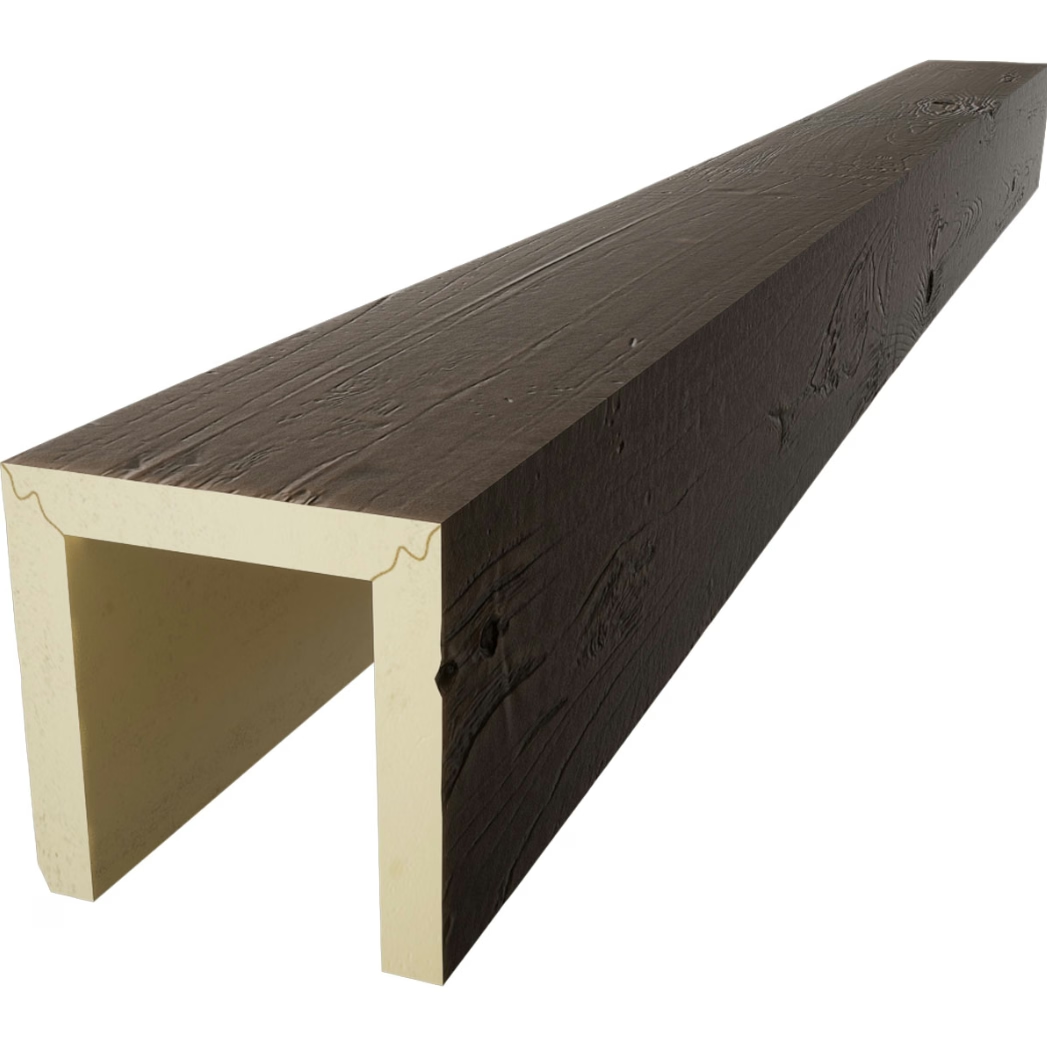
That said, the absolute cost of a single custom beam is often lower than many clients expect. A basic rectangular beam with a custom wood-grain texture and a specified finish may be produced at a cost that is competitive with a high-end catalog beam of equivalent quality. The premium for customization — the additional cost over a standard product of the same basic profile — reflects the value of getting exactly what the project requires rather than settling for an approximation.
For clients with budget constraints, several strategies can make small-quantity custom production more accessible. Simplifying the profile — using a standard cross-section rather than a fully custom geometry — reduces tooling costs while still allowing customization of texture and finish. Selecting a standard profile size minimizes material waste and machining time. Working with manufacturers who have capabilities for small-quantity runs ensures that the client is not paying for large-scale production infrastructure they do not need.
Working with Manufacturers on Small Orders
Not all beam manufacturers are set up to accommodate single-beam orders. Manufacturers focused on high-volume commercial production may have minimum order quantities that exclude small orders, or they may not have the prototyping capabilities needed to develop and approve a custom specification on a single-beam scale.
Identifying manufacturers who actively serve the small-quantity market requires some research. Companies with dedicated prototyping services, those who market to independent designers and homeowners, and manufacturers with flexible production capabilities are more likely to have the systems and culture needed to handle single-beam orders professionally.
When engaging a manufacturer for a single-beam order, clear communication is essential. The client should provide as much information as possible about the requirements: dimensioned sketches or drawings, photographs of reference beams, samples of existing materials that the new beam must match, and a clear description of the installation context. The more information the manufacturer has, the more accurately they can develop a specification that meets the client's expectations.
Prototype and Approval for Single Beams
The prototype and approval process for a single custom beam is necessarily more focused than for a large production run, but it remains important. Producing a short length of the beam for approval before committing to the full-length production ensures that the texture, finish, and dimensional characteristics are correct before the final product is made.
For single-beam orders, the prototype may serve double duty — a short section that is produced, reviewed, and, if approved, becomes the template for the full-length beam. The client reviews the prototype in the context of their project, makes any adjustment requests, and the manufacturer produces the final beam to the revised specification.
Digital tools have improved the approval process for small-quantity custom work. High-resolution photographs and video of prototype beams allow manufacturers and clients to evaluate texture and color details remotely, reducing the number of physical samples that need to be shipped and handled. For clients who can visit the manufacturer's facility, seeing the prototype in person provides the most reliable basis for approval.
Delivery and Installation of Custom Single Beams
Single custom beams are typically shipped via standard freight carriers, carefully packaged to prevent damage during transit. The packaging for a single beam should include protective end caps, surface protection for textured and painted finishes, and strapping or crating appropriate to the beam's dimensions and weight.
The light weight of polyurethane beams relative to natural wood of equivalent size is a significant advantage for single-beam orders. A beam that would require a specialized freight shipment in solid timber can often be shipped via standard ground freight in polyurethane, reducing both cost and complexity. For clients who need to transport the beam themselves, the manageable weight makes it feasible to handle the beam without specialized equipment.
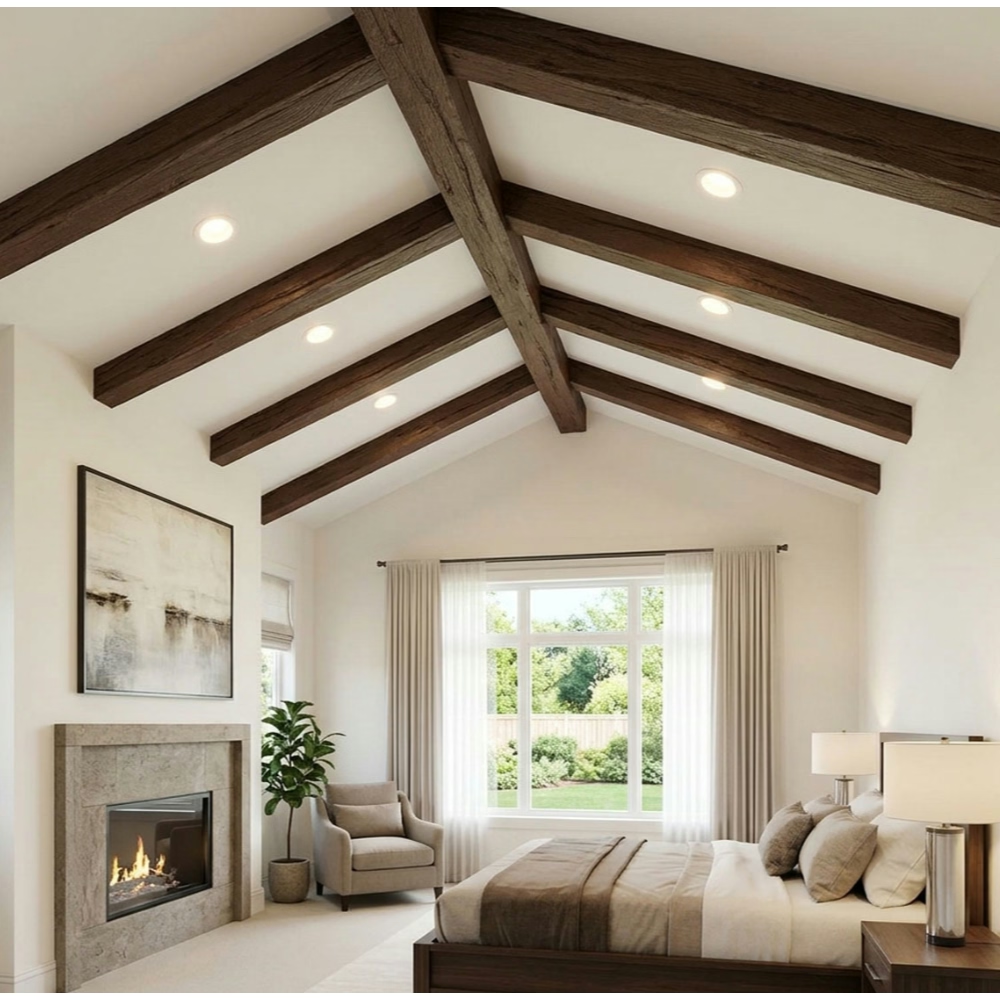
Installation of a single custom beam follows the same principles as installation of any polyurethane decorative beam. The mounting method is determined by the installation context — ceiling, wall, or freestanding — and by any load considerations. For single-beam installations where the beam is a focal point of the room, the quality of the installation detail is especially important. The beam's prominence means that any installation imperfection is immediately visible, so taking the time to achieve a clean, precise installation is worth the extra care.

Building Long-Term Relationships for Ongoing Customization
A client who has a positive experience commissioning a single custom beam is well positioned to benefit from the manufacturer's services in future projects. The documentation developed for the first project — the specifications, the approved prototypes, the quality standards — provides a foundation for faster and more accurate quoting on subsequent orders.
Designers and architects who establish relationships with custom beam manufacturers gain access to a resource that enhances their service to clients. When a project requires something that cannot be found in a catalog, the designer's ability to commission custom production expands the range of design solutions available, increasing the quality of the work and the satisfaction of the clients.
Even for the homeowner who commissioned a single beam for a personal project, the relationship with a custom beam manufacturer can be valuable for future needs. The next room renovation, the garden structure, the basement finishing project — each might benefit from the same customization capability that served the first project.
Technical References
ASTM standards cited in every specification
Test Data
Lab results from internal testing program
Updated 2026
Reviewed against current product specs


