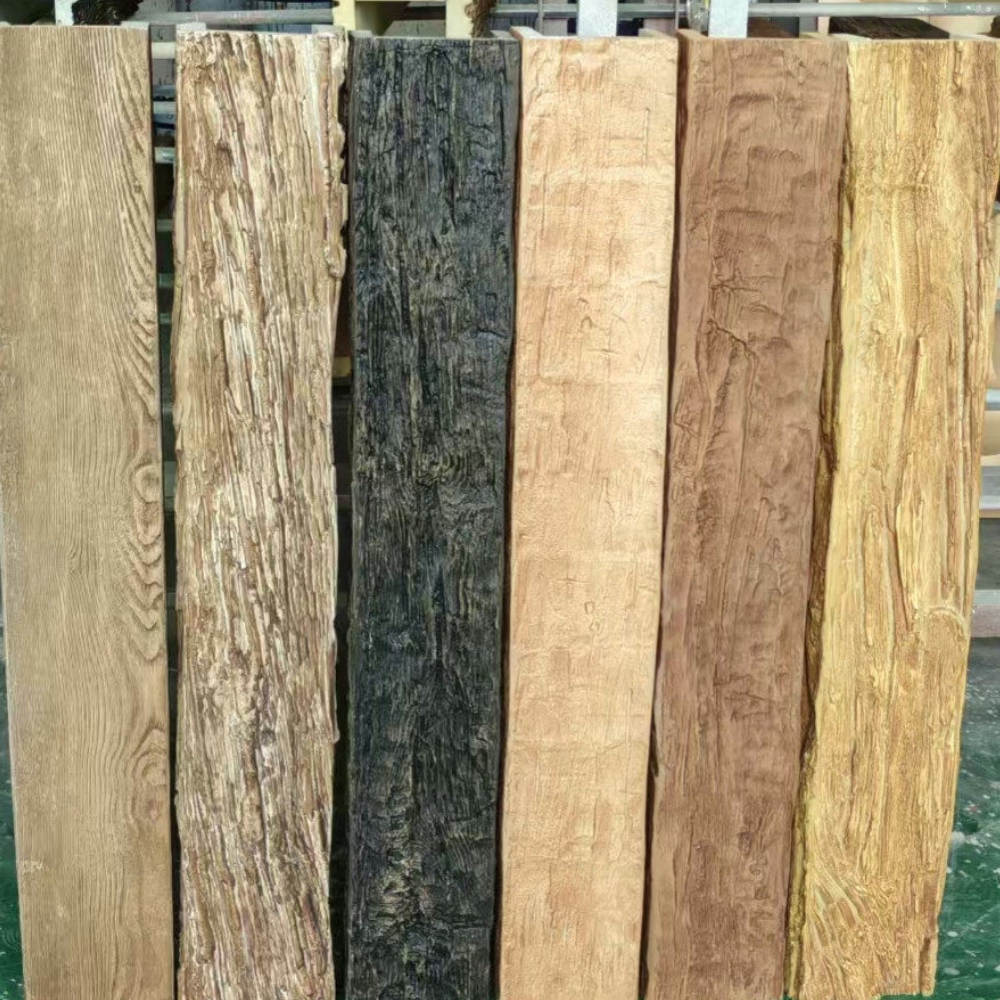
Curved architectural forms create visual drama that straight-line construction cannot match, but integrating lighting with curved surfaces introduces complexities that challenge even experienced designers. Custom curved polyurethane faux beams with pre-cut spotlight openings address these challenges through manufacturing precision that transforms difficult installations into predictable processes. Understanding how factory production handles curved geometry illuminates why these specialized products increasingly appear in sophisticated ceiling designs.
The geometry of curved surfaces affects every aspect of lighting integration. Fixture positioning must account for curvature that shifts surface normals across the span. Light distribution from curved openings differs from flat-ceiling installations, creating gradients that can be leveraged intentionally or must be compensated. Pre-cut specifications address this curved geometry systematically, producing openings positioned and oriented appropriately for intended lighting effects.
Curved Geometry Fundamentals
Architectural curves follow various mathematical profiles that influence how spotlight openings should be positioned and oriented. Circular arcs create constant curvature where fixture positioning follows predictable patterns. Elliptical and parabolic curves vary curvature intensity across spans, requiring positioning adjustments that account for changing geometry. Pre-cut specifications should reference specific curve profiles to ensure appropriate opening treatment.
The surface normal at any point on a curved beam indicates the direction perpendicular to the surface at that location. Spotlight fixtures aim along surface normals to illuminate surfaces below, creating even illumination without harsh shadows. Pre-cut opening positions should be calculated based on surface normal directions, ensuring that fixture aims achieve intended illumination evenness across curved surfaces.
Curvature radius affects how deeply light penetrates surfaces below curved beams. Tight radius curves create concentrated illumination that might be too intense for general applications. Gentle curves produce more distributed light that works better for ambient illumination. Pre-cut specifications should consider curvature radius when establishing opening spacing and fixture selection.
Opening Orientation on Curved Surfaces
Flat-cut openings positioned on curved surfaces create edge conditions where beam material meets opening perimeter unevenly. One edge of a flat opening on a curved surface will gap open while the opposite edge compresses against beam material. This mismatch compromises both appearance and structural integrity. True radius-cut openings match curved geometry exactly, producing even edges that transition smoothly between beam surface and opening perimeter.
The plane of pre-cut openings on curved beams must account for curvature across multiple axes. In addition to the primary curve following beam length, beam cross-sections may also curve, creating compound curvature that complicates cutting. Factory CNC equipment can program compound curves accurately, producing openings that match complex geometry precisely. Site cutting cannot achieve this accuracy regardless of operator skill.
Angular positioning of openings relative to viewing directions affects how fixtures appear within curved ceiling compositions. Openings visible from multiple directions require trim treatment that works across viewing angles. Openings oriented toward specific viewing positions can be optimized for those viewpoints. Pre-cut specification should document viewing requirements that guide opening orientation decisions.
Fixture Selection for Curved Applications
Adjustable fixtures on curved surfaces experience gravity loads that differ from flat-ceiling installations. The aim direction of gravity affects how adjustable components seat in their mechanisms, potentially creating different friction characteristics than vertical mounting. Pre-cut specifications should verify that selected fixtures perform acceptably on curved surfaces, potentially requiring fixture testing before final specification.
Thermal behavior of fixtures on curved surfaces differs from flat-ceiling mounting due to altered convection patterns. Heat rising from fixtures on curved surfaces follows different paths than from flat ceilings, potentially affecting heat dissipation. Pre-cut beam depth specifications should account for any altered thermal conditions, ensuring adequate thermal management even with modified convection.
Trim visibility on curved surfaces requires consideration across the range of viewing angles that occupants might experience. Trims that appear appropriate from one viewpoint might look misaligned from different positions. Pre-cut opening orientation should consider primary and secondary viewing positions, optimizing trim appearance for the most important viewpoints while maintaining acceptability across all likely viewing angles.
Design Integration Strategies
The rhythm of spotlight openings along curved beams creates visual patterns that either reinforce or compete with beam curvature. Regular spacing emphasizes arc geometry through repetition, while irregular spacing might create tension that draws attention away from curve form. Pre-cut specifications should establish spacing that supports intended design emphasis, using opening distribution to strengthen rather than undermine architectural composition.
The relationship between spotlight aims and beam curvature determines how illuminated surfaces respond to lighting. Beams curving toward illumination targets might receive concentrated light that reveals texture dramatically. Beams curving away might appear shadowed relative to adjacent surfaces. Pre-cut design should map lighting distribution across curved forms, establishing opening positions and fixture aims that create intended illumination patterns.
Contrast between illuminated and shadowed areas on curved beams creates depth perception that flat surfaces cannot achieve. The interplay between light and shadow across curved forms can make beams appear sculptural rather than merely decorative. Pre-cut specifications should leverage this dimensional potential, using spotlight integration to enhance rather than flatten the inherent drama of curved architectural forms.
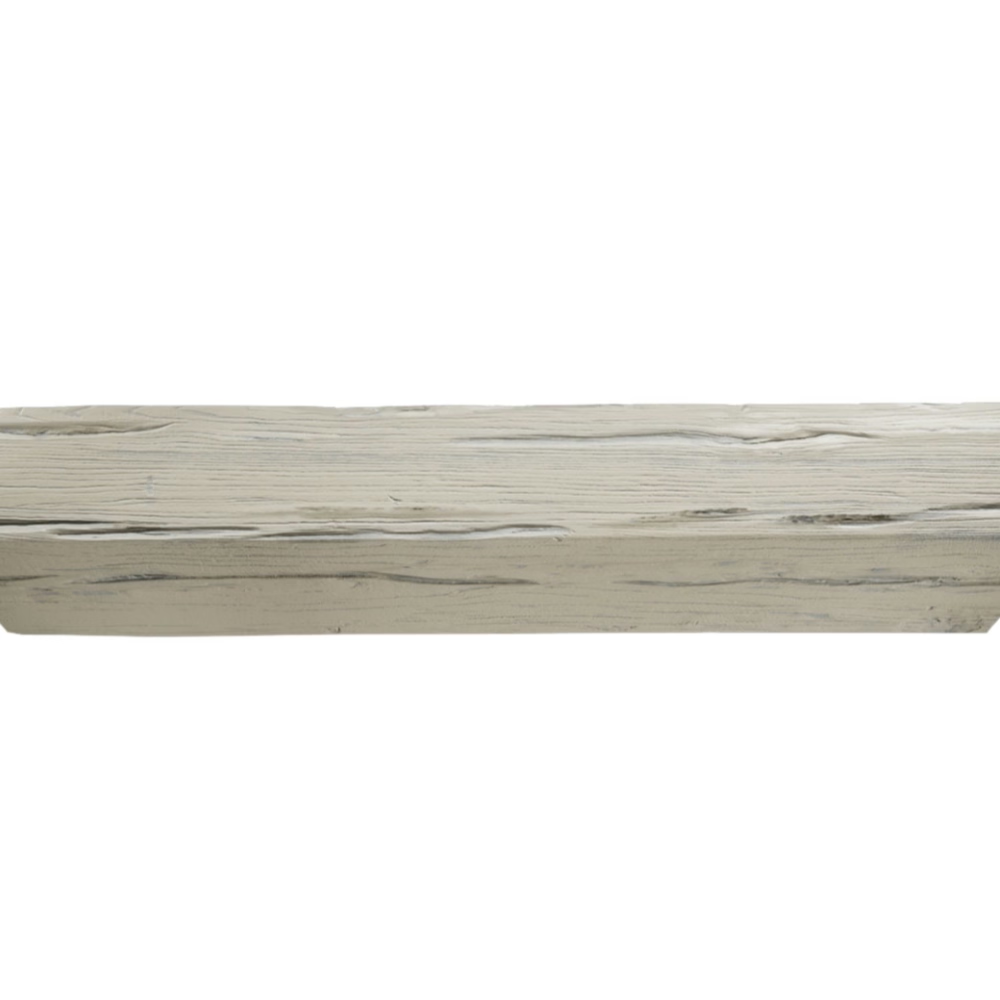
Manufacturing Process for Curved Openings
CNC machining enables the precision that curved spotlight opening production requires. Multi-axis machines can position cutting tools along complex curved paths, following mathematical curves accurately across entire beam spans. This manufacturing capability transforms design intentions into physical products with precision that traditional craft methods cannot approach.
Quality control for curved openings involves verifying geometry match between produced openings and specified curves. Coordinate measurement systems capture three-dimensional positions of opening edges, comparing results against mathematical specifications. This verification ensures that openings meet tolerance requirements across entire curved spans, not just at discrete measurement points.
Material preparation before cutting affects how curved openings appear in finished products. Factory finishing typically precedes cutting on curved surfaces, ensuring that opening edges receive the same surface treatment as exposed beam areas. This preparation sequence produces consistent appearance throughout, with opening edges matching beam surfaces without visible transition.
Installation Considerations for Curved Beams
Temporary support requirements for curved beam installation differ from straight beam approaches. The curved form creates different loading conditions that affect brace positioning and capacity requirements. Professional installers understand these differences and prepare support systems before beam positioning, ensuring adequate stability throughout the installation process.
Fixture mounting in curved openings requires alignment references that account for surface curvature. Level measurements differ on curved surfaces where true horizontal varies with position. Pre-cut specifications should include guidance on alignment verification, helping installers achieve proper fixture positioning despite unfamiliar reference conditions.
Final fixture aiming on curved beams should consider how aiming affects both illumination and appearance across multiple viewing positions. The aiming that achieves ideal illumination might create trim appearance that looks wrong from certain angles. Pre-cut specifications should document any compromise positions that balance illumination effectiveness against visual appearance appropriately.
The integration of spotlight lighting with curved polyurethane faux beams represents sophisticated design achievement enabled by manufacturing precision. Pre-cut openings transform challenging curved geometry into predictable installations that achieve design intentions reliably. The resulting ceiling compositions demonstrate how technical capability expands design possibilities, creating spaces where curved architectural forms and precision lighting combine into compelling spatial experiences.


Pre-cut spotlight openings for custom curved polyurethane faux beams unlock design possibilities that traditional approaches cannot practical实现. By bringing manufacturing precision to challenging curved geometry, these products enable installations that achieve both aesthetic refinement and functional lighting. The resulting spaces reward exploration, revealing nuances of light and form that emerge from thoughtful integration of manufacturing capability with design ambition.
Technical References
ASTM standards cited in every specification
Test Data
Lab results from internal testing program
Updated 2026
Reviewed against current product specs