Architecture has always relied on craft to achieve its finest expressions. The great buildings of history did not emerge from standard components and off-the-shelf solutions — they were the product of skilled artisans working with clients, architects, and master builders to create elements precisely matched to each project's unique requirements. Columns were sized for specific entablatures, cornices projected exact distances calculated to cast precise shadows, and ornamental details expressed the particular values and aspirations of their patrons.
This tradition of bespoke craft has never entirely disappeared, but economic pressures have pushed most contemporary building toward standardised solutions. The cost of custom fabrication, the time required for specialist craft, and the complexity of coordinating non-standard elements have collectively favoured the generic over the particular. Most interior architectural detailing today uses components that were designed for mass production and selected from catalogues — functionally adequate but rarely extraordinary.
PU faux beams represent a significant opportunity to recover the tradition of bespoke architectural craft. The material's workability, the flexibility of custom moulding processes, and the relative economy of polyurethane fabrication enable architectural detailing that would be entirely impractical in natural timber. For architects, interior designers, and property owners seeking distinctive results, custom beam millwork opens creative horizons that catalogue products cannot reach.
The Case for Bespoke Fabrication
Standard beam products serve the majority of applications admirably. Their established profiles, proven fixings systems, and reliable availability make them the sensible default choice for projects where time, budget, or technical complexity constrain design ambition. There is no inherent virtue in custom fabrication for its own sake — only when the design vision demands something that standard products cannot provide does bespoke work become the appropriate solution.
Custom beam fabrication becomes necessary when projects require non-standard dimensions, unique profiles, matched existing detailing, or integrated services. A period property restoration may require beam profiles that echo the original structural timber — profiles that cannot be sourced from current catalogues because they were formed by the specific growth patterns of century-old trees. A contemporary project may demand beams of unusual width or length that exceed the practical limits of standard production runs. An interior with existing timber elements may require colour and texture matching that only bespoke finishing can achieve reliably.
The process of commissioning custom fabrication begins with a design concept — typically expressed through sketches, mood images, and written descriptions of the desired aesthetic and functional outcome. These reference materials go to a specialist manufacturer capable of translating design intent into manufacturable specifications. Technical drawings and material samples confirm the proposed solution before production begins, ensuring that both designer and maker share a clear understanding of the intended result.
Profile Development and Custom Moulding
The creation of a custom beam profile starts with the detailed specification of the desired cross-sectional shape. This specification may be derived from historical research, generated through design exploration, or developed in response to specific structural or spatial constraints. Whatever the origin, the profile must be defined precisely before mould manufacture can begin.
Modern CNC milling technology enables the creation of custom moulds directly from digital profile definitions. A skilled machine operator translates the profile drawings into toolpaths that direct the cutting head to shape the mould surface with sub-millimetre accuracy. The resulting mould — typically machined from solid aluminium tooling blocks or high-density modelling board — captures every detail of the proposed profile in negative form.
From this custom mould, prototype samples can be produced for evaluation before full production commitment. These samples enable tactile assessment of the profile's visual weight, shadow-casting characteristics, and surface texture quality. Design adjustments can be incorporated into revised mould iterations, ensuring that the final production tooling produces elements that precisely match the design vision.
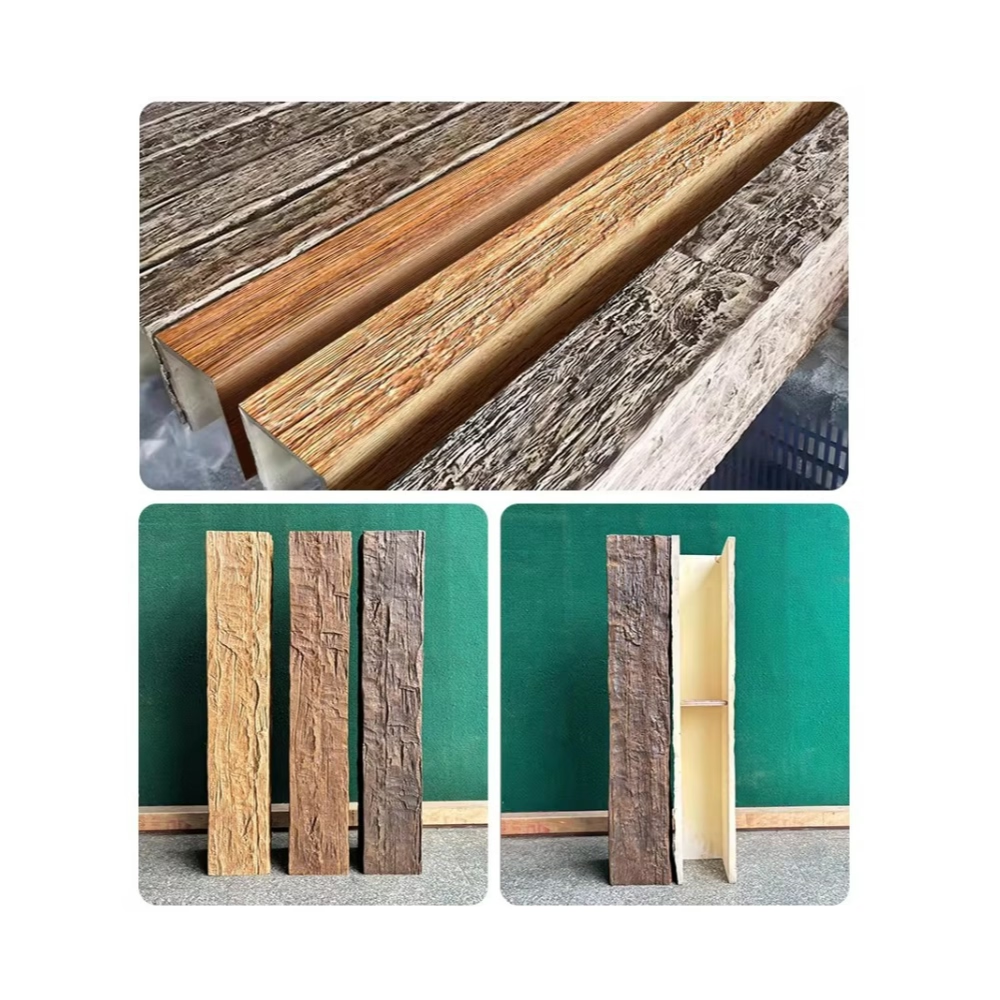
Surface texture specification represents a critical component of custom profile development. The texture of a beam surface — whether smooth, wire-brushed, hand-scraped, or deeply carved — fundamentally affects how the beam reads in the finished installation. Custom finishing techniques including sandblasting, acid etching, and mechanical texturing can replicate the surface characteristics of specific timber species or achieve entirely novel effects that natural wood cannot provide.
Colour Matching and Custom Finishing
Colour matching to existing timber elements requires a systematic approach that accounts for both the base colour and the way that colour interacts with the surrounding light environment. A beam specified to match an existing exposed timber joist must appear correct not only under the display lighting of a showroom but in the actual conditions of the installation space — including the colour temperature of the room's artificial lighting and the quality of available daylight.
Professional finishers work with physical samples placed in the actual installation environment before committing to the full production run. This on-site verification identifies any colour shift that occurs when the sample is viewed in context rather than isolation. Multiple sample iterations may be necessary to achieve a match that reads as correct across all lighting conditions the finished installation will encounter.
Custom finishing options extend well beyond colour matching to encompass functional treatments as well. Fire-retardant coatings achieve classifications required by building regulations in commercial contexts. UV-stable finishes prevent colour fade in installations receiving significant direct sunlight. Anti-graffiti coatings facilitate cleaning in public-facing applications. Each functional requirement adds a layer of specification complexity but enables applications that would otherwise be unsuitable.
Metallic and special-effect finishes represent an emerging custom finishing category. Bronze-patina effects, aged-brass tones, and contemporary metallic sheens applied to beam profiles create unexpected intersections between natural material aesthetics and industrial finishing techniques. These hybrid appearances appeal to designers seeking to push beyond conventional material categories toward genuinely novel spatial experiences.
Integrated Service Installations
Custom beam millwork can incorporate services that standard products cannot accommodate. The hollow cross-section of many beam profiles provides space for running electrical cables, data wiring, speaker cabling, and low-pressure air ducting — concealing infrastructure that would otherwise require visible conduit or trunking runs.
The integration of lighting within custom beam elements represents one of the most practically valuable custom fabrication possibilities. Channels routed within the beam mass accommodate LED strip lighting, small-profile downlight housings, or linear light sources. The resulting installation presents clean beam surfaces to the room while housing all electrical components out of sight. This approach proves particularly valuable in spaces where surface-mounted lighting would compromise the architectural purity of the beam installation.
Acoustic treatment integration addresses the sound quality challenges common in spaces with hard reflective surfaces. Custom beam profiles can incorporate acoustic absorption materials within their mass, using the structural element to address both visual and acoustic design objectives simultaneously. This dual-function approach simplifies ceiling composition and reduces the separate acoustic treatment layer that would otherwise require additional ceiling void depth.
Collaboration and Communication
Successful custom beam fabrication depends on clear communication between designer, manufacturer, and installer. Each party brings specialised knowledge that must be shared effectively for the project to succeed.
Designers should provide manufacturers with as much context as possible — not only the specific beam requirements but the broader design intent, the constraints the installation must navigate, and the priorities that should guide decisions when specifications conflict. A manufacturer who understands why a particular detail matters is better equipped to propose practical solutions when unexpected challenges arise.
Manufacturers contribute technical expertise that helps translate design ambition into achievable production. They can identify material limitations, suggest profile modifications that improve structural performance or installation practicality, and advise on finishing options that affect long-term appearance retention. This advisory role is most valuable when engaged early in the design process, before critical decisions have been made.
Installers provide the practical knowledge of site conditions and fixing methods that informs final specification. The installer who will actually fit the beams can identify access constraints, substrate issues, and sequencing considerations that affect both profile design and mounting system selection. Their input during the design phase prevents installation difficulties that might otherwise surface only when the beams arrive on site.
Realising Design Vision Through Custom Work
The reward for navigating the additional complexity of custom fabrication is an interior architectural result that could not be achieved any other way. Spaces featuring bespoke beam millwork carry a quality of considered intention that distinguishes them from environments built entirely from standard components.
This distinctiveness has tangible value. Boutique hospitality venues, premium retail environments, and high-end residential projects all benefit from architectural differentiation that justifies their positioning and supports their commercial objectives. The investment in custom fabrication returns through enhanced brand perception, improved customer experience, and the sense of occasion that bespoke environments create.
For the design community, custom beam fabrication represents an opportunity to exercise the full scope of creative capability that training and talent enable. The constraints of catalogue selection and standard product ranges limit what can be achieved; custom work removes these limits, returning to the designer the freedom to create environments that express their full design vision.
Technical References
ASTM standards cited in every specification
Test Data
Lab results from internal testing program
Updated 2026
Reviewed against current product specs


