The ceiling has been liberated. After decades of neutrality — the default assumption that ceilings should be flat, white, and forgotten — contemporary interior design has rediscovered the overhead plane as a canvas for creative expression. Architects and interior designers routinely specify ceiling treatments that would have seemed impossibly ambitious a generation ago: vaulted volumes with exposed structure, elaborate coffers and relieving panels, bold painted surfaces that transform the spatial experience, and of course the dimensional architecture that beam installations provide.
This liberation has been enabled partly by changing client expectations and partly by the evolution of construction materials and techniques. The availability of lightweight but rigid structural products, efficient lifting equipment, and sophisticated fixing systems means that ceiling installations that once required specialist skills and significant structural engineering can now be realised by competent tradespeople using readily available products. PU faux wood beams sit at the centre of this democratised ceiling design revolution, providing the material vocabulary that enables both professionals and sophisticated home owners to achieve contemporary ceiling architecture.
The Contemporary Ceiling Design Landscape
Modern ceiling design encompasses several distinct approaches, each with its own aesthetic logic and appropriate beam specification strategy. Understanding these approaches enables intentional design decision-making rather than arbitrary selection from a catalogue of options.
Geometric minimalism represents the most austere contemporary ceiling approach. The defining characteristics are restraint, precision, and the elimination of everything that cannot be justified. In this context, beam installations use thin-section, precisely detailed elements that read as architectural lines rather than decorative objects. The beams are not the focal point of the ceiling — they are one carefully considered element among several that together create a composed spatial environment. Dark-stained finishes in this context create strong shadow lines; pale finishes recede and maintain the overall visual quietness.
Structural expression takes a different approach, celebrating the beam as a structural element with genuine presence. The beams in this mode are substantial — deep sections with pronounced profiles that read as load-bearing even when they are purely decorative. This approach suits loft conversions, warehouse conversions, and other spaces with exposed structural elements that the beam installation can echo or complement. The structural expression aesthetic is honest about the decorative nature of the beams while treating that decoration as a legitimate architectural statement rather than a simulation of something it is not.
Material layering combines beams with other ceiling elements — plasterboard sections, metal panels, glass panels, integrated lighting — to create composite ceiling compositions of considerable complexity. This approach demands sophisticated design coordination to prevent the ceiling from becoming busy rather than rich. The beam element in a layered ceiling composition should play a specific role — adding texture, establishing rhythm, or providing visual weight — rather than simply contributing to visual noise.
Profile and Configuration Innovations
Contemporary beam design has moved beyond the standard profiles of earlier product ranges, with manufacturers and designers developing configurations that serve specific contemporary design purposes.
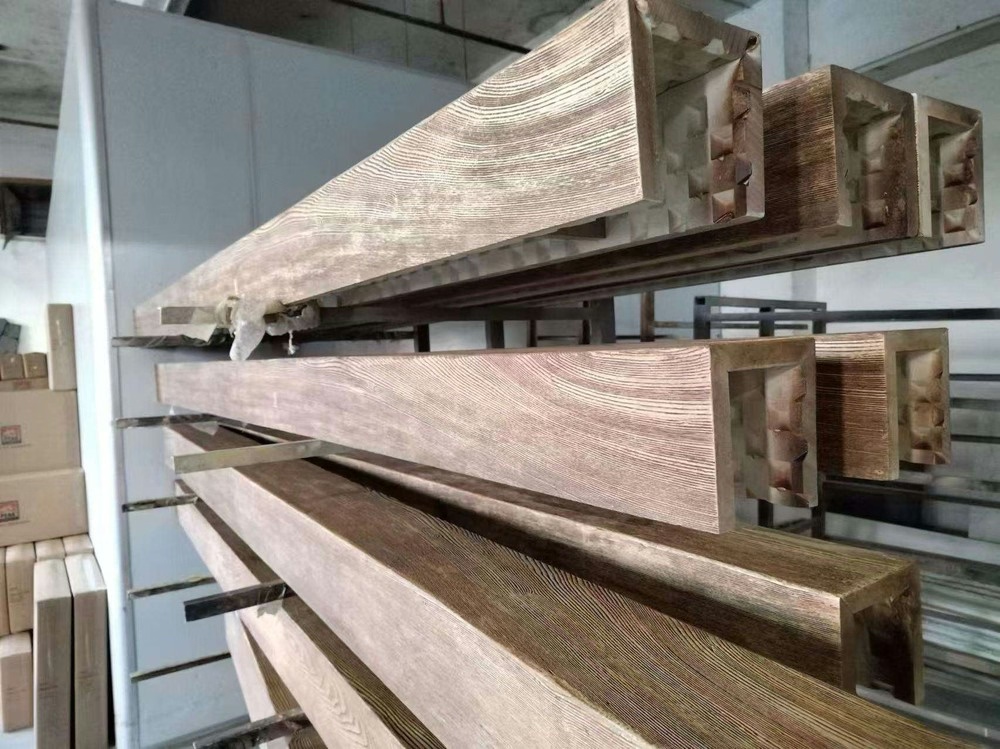
Thin-flange beam profiles represent a significant innovation for contemporary applications. These beams — with flanges of 20mm or less — read more as architectural lines than traditional timber sections. They are particularly effective in runs of parallel beams where the thin section creates delicate shadow lines across the ceiling without the visual mass of conventional beams. The thin-flange approach suits contemporary interiors with clean lines, minimal ornament, and generous natural light.
Paired and grouped beam arrangements use multiple slim sections in deliberate proximity to create composite elements of greater visual presence. Two or three narrow beams mounted close together create the impression of a single substantial beam while maintaining the refined quality of thin-section elements. This grouped approach provides flexibility in visual weight — a ceiling can be made more or less substantial by adjusting the number of beams in each group without changing the individual beam section.
Asymmetric beam configurations break from the traditional symmetry of beam installations to create deliberately unbalanced compositions. A single dominant beam off-centre in a room, or a cluster of beams occupying one corner of a ceiling, creates dynamic tension that suits contemporary interiors seeking to avoid the static quality of symmetrical arrangements. This asymmetric approach requires confident design judgment to avoid appearing arbitrary or unresolved.
Colour and Texture in Contemporary Applications
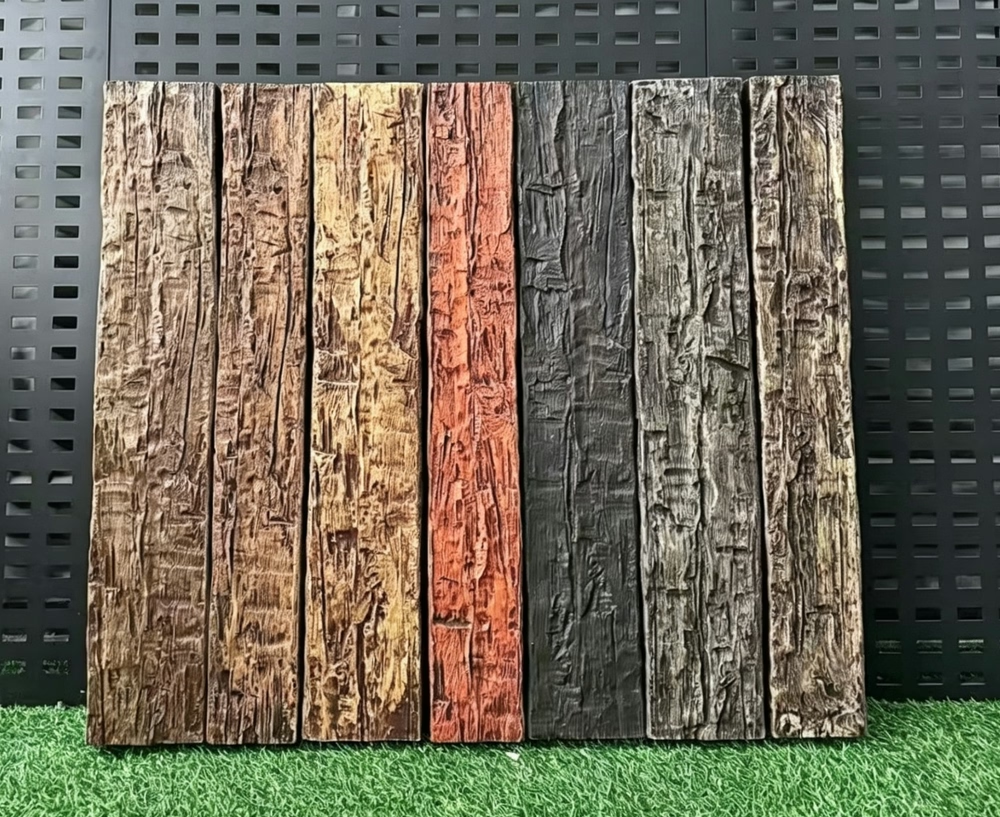
The colour palette for contemporary beam installations has expanded dramatically beyond the natural wood tones of earlier products. Contemporary interiors can accommodate beams in virtually any colour, opening creative possibilities that traditional timber could never offer.
White and near-white beams have become increasingly popular as contemporary interiors have embraced pale, neutral palettes. These beams maintain the dimensional interest of beam architecture while contributing to the light, airy quality that characterises contemporary residential design. White beams require high-quality surface finishes to avoid appearing plastic or artificial; the best products achieve a subtlety that reads as premium rather than cheap.
Dark and black-stained beams provide the strongest contemporary statement. Deep charcoal, carbon, and pure black finishes create dramatic contrast against pale walls and ceilings, establishing the beam as a dominant visual element. These dark treatments work best in rooms with generous natural light, where the dramatic shadow play creates atmosphere without gloom. In darker rooms or north-facing spaces, dark beams may absorb too much available light and make the space feel smaller than it is.
Grey tones occupy the middle ground between white and black, providing textural interest without the stark contrast of darker finishes. Warm greys with brown or beige undertones relate naturally to stone, plaster, and neutral upholstery materials. Cool greues with blue undertones suit contemporary kitchens and bathrooms where white and grey dominate the material palette. The specific grey selected should be tested against the actual room conditions — artificial lighting and the colour temperature of adjacent surfaces both affect how grey reads in context.
Lighting Integration for Contemporary Effect
Contemporary ceiling design integrates lighting as a primary design element rather than a secondary functional requirement. The relationship between beams and lighting defines the atmosphere of the space and must be considered from the earliest design stages.
Linear LED installations recessed into beam soffits create a contemporary aesthetic that has become something of a signature treatment. The continuous light line — running the full length of the beam or along the junction between beams — provides ambient illumination while maintaining the clean lines of the beam composition. This integrated approach eliminates the visual clutter of surface-mounted light fixtures while delivering the atmospheric quality that contemporary interiors demand.
Grazing light — directed steeply across beam surfaces to emphasise texture — creates the most dramatic beam lighting effect. The interaction between light and shadow across a textured beam surface generates a three-dimensional quality that flat lighting flattens. Grazing light is most effective on deeply textured beam profiles; on smooth or subtly textured surfaces, it may produce minimal visible effect.
Smart lighting control has transformed the possibilities for beam lighting. Systems that adjust colour temperature, intensity, and distribution enable the same beam installation to serve multiple atmospheric purposes — bright functional illumination during the day, warm ambient light in the evening, and subtle accent lighting for social occasions. The beam installation becomes a dynamic element rather than a static feature, changing character throughout the day and across different uses.
Case Studies in Contemporary Beam Design
Examining specific contemporary beam installations reveals the design thinking that underlies successful implementations and the pitfalls that less successful projects encounter.
A recent residential project in a converted industrial building demonstrates the structural expression approach effectively. The original cast-iron columns and steel roof trusses established an industrial spatial language that the beam installation deliberately echoed. Substantial faux beams in a dark-stained finish ran perpendicular to the original roof trusses, creating a layered ceiling composition that acknowledged both the original structure and the contemporary intervention. The result was a space that read as authentically industrial while providing the warmth and material richness that the clients sought.
A new-build contemporary house showcases the geometric minimalism approach. The architect specified thin-flange beams in a warm grey finish running parallel across the main living space ceiling. The beams were precisely spaced at 600mm centres — echoing the module of the furniture arrangement below — creating a ceiling rhythm that organised the open-plan space without overwhelming it. Integrated linear LED lighting within the beam soffits provided ambient illumination that complemented the natural light from the full-height glazed elevation.
A boutique hotel project illustrates the material layering approach in a commercial context. The designer combined faux beams with pre-cast concrete panels, brass trim details, and integrated acoustic insulation to create a ceiling composition that addressed aesthetic, acoustic, and fire performance requirements simultaneously. The beams contributed warmth and texture to what might otherwise have been a cold industrial ceiling, while the concrete panels and brass trim established the contemporary luxury aesthetic that the hotel brand required.
Realising Contemporary Ceiling Vision
The gap between a compelling ceiling design concept and a successfully realised installation depends on several factors that can be planned and managed.
Specifying quality products from the outset prevents the compromises that arise when budget pressure leads to specification downgrades mid-project. The beam products should be selected for their contribution to the overall design vision rather than their cost; the ceiling treatment is too visible and too permanent to be the place where design compromises are made.
Engaging experienced installers for contemporary beam work ensures that the precision required for clean contemporary detailing is achieved. Contemporary installations demand tighter tolerances, cleaner joints, and more careful alignment than traditional rustic installations where some imperfection reads as authentic character. The installation team should understand the design intent and share the commitment to precision that contemporary execution requires.
Commissioning the lighting design as an integral part of the beam specification — rather than treating it as a secondary consideration — ensures that the atmospheric potential of the beam installation is fully realised. The lighting designer and beam supplier should coordinate their specifications to ensure compatibility and to optimise the interaction between beam surface, beam profile, and light source.
Technical References
ASTM standards cited in every specification
Test Data
Lab results from internal testing program
Updated 2026
Reviewed against current product specs


