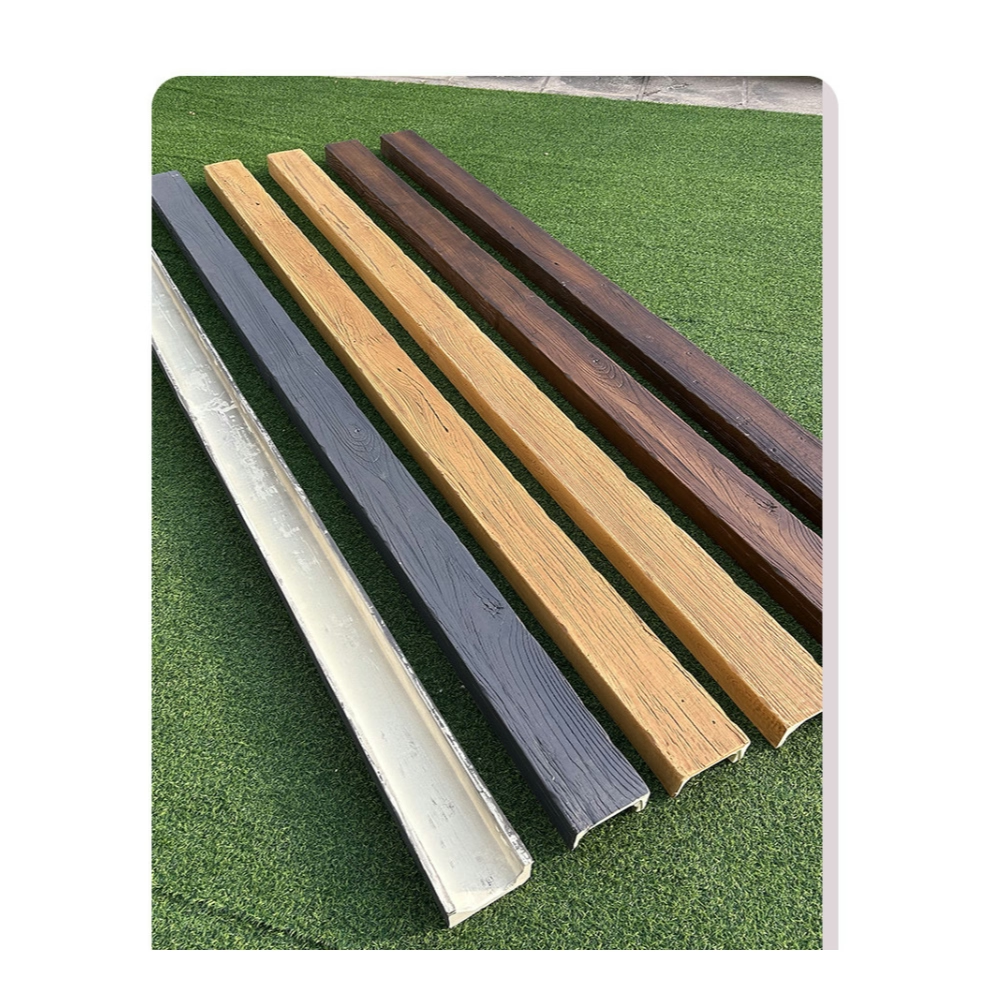
Every contractor who has managed an exposed beam installation knows the hidden labor costs that are not visible in the initial estimate. Cutting beams to length with acceptable accuracy, assembling multi-piece beam shells, applying finish to visible surfaces, fitting beams around existing obstructions, touching up finish at fastener locations — each of these operations consumes time and generates small frustrations that compound into meaningful delays. Pre-assembled PU faux beams address this category of installation friction directly by relocating the fabrication and finishing work to a controlled factory environment where quality can be managed systematically, leaving only the hanging work for the jobsite.
The pre-assembled designation refers specifically to beams that arrive at the jobsite as complete units — fully formed, fully finished, and ready for immediate installation without any assembly, cutting, or finishing work. A contractor removing a beam from its packaging should be able to lift it directly to the ceiling, position it against the mounting surface, and secure it with fasteners within minutes. The beam arrives with its finish applied and cured, its structural backing if any already integrated, and its mounting provisions already engineered and located. This is fundamentally different from a beam kit that requires assembly from components, or a raw beam that requires finishing before or after installation.

The most common pre-assembled configurations include single-piece beams for spans up to typical residential dimensions, multi-span beam assemblies that combine several beam sections with integrated connecting hardware, and architectural detail assemblies that include corbels, plates, or decorative elements pre-attached to the main beam body. Each configuration addresses a specific installation scenario, and understanding which configuration matches the project requirements is the first decision point in the specification process. For simple ceiling installations where the beam simply spans between two load-bearing points, a single-piece pre-assembled beam is almost always the appropriate choice. For more complex installations involving multiple beams intersecting at angles or beams that must navigate around existing structural elements, the manufacturer should be consulted about custom pre-assembled configurations.
The time savings from pre-assembled beams scale roughly with the number of beams in the project and the complexity of each installation. For a typical residential living room with three beams spanning the ceiling, the installation labor savings compared to site assembly and finishing might amount to four to eight hours of skilled labor — a meaningful reduction in total project cost that does not sacrifice quality, because the factory finishing that replaced site finishing is consistently superior to what can be achieved in the field. For commercial projects with dozens of beams across large ceiling areas, the cumulative savings can represent days of labor and significantly compressed project schedules.
The quality dimension of pre-assembled beams deserves emphasis. Factory finishing — whether stain and clear coat, paint, or textured coating — is applied in controlled conditions with proper surface preparation, consistent application technique, and adequate cure time between coats. The result is a finish that is more uniform, more durable, and more consistent than field-applied finishes, which are subject to temperature and humidity variation, dust contamination, and the time pressures that characterize active construction sites. The beams arrive looking as though they were installed by a master finisher, because in a meaningful sense they were — just not on site.
Fast-track construction projects benefit particularly from the pre-assembled beam approach. In commercial interiors where the overall project schedule is compressed and multiple trades are working in sequence, any activity that can be parallelized rather than serialized saves time. Pre-assembled beams can be ordered, manufactured, and finished during the period when other work — framing, electrical, mechanical — is proceeding in the space. When the beams arrive, they can be installed in a single pass without waiting for finish work to be completed elsewhere. This parallelization of activities is a significant scheduling advantage that project managers should factor into their planning.
For renovation projects in occupied spaces, pre-assembled beams offer a practical advantage that goes beyond time savings: they reduce the duration and intensity of the disruption to the household or business. A beam installation that would require two days of messy finishing work — sanding, staining, clear coating, cure time — can be completed in a matter of hours with pre-assembled beams, with only the drilling of fastener holes and the hanging of the beams occurring in the occupied space. The contrast in disruption level can be the deciding factor in whether a homeowner or business owner chooses to proceed with the project at all.
The mounting systems used with pre-assembled PU beams are engineered for both security and appearance. Most installations use concealed clip systems that attach to the building structure and engage with mounting channels built into the beam, holding it securely against the ceiling while leaving no visible hardware. Some configurations use decorative exposed hardware — iron straps, forged brackets — that is part of the intended aesthetic. The manufacturer should be consulted about the appropriate mounting system for each installation, including the type and spacing of structural fasteners required for the specific ceiling construction and the expected load conditions.
Quality pre-assembled beams incorporate structural reinforcement that allows them to span between mounting points without sagging or deformation over time. This reinforcement is typically a lightweight metal or engineered wood structural member running the full length of the beam, capable of supporting its own weight plus any additional loads from lighting fixtures, ceiling fans, or other items that might be attached to the beam. The reinforcement is concealed within the beam shell, invisible from below, but it is what allows the beam to perform structurally while remaining lightweight enough for simple installation.
Shipping and handling of pre-assembled beams requires attention to packaging quality. The beams should arrive in custom-fit packaging that protects the finish and the structural integrity during transport. Any beams that arrive with damaged finishes should be documented with photographs immediately upon receipt and reported to the supplier before installation, as damage discovered after installation becomes a claim that is more difficult to process. Professional suppliers use foam inserts, cardboard wrapping, and outer crating as appropriate to the beam dimensions and the anticipated transport conditions.
Technical References
ASTM standards cited in every specification
Test Data
Lab results from internal testing program
Updated 2026
Reviewed against current product specs