
Even the most skillfully executed joints represent compromises with perfection. Adhesive lines, reinforced splices, and carefully concealed transitions all acknowledge that joints exist, however invisibly. For some applications, this acknowledgment suffices—installations where quality standards are reasonable and where occasional close inspection won't reveal manufacturing origins. But for projects demanding the absolute highest ceiling aesthetics, joint-free designs represent the only acceptable solution. These remarkable products demonstrate what's possible when manufacturing capabilities push toward their theoretical limits.
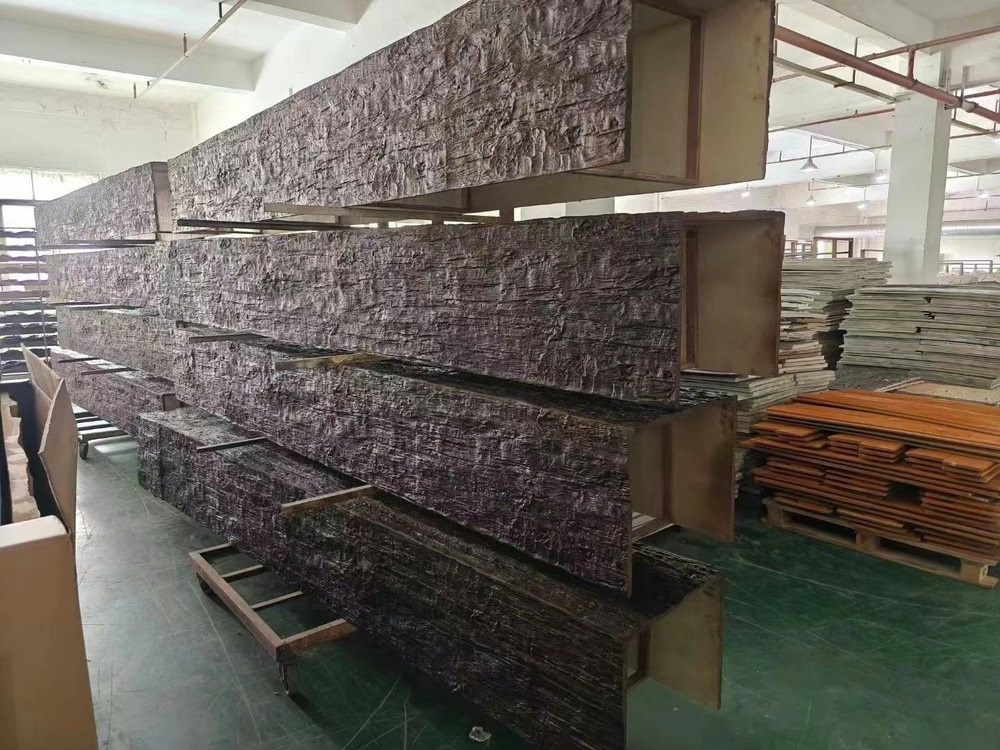
Joint-free PU faux wood beams achieve continuous appearances that approach the impossible. Span limitations still constrain what's physically possible—manufacturing, transportation, and handling all impose practical limits on product length. But within those limits, joint-free designs deliver appearances that satisfy the most demanding aesthetic requirements, eliminating the compromises that jointed installations necessarily involve.
The Manufacturing Achievement Behind Joint-Free Beams
Producing long continuous beam sections requires manufacturing capabilities that push industrial processes toward their limits. Extrusion systems capable of maintaining consistent dimensions across extended lengths demand precision engineering and rigorous quality control. Any variation in the production process compounds over distance, eventually exceeding acceptable tolerances.
Material formulation for long production runs must maintain consistent characteristics throughout. Density, color, texture, and every other property must remain identical from first inch to last. This consistency requires raw material quality control and process monitoring that exceed what shorter production runs might demand. The effort invested in maintaining consistency enables the aesthetic quality that joint-free designs require.
Molding processes for joint-free profiles involve tool design and maintenance that accommodate thermal expansion, material flow variations, and wear patterns across extended production runs. The molds themselves become engineering achievements, precision instruments producing identical results thousands of times over. This manufacturing precision translates directly into installation simplicity—joint-free beams arrive ready for mounting without preparation that spliced products would require.
Advantages Beyond Aesthetics
Joint-free designs eliminate the potential failure points that any joint represents. A perfectly made joint may perform indefinitely, but joint-free products remove the question entirely. No adhesive can fail, no reinforcement can corrode, no connection can loosen when there are no connections to consider. This inherent reliability appeals to applications where maintenance access is difficult or where failure consequences are severe.
Installation speed increases dramatically when beams arrive ready for mounting without preparation. The measuring, cutting, fitting, and joining that spliced installations require simply don't exist for joint-free products. Mounting proceeds directly from positioning to attachment, cutting installation time in half for comparable spans.
Quality consistency improves with joint-free designs because there's no assembly quality to consider. The beam that leaves the factory maintains its appearance through transport, handling, and installation. Jointed products introduce variability at each assembly step, creating opportunities for quality differences that joint-free designs eliminate entirely.
Span Limitations and Solutions
Physical constraints inevitably limit maximum beam lengths regardless of manufacturing capabilities. Transport restrictions on long loads, handling requirements for safe movement, and installation practicalities all impose effective limits on joint-free product sizes. Understanding these limits helps specify products that can actually be delivered and installed.
For spans exceeding practical manufacturing limits, combining joint-free main spans with carefully located spliced additions can maintain overall visual unity. Positioning joints at naturally concealed locations—behind architectural features, in shadow zones, or at ceiling transitions—keeps the vast majority of visible beam surface joint-free. This hybrid approach delivers near-joint-free appearance while accommodating practical constraints.
Custom fabrication for specific projects enables joint-free appearance for non-standard applications. Projects with unique requirements may justify the tooling investment and production planning that custom joint-free beams require. While more expensive than standard products, custom fabrication ensures that appearance requirements are satisfied completely.
Design Applications Suited to Joint-Free Products
High-end residential installations frequently specify joint-free beams for the absolute best appearance. Primary viewing areas, great rooms, and spaces where ceiling beams receive direct attention demand the quality that joint-free products deliver. The investment in premium materials signals attention to detail that distinguishes excellent work from merely adequate completion.
Hospitality venues benefit from joint-free aesthetics in lobbies, ballrooms, and public spaces where first impressions matter. These commercial applications also appreciate the reliability advantages that joint-free designs provide, eliminating potential maintenance concerns in spaces where appearance quality directly affects customer perception.
Healthcare and educational facilities increasingly specify joint-free beams for新建 installations. The reliability advantages matter in these applications where maintenance disruption affects operations and where ceiling work may require coordination with sensitive equipment or activities. Joint-free installation simplifies project planning by eliminating the variables that joint assembly introduces.

Installation Considerations for Joint-Free Beams
Handling long joint-free beams requires planning and equipment appropriate to their length. Forklifts, beam lifts, or multiple handlers may be necessary for beams that exceed what individuals can safely manage. Planning material handling before delivery prevents delays and safety incidents during installation.
Support spacing for long beams must account for increased span and associated deflection. The calculations for joint-free installations often differ from spliced approaches because continuous beams behave differently than assembled sections. Engineering review ensures that mounting systems accommodate actual load conditions.
Alignment becomes more critical with longer beams because errors accumulate over distance. Precise layout, careful positioning, and verification under good lighting ensure that extended installations proceed without developing alignment problems. Any deviation over long spans becomes more noticeable than equivalent deviation across shorter distances.
The Value Proposition of Joint-Free Excellence
The premium that joint-free beams command reflects genuine manufacturing and performance value. The consistency, reliability, and appearance advantages translate directly into benefits that clients receive. When ceiling aesthetics truly matter—when spaces are designed to impress, when quality signals value, when maintenance concerns must be minimized—joint-free designs deliver what other products cannot.
Evaluating whether joint-free premium is justified requires honest assessment of specific project requirements. For applications where appearance at close inspection matters, where joints would receive scrutiny, the premium represents money well spent. For applications where beams will be largely concealed, where joints would fall in naturally concealed locations, or where budget constraints are binding, jointed alternatives may prove more appropriate.
The pursuit of joint-free excellence represents the ultimate expression of faux beam aesthetics. These products demonstrate that the gap between manufactured and authentic continues to narrow, that with sufficient engineering investment, manufactured elements can achieve appearances indistinguishable from natural originals. For projects demanding the absolute best, joint-free designs deliver exactly what's required.
Technical References
ASTM standards cited in every specification
Test Data
Lab results from internal testing program
Updated 2026
Reviewed against current product specs


