Human beings possess an innate appreciation for symmetry that reflects evolutionary pressures dating back millennia. Faces, bodies, and natural formations that exhibit bilateral symmetry register as more attractive, more trustworthy, and more stable than asymmetrical alternatives. This preference extends to architectural perception—spaces with symmetrical ceiling treatments often feel more resolved and comfortable than those with irregular beam arrangements, even when viewers cannot articulate exactly why the difference matters.
Symmetrical paired beam installations leverage this perceptual tendency to create ceilings that feel intentionally designed and architecturally complete. The precision of matched pairs, positioned with careful attention to spatial geometry, produces an orderliness that supports other design elements without competing for attention. This balanced approach proves particularly effective in formal spaces, traditional interiors, and contemporary designs where clean geometry takes priority.
Principles of Symmetrical Ceiling Design
Effective symmetry begins with understanding what should be symmetrical—the visible beam elements, or the structural logic they represent? True architectural symmetry typically mirrors a central axis, with beams on opposite sides of the axis maintaining equivalent dimensions, spacing, and positioning. This rigor distinguishes genuine symmetry from approximate balance that merely suggests order without achieving it.
Central axis symmetry works naturally in rectangular spaces where a clear center exists. A pair of beams equidistant from the room's center point, running parallel to the room's length, creates an immediately perceptible bilateral balance. The mathematical precision of this arrangement—the left side matching the right—satisfies deep-seated perceptual expectations that viewers register before conscious analysis begins.
Off-center symmetry creates more complex but equally satisfying arrangements. In rooms with asymmetric architectures—hearths offset from room centers, door placements that prevent centered treatments, or irregular ceiling planes—symmetry can relate to functional elements rather than geometric centers. A pair of beams flanking a fireplace, though offset from room center, achieves its own balanced logic that feels intentional rather than arbitrary.
Designing with Paired Beams
The "paired" aspect of symmetrical beam design suggests two-beam arrangements rather than single accent beams or multi-beam runs. This limitation focuses design attention on the relationship between elements rather than pattern complexity. Pairs create visual groupings that read as unified treatments rather than accumulated decoration.
Proportions within pairs affect perceived relationships. Beams installed close together read as a single unit—perhaps a built-up beam simulating dimensional lumber. Wider spacing between paired beams allows each to register individually while maintaining their paired identity. The choice between these approaches depends on desired visual weight and the scale of the overall installation.
Cross-pairing—two pairs crossing at right angles—creates grid formations that work well in square or nearly square rooms. This arrangement provides symmetrical treatment in both directions, achieving balance that reads clearly regardless of viewing angle. The resulting cofferred or cassetted ceiling effect provides architectural richness that supports formal furnishing arrangements.
Installation Considerations for Symmetrical Results
Achieving true symmetry requires precise measurement and marking before any installation begins. The centerline of the room must be established, typically using chalk lines or laser levels that provide visual reference during positioning. Measurements from this centerline to proposed beam locations must balance precisely—any deviation will register visibly against the symmetry the design seeks.
Wall-to-beam relationships matter as much as room-centering. Beams that begin or end at different distances from adjacent walls destroy symmetry perception even when their inter-beam relationships remain balanced. Careful attention to end-point positioning ensures that each beam relates equivalently to the room boundaries it approaches.
Temporary bracing during installation maintains positioning while adhesive cures or fasteners are placed. Even slight movement during the fastening process can introduce asymmetries that compound across the installation. Professional installers use sophisticated bracing systems that hold beams precisely in position until mounting is fully secured.
Contextual Suitability of Symmetrical Treatments
Formal living spaces—drawing rooms, dining rooms, formal entries—suit symmetrical beam treatments that reinforce their architectural formality. The balanced ceiling treatment complements furniture arrangements that often follow their own symmetrical logic. A formal dining table centered beneath a symmetrical beam pair creates spatial coherence that benefits the entire room composition.
Contemporary interiors can incorporate symmetry through updated material choices while maintaining traditional spatial logic. Modern beam profiles—cleaner, more refined than rustic alternatives—bring symmetry into current design contexts. The result bridges historical precedent and contemporary sensibility, providing design continuity that respects architectural heritage.
Bedrooms present nuanced opportunities for symmetry depending on furnishing preferences. Rooms with centered beds and matching bedside tables benefit from symmetrical beam treatments that reinforce the centered composition. More eclectic bedroom arrangements, where beds sit off-center or furniture groups asymmetrically, might feel constrained by rigid symmetry that conflicts with the intentional imbalance below.
When Symmetry Succeeds and When It Doesn't
Spaces with strong existing asymmetry may resist symmetrical beam treatment. A room with a prominently off-center window wall, a dramatically angled ceiling, or a functional element that demands visual priority might provide insufficient context for balanced beam installation. Attempting symmetry in these spaces produces cognitive dissonance rather than resolution—the beams suggest balance that the architecture contradicts.
Minimalist spaces can struggle with symmetrical beam treatment when the beams introduce excessive visual weight. Minimalism typically favors reduction rather than addition; adding symmetrical beams, even well-proportioned ones, may conflict with the aesthetic goals of spaces defined by their emptiness. When minimalism does incorporate beams, the treatment often favors single, understated elements rather than symmetrical pairs.
Scale relationships determine whether symmetry enhances or overwhelms. Large rooms with generous ceiling height support symmetrical treatment with substantial beams; the space can absorb the visual weight without feeling crowded. Small rooms or low ceilings may find symmetrical treatment creates compression rather than elegance, the beam pair competing with furniture and circulation for visual space.
Maintaining Symmetry Over Time
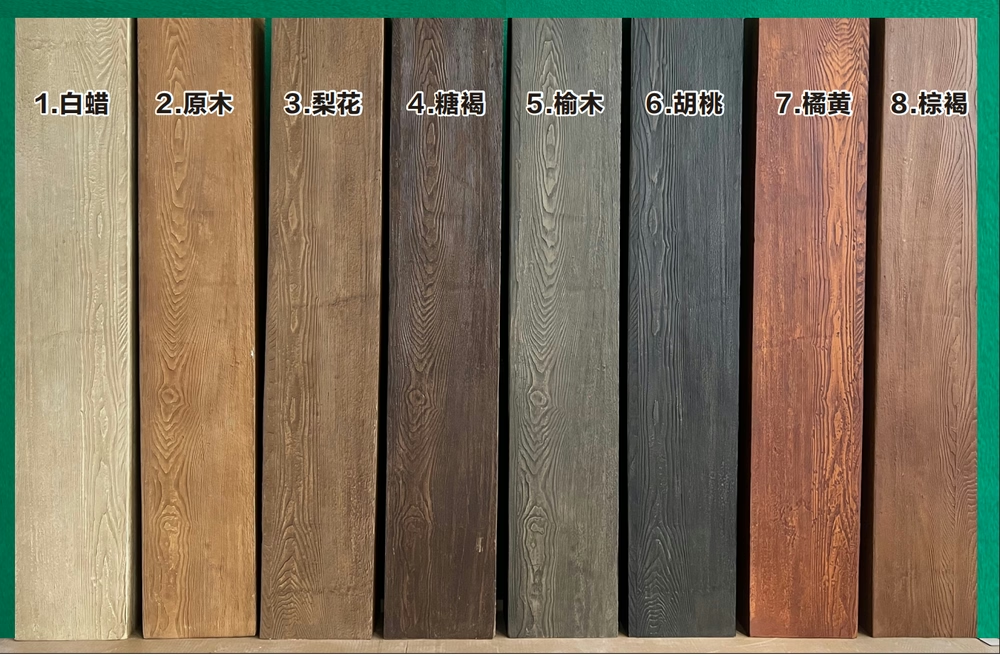
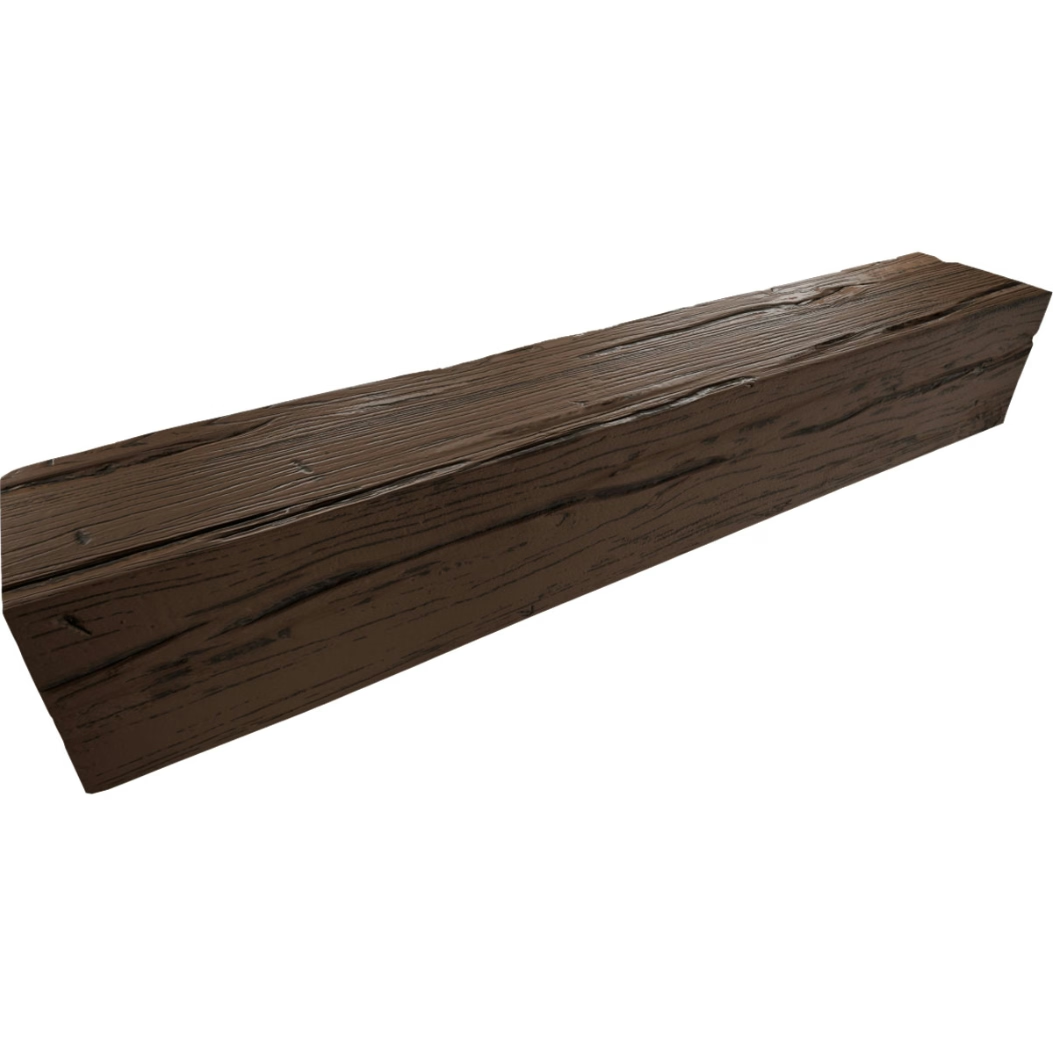
One advantage of manufactured beams for symmetrical installations lies in their consistency. Each beam matches its pair exactly—identical dimensions, identical texture, identical finish. Natural wood cannot provide this precision; even beams from the same tree exhibit variations that challenge perfect symmetry. PU faux beams enable symmetry that remains consistent across decades of service.
Dimensional stability supports long-term symmetry maintenance. Natural wood expands and contracts with humidity variation, potentially shifting beam positions slightly over seasonal cycles. These movements might be imperceptible individually but accumulate over time to compromise installation precision. Polyurethane's stability ensures that the symmetry established at installation persists unchanged through environmental variation.
Repair and replacement considerations favor manufactured consistency. If a beam requires replacement due to damage, the replacement matches original installation exactly. Natural wood finding matching replacement beams—same species, same grain pattern, same dimensions—may be impossible, creating visible discontinuity in the symmetrical arrangement.
Technical References
ASTM standards cited in every specification
Test Data
Lab results from internal testing program
Updated 2026
Reviewed against current product specs


