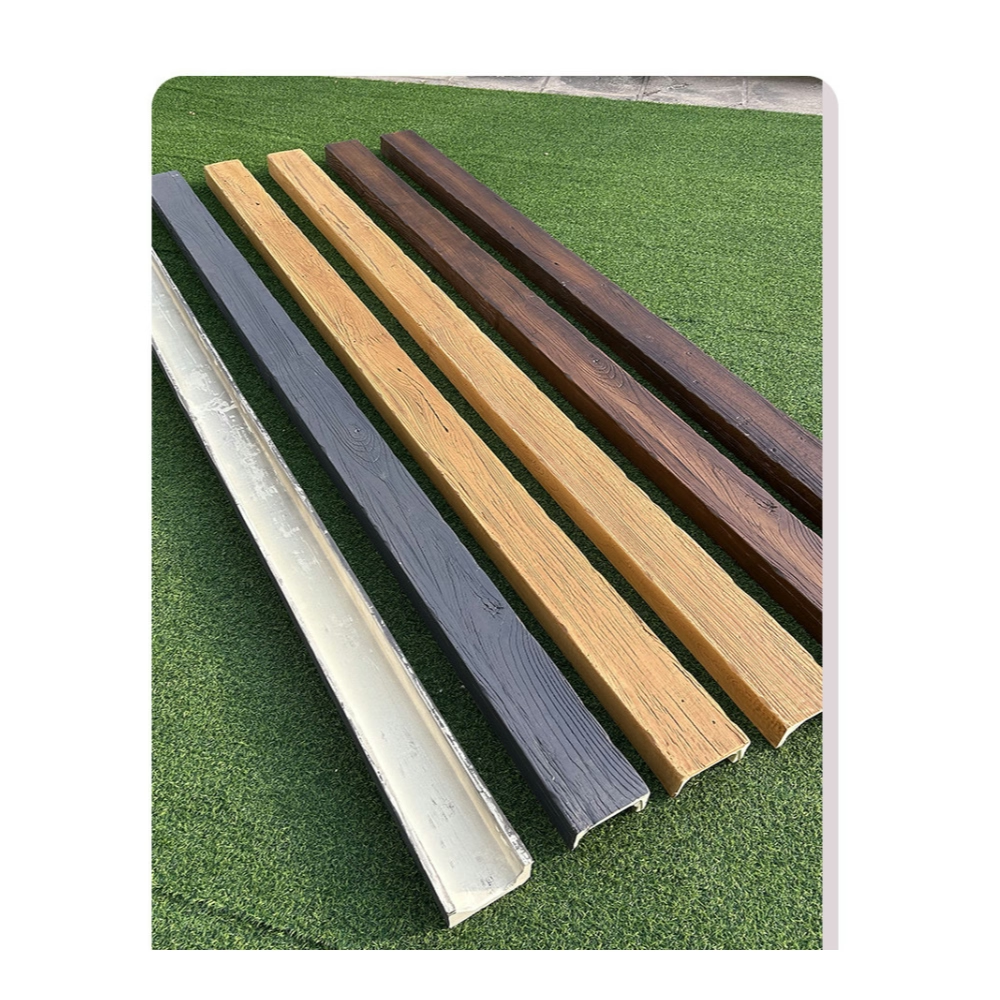
Efficient faux beam installation depends heavily on having pieces cut accurately before installers arrive at the job site. On-site cutting wastes time navigating obstacles and working in confined spaces while achieving inferior results compared to workshop precision. Professional workshops develop systems that produce accurately cut, labeled pieces ready for immediate installation, transforming field work from fabrication into simple assembly.
Workshop Configuration
Effective beam workshops require adequate space for material storage, cutting operations, and assembly verification. Minimum working areas should accommodate beams laid flat with clearance for saw operation and operator movement. Multiple simultaneous operations including cutting, joining, and finishing require proportionally more space.
Lighting quality directly affects cutting accuracy. Uniform illumination across work surfaces eliminates shadows that distort cut line visibility. LED shop lights provide consistent, cool light that does not create heat affecting material or operator comfort. Positioning lights to minimize reflections from polished beam surfaces prevents visibility interference.
Dust collection protects both operator health and workshop cleanliness. Polyurethane cutting produces fine dust that accumulates on surfaces and potentially poses respiratory concerns. Adequate dust collection at cutting locations maintains visibility and cleanliness that support quality work. Portable collectors serve individual tools while central systems serve fixed equipment.
Equipment Selection
Miter saws provide the most versatile cutting capability for beam prefabrication. Compound miter saws with sufficient blade diameter cut through beam profiles cleanly in single passes. Sliding compound miter saws extend cutting capacity for wider beams that fixed-head saws cannot accommodate. Saw selection should match the largest beam profile the workshop expects to cut.
Table saws excel at straight cuts and ripping operations. Cross-cut sleds transform table saws into precision cross-cut stations for production cutting. The flat table surface supports beams securely during cuts, improving accuracy compared to supported cuts on miter saws. Table saws work particularly well for cutting beams to length before profile shaping.
Band saws handle curved cuts and complex profiles that straight saws cannot address. Resawing capability allows thickness reduction for special applications. Band saw blades for polyurethane should have fine teeth that produce smooth cuts without tear-out. This equipment handles specialty work that miter and table saws cannot address.

Blade Selection and Maintenance
Blade choice affects cut quality dramatically. Carbide-tipped blades designed for non-ferrous metals or plastics provide clean cuts through polyurethane without excessive friction that might melt material. Fine-tooth blades, typically 80-100 teeth for 10-12 inch blades, produce smoother cuts than coarse-tooth alternatives.
Blade sharpness directly affects cut quality and operator safety. Dull blades require excessive force that causes binding and potential kickback. Regular inspection identifies teeth that are chipped, missing, or dull. Professional workshops maintain blade change schedules based on cutting volume rather than waiting for visible degradation.
Blade speed affects cut quality for different materials. Variable-speed saws allow optimization for polyurethane versus wood or metal cutting. Lower speeds reduce heat generation that might cause surface melting, while higher speeds improve cut quality in some materials. Matching speed to material maximizes cut quality and extends blade life.
Measurement and Layout
Precise measurement begins with quality measuring tools. Steel tape measures with fractional inch markings provide accuracy appropriate for beam work. Long tapes for measuring extended beams should be checked against reference standards periodically to verify accuracy. Worn or damaged tapes introduce errors that propagate through all measurements.
Layout surfaces should be flat and clean, providing accurate reference for marking. Plywood cutting tables with clamped straightedges provide layout surfaces that maintain accuracy over extended use. Marking with sharp pencils or markers that produce visible lines enables accurate cuts. Mark placement should consider saw kerf that removes material during cutting.
Dimension verification before cutting prevents errors from measurement mistakes. Checking calculated dimensions against reference measurements catches errors before material is cut. The extra moment for verification costs nothing compared to the cost of cutting pieces incorrectly.
Cross-Cutting Techniques
Cross-cut sleds on table saws provide the most accurate cross-cutting capability for production work. These sleds ride in table grooves while a stop block positions workpieces precisely for each cut. The fixed relationship between stop and blade ensures identical cuts across unlimited repetitions. Production runs for multiple pieces of the same length benefit enormously from sled-based cutting.
Miter gauge techniques work for shorter production runs where sled setup time exceeds time savings. The miter gauge guides workpieces at set angles while stops position cut locations. This approach works well for angled cuts including standard 45-degree mitering. Accuracy depends on miter gauge repeatability and stop positioning precision.
Story sticks—physical templates that capture multiple dimensions—eliminate repeated measurement for complex cuts. A story stick marked with beam lengths and angles becomes a reference that ensures consistency across multiple pieces without requiring individual measurement for each cut. This technique works particularly well for pieces that repeat throughout a project.
Angle Cutting for Beam Intersections
Beam-to-beam connections often require angled cuts that create clean intersections. The angle of cut depends on the three-dimensional relationship between intersecting beams, which varies based on beam orientations and ceiling geometries. Calculating correct angles requires understanding the geometry that typical installations create.
Standard 45-degree mitering handles beams meeting at 90-degree angles in the same plane. This standard angle serves many common installations efficiently. However, real building conditions rarely present perfectly 90-degree intersections, requiring adjustment from standard angles.
Compound angle cuts address beams meeting at non-90-degree angles in multiple planes simultaneously. These cuts require precise angle calculation and careful saw setup to achieve accurately. Templates that capture actual site angles enable workshop cutting that matches field conditions precisely.

Coping and Profile Cutting
Coping cuts remove material from beam ends to match three-dimensional wall surfaces. While coping typically occurs in the field due to site-specific conditions, some coping can be pre-fabricated when site measurements enable template creation. Pre-coping accelerates field installation significantly.
Profile cutting shapes beam edges to match architectural details. Fluting, reeding, and decorative edge treatments add visual interest to simple beam profiles. These profile operations typically require specialized tooling including router bits or shaper knives that produce the desired profile consistently.
Router jigs enable controlled routing along beam edges for consistent profile depth and width. Jig construction should account for router base dimensions and bit specifications to achieve repeatable results. Multiple passes with progressively deeper cuts prevent tear-out that single deep passes might cause.
Quality Control and Verification
Checking cut accuracy before pieces leave the workshop prevents field problems that correction would complicate. Dimensional verification with measuring tools confirms that cuts match specifications. Square checking verifies that cross-cuts are truly perpendicular to beam length.
Dry-fit verification assembles cut pieces to confirm that joints work as intended. This assembly occurs without adhesive, using temporary clamping to hold pieces in position. Any fitting issues identified during dry-fit can be addressed before adhesive application makes correction impossible.
Labeling systems identify pieces for their installation locations without requiring identification after wrapping and transport. Marking systems should be legible but removable before installation. Pre-printed labels or hand-written numbering on concealed surfaces creates organized identification that field crews can follow.
Workflow Optimization
Sequencing cutting operations for efficiency reduces overall production time. Grouping similar cuts together eliminates tool repositioning that interrupts workflow. Cutting all pieces of one length before moving to the next length, rather than cutting pieces in installation sequence, minimizes setup time.
Batch processing for repetitive cuts amortizes setup time across multiple pieces. Setting up stops for a specific length and cutting all pieces at that length before changing setup proves far more efficient than setting up for each individual cut. This approach works particularly well for projects with multiple identical pieces.
Documentation of cut specifications enables reproduction if additional pieces are needed.记录 cutting angles, lengths, and any special requirements ensures that future work can replicate current production without reverse-engineering from installed pieces. This documentation becomes a valuable reference for similar future projects.
Professional workshop cutting transforms beam prefabrication from time-consuming field work into efficient workshop production. The investment in proper equipment, technique development, and workflow optimization pays returns through faster field installation and higher quality results. Professional installers who master workshop techniques expand their service capacity and improve profitability while delivering better results to clients.
Technical References
ASTM standards cited in every specification
Test Data
Lab results from internal testing program
Updated 2026
Reviewed against current product specs