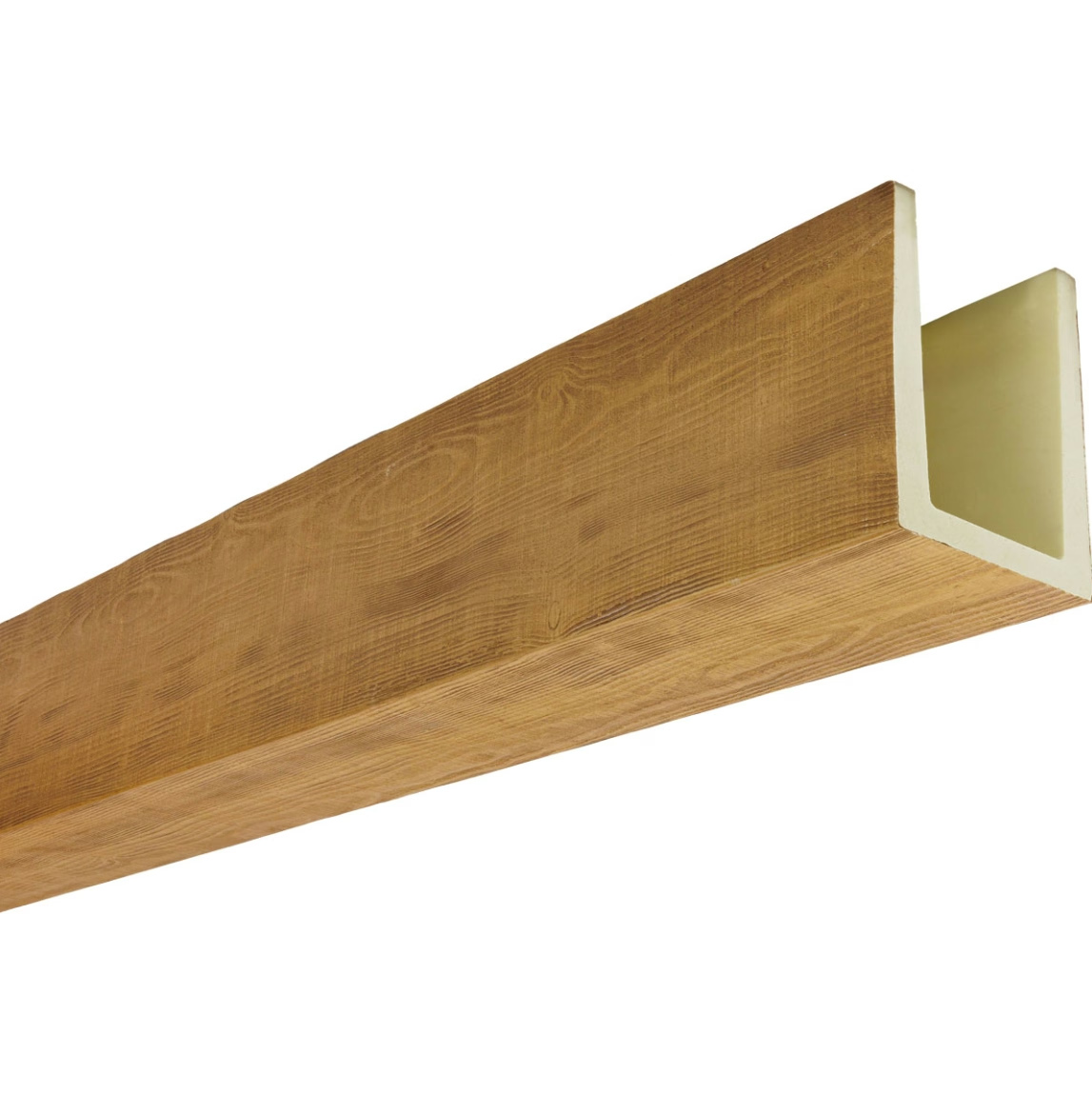
Pricing for premium faux timber beams varies more than most product categories. The spread between budget and premium stock at the same profile can reach 3x. Knowing where the price drivers sit helps trade buyers and project planners budget accurately.
Here's what the 2026 market looks like.
Base pricing by profile
Premium faux timber beam pricing scales with profile size, finish complexity, and order volume. Base pricing (per linear foot, factory direct, 2026):
| Profile | Standard Finish | Premium Finish | Heavy Texture Finish |
|---|---|---|---|
| 4x6 | $18–$28 | $26–$38 | $34–$48 |
| 6x8 | $32–$48 | $42–$62 | $54–$78 |
| 8x8 | $42–$62 | $54–$78 | $68–$98 |
| 8x10 | $58–$85 | $72–$105 | $92–$135 |
| 10x10 | $85–$130 | $108–$158 | $138–$195 |
| 10x12 | $115–$165 | $142–$205 | $178–$258 |
| 12x12 | $145–$210 | $178–$258 | $228–$325 |
These are factory-gate prices in US dollars. They don't include shipping, customs, or installation.
Finish premiums explained
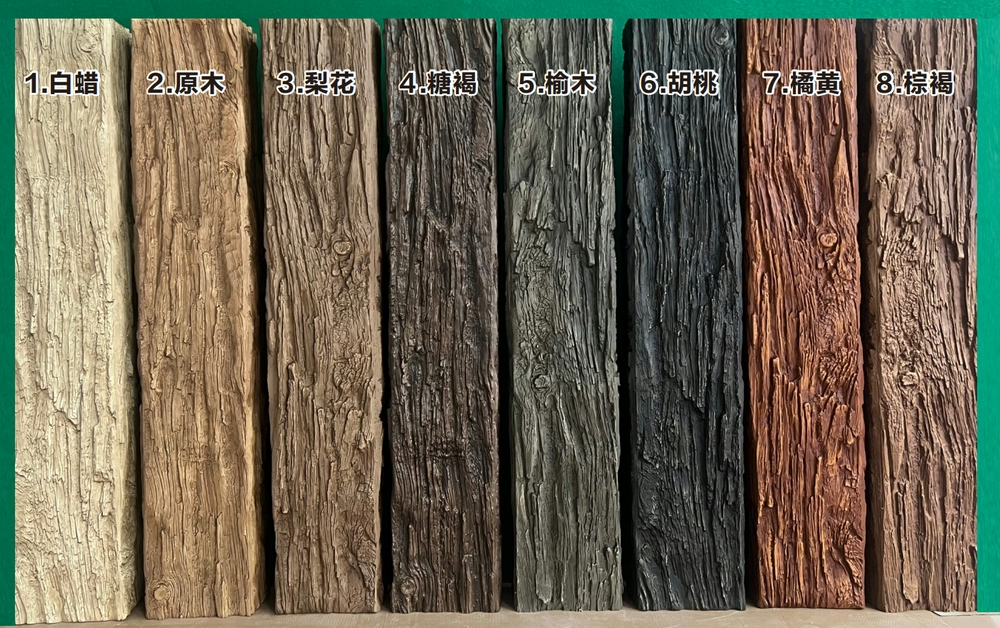
The "premium finish" column above represents textured or multi-step finishes — typically hand-hewn, rough-sawn, or reclaimed-style surfaces that require additional mold work or finishing steps. The premium tier commands 20 to 40 percent over standard finishes because:
- Higher-resolution molds cost more to produce
- Lower manufacturing yields due to texture defects
- More frequent mold replacement cycles
- Additional quality control steps
The "heavy texture" column represents the highest-tier finishes — deep hand-hewn, distressed reclaimed, or specialty weathered looks. These command 40 to 80 percent over standard because:
- Multi-step hand-finishing processes
- Lower production volumes
- Higher scrap rates
- Specialty finishing materials
Most residential projects specify standard or premium finishes. Heavy texture is reserved for lodge, chalet, and high-end rustic projects where the deep texture is the design intent.
Length-based pricing
Length affects price because longer beams:
- Require larger molds
- Have lower production yields (defects more likely over longer runs)
- Pack less efficiently in shipping containers
- Need more careful handling
Length premiums over the 8-foot baseline (approximate):
| Length | Premium |
|---|---|
| 8 ft | baseline |
| 10 ft | 5–10% |
| 12 ft | 12–20% |
| 14 ft | 20–30% |
| 16 ft | 30–45% |
| 20 ft | 50–75% |
| Custom length | 60–100%+ |
The length premium reflects both production economics and shipping costs. For most residential projects, 12 to 14-foot stock hits the best balance of length and price.
Volume discount tiers
Trade buyers typically see volume discounts at predictable breakpoints:
- Under 100 linear feet — full retail pricing
- 100 to 300 linear feet — 8 to 15 percent volume discount
- 300 to 800 linear feet — 15 to 25 percent volume discount
- 800 to 2,000 linear feet — 25 to 35 percent volume discount
- 2,000+ linear feet — 35 to 45 percent volume discount (negotiated)
The biggest discounts are at container-load quantities. A 40-foot container of standard 8-foot beams at 6x8 profile runs about 2,500 to 3,000 linear feet, which hits the top discount tier.
For smaller trade buyers, consolidating orders with other buyers through a buying group can access the 300+ linear foot tier without individually hitting it.
Custom finish pricing
Custom finishes (colors, textures, or profiles not in the manufacturer's standard catalog) carry significant premiums:
- Custom color match — $500 to $1,500 setup fee plus 8 to 15 percent per-piece premium
- Custom texture — $3,000 to $8,000 mold modification plus 25 to 50 percent per-piece premium
- Custom profile — $8,000 to $25,000 new mold plus 30 to 60 percent per-piece premium
- Custom length — $1,500 to $4,000 setup fee plus 15 to 30 percent per-piece premium
Custom work requires minimum order quantities (typically 200 to 500 linear feet) and longer lead times (45 to 90 days). The economics work for large projects but rarely for one-off residential jobs.
Total installed cost
The total installed cost of faux timber beams includes:
- Materials — the beam itself
- Shipping — varies by destination and shipping method
- Customs and duties — for international shipments
- Mounting hardware — adhesive, fasteners, backing
- Labor — installation time at local rates
- Finishing — paint touch-up, joint finishing, end caps
Material cost is typically 50 to 65 percent of total installed cost. Labor runs 25 to 35 percent. Hardware and finishing account for 5 to 15 percent.
A typical residential installation breakdown:
| Component | 8x10 Beam | 10x10 Beam |
|---|---|---|
| Beam materials | $72/lf | $108/lf |
| Shipping (per lf) | $4–$8 | $5–$10 |
| Mounting hardware | $3–$5 | $4–$7 |
| Labor (per lf installed) | $18–$30 | $22–$35 |
| Finishing | $2–$4 | $3–$5 |
| Total installed | $99–$119/lf | $142–$165/lf |
These figures assume US residential labor rates. International labor rates vary significantly.
Regional price variations
Beam pricing varies by region because of:
- Shipping costs (longer distances = higher costs)
- Local labor rates
- Import duties and taxes
- Currency exchange rates
- Local competition and market maturity
Approximate regional pricing factors (relative to US baseline):
| Region | Pricing Factor |
|---|---|
| US (domestic) | 1.0x baseline |
| Canada | 1.05–1.15x |
| UK | 1.15–1.30x |
| Western Europe | 1.15–1.30x |
| Eastern Europe | 1.10–1.25x |
| Australia | 1.25–1.45x |
| Middle East | 1.20–1.40x |
The variations mostly reflect shipping and duty costs. US-based warehouses offer the most competitive pricing for North American projects.
What drives price changes in 2026
Several factors are affecting 2026 pricing:
Raw material costs — polyurethane resin prices increased 6 to 9 percent year-over-year in 2025-2026 due to feedstock price volatility. Most manufacturers passed through these costs in early 2026.
Shipping rates — ocean freight rates stabilized in 2025 after the 2024 spike, but remain 20 to 30 percent above pre-pandemic norms. Expect stable-to-slight-increase shipping rates through 2026.
Labor costs at factories — Asian manufacturing labor rates increased 4 to 7 percent in 2025. Most manufacturers absorbed these costs without passing them through fully, but 2026 prices reflect some labor-driven increases.
Energy costs — manufacturing energy costs remain elevated compared to pre-2022 baselines. Most manufacturers have implemented energy efficiency measures but pass through residual costs.
Currency — USD strength affects pricing for non-USD buyers. Strong USD makes US-sourced beams more expensive for European and Asian buyers.
Pricing strategies for trade buyers
For trade buyers managing 2026 budgets:
Lock pricing early — most manufacturers hold pricing for 30 to 60 days from quote. Lock orders when budgets are firm.
Consolidate orders — combining multiple project orders into single purchase orders accesses higher volume discounts.
Standardize specs — using standard profiles and finishes avoids custom premiums.
Plan for inventory — purchasing ahead of need and warehousing can capture volume discounts for smaller projects.
Negotiate on payment terms — faster payment often unlocks 2 to 5 percent additional discount at most suppliers.
A practical budget guide
For different project types in 2026:
Budget residential project — 6x8 or 8x8 profile, standard finish, 8 to 12-foot lengths, 100 to 300 linear feet total. Budget $80 to $120 per linear foot fully installed.
Mid-range residential project — 8x10 or 10x10 profile, premium finish, 10 to 14-foot lengths, 200 to 500 linear feet total. Budget $130 to $190 per linear foot fully installed.
Premium residential project — 10x12 or 12x12 profile, heavy texture finish, custom lengths, 300 to 800 linear feet total. Budget $200 to $320 per linear foot fully installed.
Commercial project — varies widely by code requirements, mounting systems, and scale. Budget $180 to $380 per linear foot fully installed for most commercial work.
A practical rule
For 2026 budgeting, expect to pay $80 to $200 per linear foot for most premium faux timber beam installations, depending on profile, finish, and project scale. The biggest cost drivers are profile size (which scales roughly linearly with material cost) and finish complexity (which can add 20 to 80 percent). Volume discounts are real but require planning to capture.
Technical References
ASTM standards cited in every specification
Test Data
Lab results from internal testing program
Updated 2026
Reviewed against current product specs