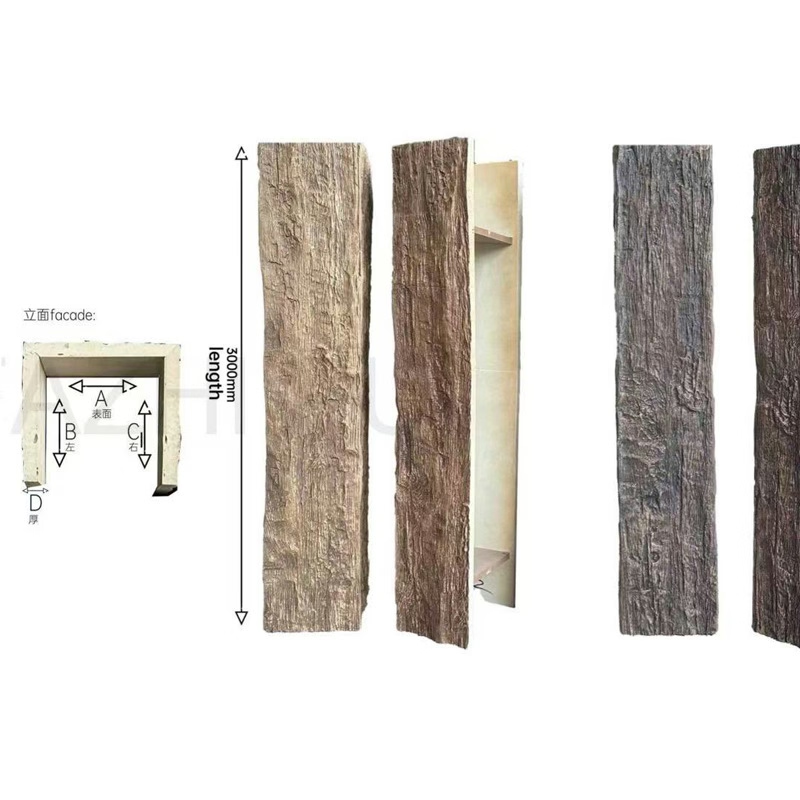
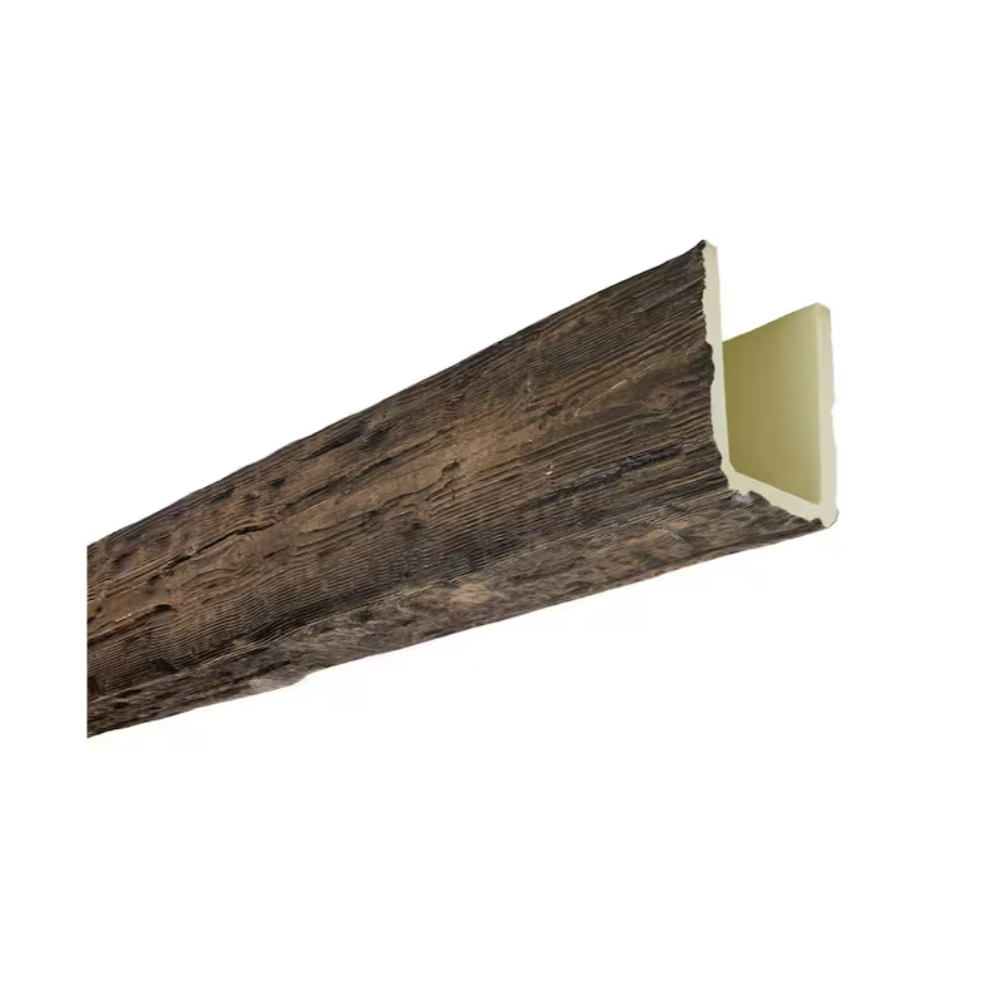
Stock beam lengths work great for stock ceiling dimensions. Real renovation projects rarely have stock dimensions. The living room that started as 12 feet now measures 12 feet 4 inches after the kitchen addition. The vaulted ceiling follows a roofline that no architect in 1952 bothered to make square. The historic home has settled just enough that the wall-to-wall distance varies by half an inch between the front and back of the room. Each of these situations demands beams that match the actual space, not generic dimensions that force awkward field cuts.
Exact-size custom polyurethane faux beams address this gap between standard inventory and actual project conditions. The beams arrive sized to the dimensions provided, ready to install without trimming. For contractors and designers managing renovation projects, the value is not just convenience. It is cleaner finished work, faster installation, and reduced material waste.
How exact sizing differs from custom sizing
The terms "custom size" and "exact size" are sometimes used interchangeably, but they describe slightly different offerings. Custom size generally means any dimension different from standard stock lengths. Exact size implies a more rigorous tolerance and a confirmation process that the beam will match the measured space with minimal field adjustment.
An exact-size order typically starts with the buyer providing precise measurements of the installation space. The factory confirms dimensions, sometimes requesting additional information like corner angles or wall conditions, before producing the beams. The final products arrive with documentation that confirms their actual measured dimensions, which the installer can verify before beginning work.
For projects with critical dimensional requirements, exact sizing offers a level of confidence that generic custom orders cannot. The beam arrives at the site, the installer measures it against the opening, and the fit is correct within the agreed tolerance. No time is spent on field trimming, no material is wasted in cut-offs, and no compromise is needed in the finished appearance.
Measuring accurately for exact-size orders
The accuracy of an exact-size beam depends on the accuracy of the measurements provided to the factory. Renovation spaces present measurement challenges that new construction does not. Walls are rarely perfectly parallel. Ceilings often have slight variations. Corners may not be true right angles. Each of these irregularities needs to be captured in the measurement information sent to the factory.
The most reliable approach is to measure each beam location individually rather than assuming that opposite walls produce matching beam lengths. A 14-foot room might need a 13-foot 11-inch beam at one end and a 14-foot 1 inch beam at the other. Treating each beam as a unique dimension prevents the kind of cumulative error that produces visible gaps at one end and tight fits at the other.
Measurements should be taken at the actual beam mounting height rather than at the floor. Walls are not always plumb, which means a measurement at the floor can be quite different from a measurement at ceiling level. For ceiling-mounted beams, the relevant dimension is the distance between the walls where the beam will actually sit. For wall-mounted beams, the relevant dimension is at the mounting height.
Document measurements with photographs when possible. A photo of the installation space with a tape measure visible in the frame communicates spatial conditions that numbers alone cannot capture. The factory's production team can use the photos to identify potential issues like obstructions, uneven surfaces, or unusual corners that might affect beam sizing or installation.

Tolerance expectations
Manufacturing tolerances for exact-size polyurethane beams are typically plus or minus 2mm to 3mm per linear meter for length. For a 4-meter beam, that means the actual length can vary by up to about 12mm from the specified dimension. This tolerance is tight enough for most renovation applications, where small gaps can be hidden by end caps, caulking, or trim.
Premium production can achieve tighter tolerances, often plus or minus 1mm per linear meter, for projects that demand extreme precision. The tighter tolerance typically requires additional quality control steps during production and may extend lead time by a week or two. For most decorative beam applications, the standard tolerance is sufficient, and the cost savings of standard tolerance production can be significant.
Cross-sectional dimensions (width and depth) are typically held to tighter tolerances because the molds are precision-machined. Width and depth can be expected to match specifications within 1mm to 2mm regardless of production run. This dimensional consistency is important for installations with multiple beams where the visible cross-section must be uniform across the entire run.
Where exact sizing delivers the most value
Several renovation scenarios benefit especially from exact-size beam production. Older homes with non-standard construction are obvious candidates. A 1940s bungalow with 11-foot 3-inch ceilings, for example, needs beams sized to that exact dimension rather than 11-foot stock that has to be cut down. The cut-down approach wastes material and produces a cut end that needs finishing.
Additions and remodels that combine old and new construction often produce unusual dimensions. A kitchen addition might have created a 13-foot 6-inch span that no stock length matches. The transition between original construction and addition may have slight offsets that require beams sized to bridge the actual geometry rather than idealized parallel walls.
Historic renovations present special challenges. Heritage buildings often have walls that are out of plumb by several centimeters over their height. Beam installations in these buildings require each beam to be sized to its specific location, with the factory producing a range of slightly different lengths that all fit the same general space but account for local variations.
Commercial renovations in older buildings face similar challenges. Restaurants, retail stores, and offices in converted warehouses or historic structures rarely have the clean dimensions of new construction. Exact-size beams allow designers to maintain the integrity of their design intent while accommodating the realities of the building.
Coordinating exact sizing with finish specifications
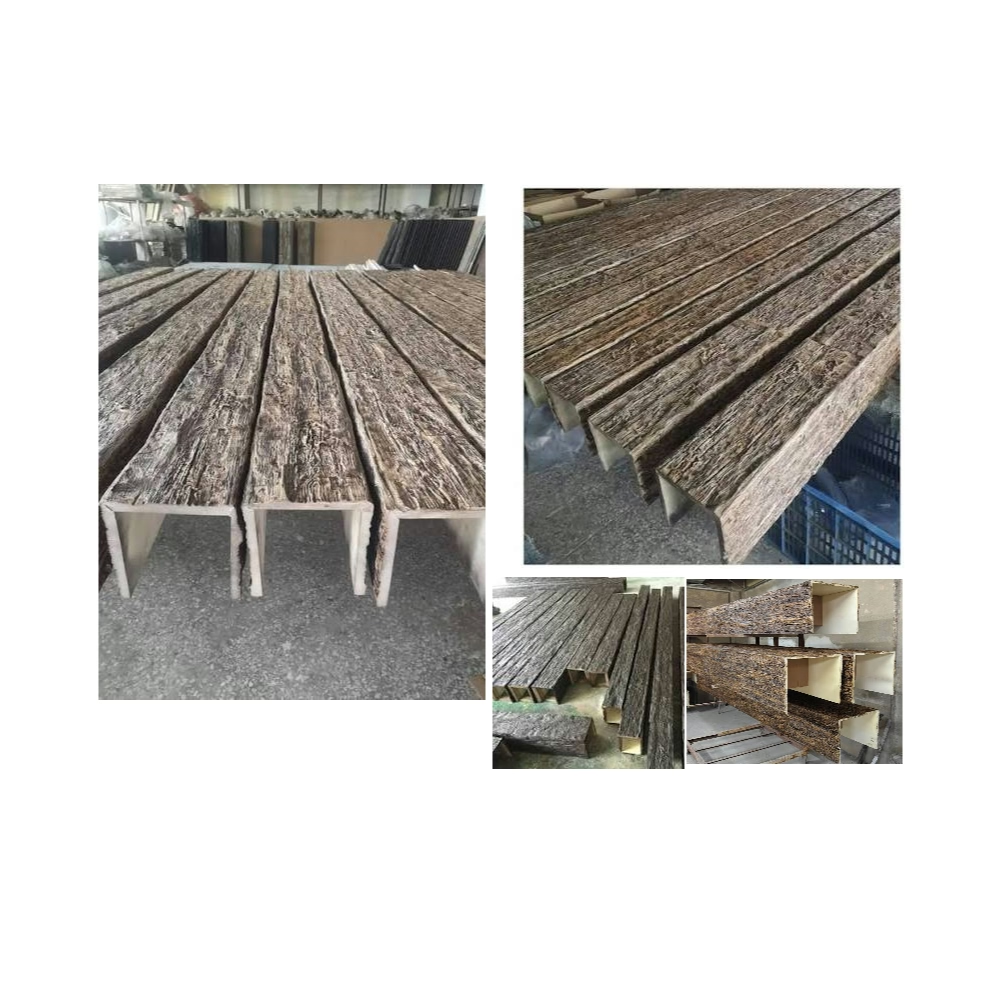
Exact-size production should be coordinated with finish specifications to avoid coordination problems. A beam that arrives in the right length but the wrong finish is not a useful delivery. The factory should confirm both dimensions and finish before production begins, ideally with a written approval from the buyer that locks in both sets of specifications.
Sample approval before production is particularly important for exact-size orders because the cost of error is higher. A stock-length beam that arrives with the wrong finish can sometimes be substituted with a different stock item. An exact-size beam in the wrong finish cannot be easily replaced. The production run needs to get it right the first time.
For multi-phase projects, all exact-size beams should ideally be ordered in a single production run. This ensures finish consistency across phases, even when installation happens months apart. Splitting the order across multiple production runs introduces the risk of slight color or texture variation that becomes visible when beams from different runs are installed in adjacent spaces.
Installation advantages of exact-size beams
The installation benefits of exact-size beams extend beyond just saving field cutting time. With beams sized to match the actual space, installers can work more efficiently throughout the entire process. Layout marking is simpler because the beam positions correspond directly to the measured dimensions. Bracket placement can be planned in advance based on the beam lengths.
Joint treatment is also easier with exact-size beams. Beams that meet at corners arrive with ends cut to the correct angle, eliminating the need for field mitering. Joints between abutting beams can be tight from the start, requiring minimal filler or touch-up. The cleaner joints contribute to an overall installation that looks more precise and intentional.
Cleanup and waste handling are reduced as well. Field cutting produces sawdust, cut-off pieces, and packaging waste from the cut-down process. Exact-size beams arrive with minimal cutting required, so the work site stays cleaner and disposal is simpler. For occupied renovation projects where homeowners are living through the work, this reduction in mess is a real quality-of-life benefit.
Coordinating with other trades
Renovation projects involve multiple trades working in sequence. Exact-size beam installation must be coordinated with the work of electricians, plumbers, HVAC installers, and finish carpenters. When beams are sized exactly to the space, the coordination with other trades becomes more straightforward because the beam positions are known precisely from the start.
Electrical work for recessed lighting, ceiling fans, or other fixtures integrated with the beams can be planned around the actual beam locations. HVAC ductwork that needs to navigate around or through beams can be designed to accommodate the exact beam dimensions. Coordination meetings between trades become more productive when everyone is working from the same dimensional information.
Finish carpenters who handle adjacent trim work, crown molding, or built-ins can also plan more accurately when beam dimensions are confirmed. The transition between beam ends and wall surfaces is one of the most visible details in a beam installation, and getting it right requires coordination between the beam installer and the carpenter handling the wall finishes.
Cost-benefit analysis
Exact-size beams typically cost more than stock-length beams of equivalent profile and finish. The premium covers the additional production planning, scheduling, and quality control required for non-standard dimensions. For a single beam, the premium might add 15 to 25 percent to the unit cost. For larger orders, the premium may decrease as setup costs are amortized across more units.
The cost-benefit calculation should include labor savings on installation, reduced material waste, and improved finished appearance. A beam that saves 30 to 60 minutes of field cutting labor has effectively paid for the exact-size premium at typical contractor rates. For multi-beam installations, the cumulative labor savings can be substantial.
The improved finished appearance is harder to quantify but real nonetheless. An installation with tight joints, properly fitted ends, and consistent beam positions looks more professional than one with field-cut compromises. For projects where the ceiling is a focal point or where the homeowner is detail-oriented, this quality difference is often the deciding factor in choosing exact-size production.
Working with a supplier on exact-size orders
Successful exact-size orders depend on clear communication between buyer and factory. Provide measurements in a consistent format, with units clearly marked. Include photographs of each beam location where possible. Specify the measurement reference points so the factory understands what each dimension represents.
Confirm receipt of measurements in writing. A simple email confirming "beam 1: 4 meters 235mm, beam 2: 4 meters 412mm" creates a record that both parties can reference. Verbal confirmations are easy to forget or misremember, and they lead to production errors that are costly to correct.
Maintain a relationship with a single supplier for exact-size work where possible. The supplier learns the measurement formats and quality expectations that your projects require. Over time, the ordering process becomes faster and the results become more consistent. Switching suppliers for each project reintroduces learning curves that cost time and create risk.
Technical References
ASTM standards cited in every specification
Test Data
Lab results from internal testing program
Updated 2026
Reviewed against current product specs