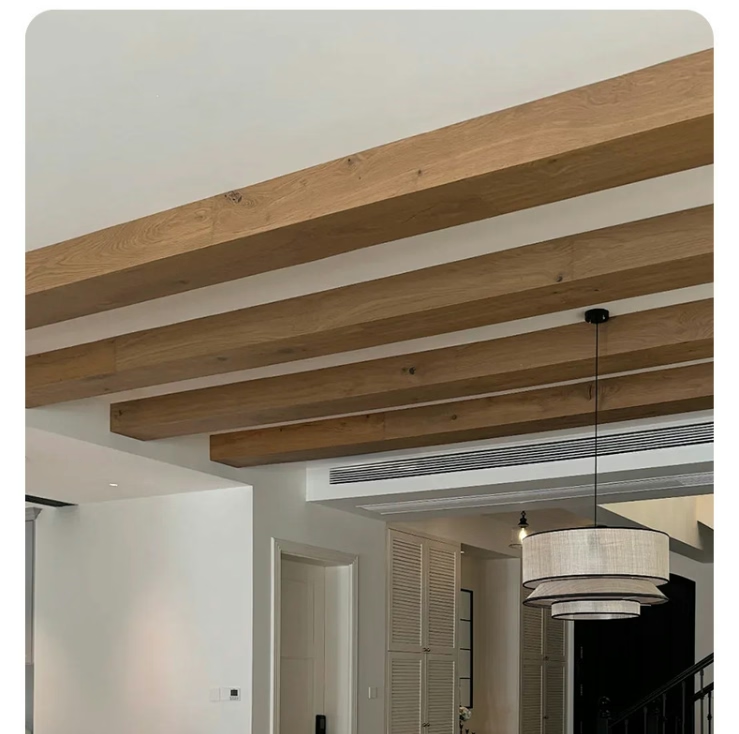
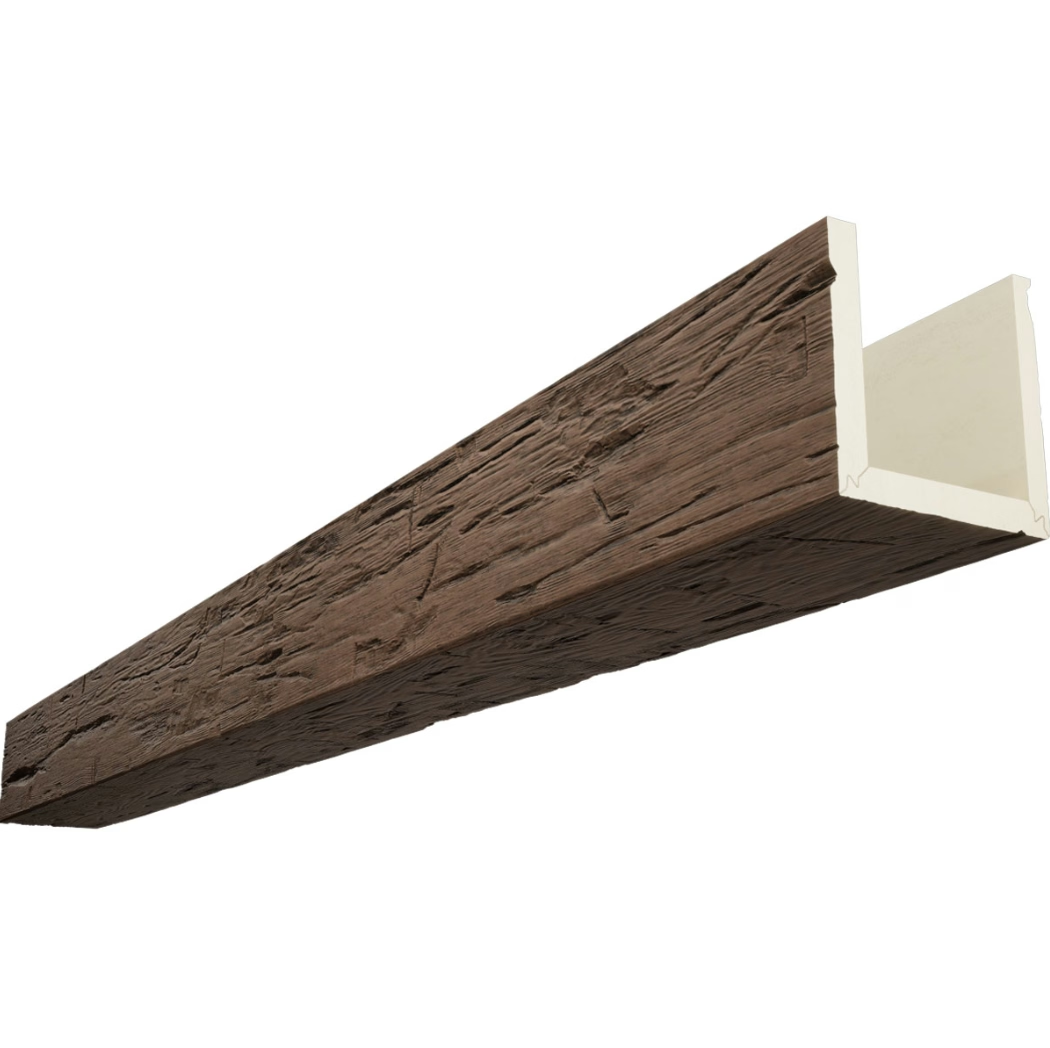
Wholesale pricing on faux wood beams follows a familiar volume-based structure, but the specifics vary widely between suppliers. Some offer modest discounts that kick in at order values most small businesses never reach. Others structure their tiers to reward genuine volume commitments with substantial savings that significantly improve the buyer's margin. Understanding how these tiers typically work helps wholesale buyers position their businesses to qualify for the best available pricing.
The underlying economics of faux beam production favor volume. Raw material purchases in larger quantities cost less per unit. Mold setup costs amortize across more pieces. Production runs become more efficient as workers gain familiarity with a specific profile and finish. Packaging and shipping costs decrease on a per-unit basis as container utilization improves. These savings can be substantial, and suppliers who pass them along to volume buyers create win-win relationships that drive repeat business.
For buyers, the challenge is matching order volumes to the discount tiers that make economic sense. Ordering too few units misses out on savings. Ordering too many ties up capital in inventory and risks obsolescence if finishes change or customer preferences shift. The sweet spot is the order volume that qualifies for meaningful discounts while staying within the buyer's actual sales pipeline.
Typical volume discount tiers
Most faux beam suppliers structure their wholesale pricing in three to five tiers. The first tier, sometimes called the entry wholesale level, might apply to orders of 50 to 100 beams and offer 10 to 15 percent off list pricing. This tier is designed for smaller contractors and design firms who buy regularly but in modest quantities per order.
The mid-tier, often starting at 200 to 500 beams, typically offers 20 to 30 percent off list. This is where serious wholesale buyers operate. The savings at this level justify dedicated inventory space and allow competitive pricing against larger competitors who might be sourcing from different suppliers at different price points.
The top tier, usually reserved for orders of 1000 or more beams, can offer 35 to 45 percent off list pricing. At this level, the buyer is essentially operating as a regional distributor, and the pricing reflects the role they play in moving volume through the supply chain. Some suppliers negotiate custom pricing above certain thresholds, especially for buyers who commit to ongoing purchase agreements.
Volume can be measured in units, in dollar value, or in container loads. Some suppliers prefer unit counts because they are easier to track. Others prefer dollar values because they reflect the actual revenue impact. Container-load pricing is common for international buyers and ties the discount to the freight economics that drive much of the underlying cost structure.
Qualification criteria beyond volume
Volume is not the only criterion suppliers consider when offering bulk discounts. Payment terms matter because they affect the supplier's cash flow. Buyers who pay deposits upfront and balance on delivery are lower risk than buyers who request extended payment terms. Suppliers often offer better pricing to buyers who can commit to faster payment.
Consistency of ordering also influences discount eligibility. A buyer who places a single large order and then disappears for a year is less attractive than a buyer who places smaller orders regularly. Suppliers prefer predictable revenue streams over spike-and-drought patterns, and they structure discounts to reward ongoing relationships. Some suppliers offer annual volume rebates that pay out at year end based on total purchases, which incentivize steady ordering throughout the year.
Product mix can affect discount levels too. Buyers who stock a wide range of profiles and finishes provide the supplier with more stable production scheduling than buyers who only order one or two SKUs. The supplier can run the popular SKUs continuously and the specialty SKUs as needed, smoothing out production. This efficiency sometimes translates into better pricing for the buyer with the broader product mix.
Geographic exclusivity or territory protection is another qualification lever. Buyers who commit to not selling outside an agreed territory, or who agree to exclusive representation in a specific region, often receive preferential pricing. The supplier gets market coverage without channel conflict, and the buyer gets pricing that reflects the protected market position.

How to position for better tiers
Wholesale buyers looking to access better discount tiers have several options. The most direct is simply increasing order volumes, but this requires capital, storage space, and confidence in sell-through. For buyers not ready to commit to larger inventory, other positioning strategies can help.
Establishing a written forecast with the supplier signals serious intent. A buyer who projects 300 beams over the next six months, with quarterly order sizes and product mix specified, often qualifies for mid-tier pricing even if individual orders are smaller. The supplier gains visibility into upcoming demand and can plan production accordingly, while the buyer locks in better pricing without taking on excessive inventory risk.
Combining orders with other buyers in a purchasing consortium is another approach. Multiple small contractors or designers who coordinate their orders can collectively reach volume thresholds that none of them could reach individually. Some industry associations facilitate this kind of collective purchasing. The savings are shared among participants, and each buyer gets better pricing than they would qualify for on their own.
Negotiating annual contracts with committed volumes is increasingly common. A buyer who commits to purchasing 1000 beams over a 12-month period at agreed prices can often negotiate pricing equivalent to a single 1000-beam order, even if individual deliveries are smaller. The supplier gets volume commitment and the buyer gets the discount without the inventory risk of a single large purchase.
Hidden costs to watch for
Discount tiers sometimes come with conditions that affect the overall value. Minimum order quantities might apply to certain discount levels, requiring the buyer to commit to more units than their immediate need justifies. Restocking fees for beams returned from a discounted order can offset some of the savings. Payment terms might shorten for discount orders, requiring faster cash outlay than standard terms.
Shipping costs deserve special attention in any discount analysis. A quoted unit price with volume discount may not include shipping, and the freight on a large order can be substantial. Some suppliers offer free shipping above certain order values, which effectively increases the discount. Others charge shipping at cost, which can be significant for heavy or bulky faux beam products.
Customs duties, import taxes, and broker fees apply to international orders and should be factored into the landed cost comparison. A 30 percent discount on the unit price may translate to only a 15 percent savings on landed cost if the order triggers new customs thresholds or requires special handling. Working with a supplier who provides DDP (Delivered Duty Paid) shipping simplifies this analysis because all costs are included in the quoted price.
Building a long-term wholesale relationship
The best pricing on faux wood beams usually comes from long-term wholesale relationships rather than spot purchases from the lowest bidder. Suppliers who know a buyer's business, understand their customer base, and trust their payment reliability will often extend pricing that exceeds their published tiers. This preferential treatment is earned over time through consistent ordering, prompt payment, and professional communication.
Buyers should treat their faux beam supplier as a strategic partner rather than a transactional vendor. Sharing forecasts, providing feedback on customer preferences, alerting the supplier to upcoming projects, and collaborating on marketing materials all strengthen the relationship. The supplier becomes invested in the buyer's success and is more willing to extend favorable terms when the buyer needs them.
Volume rebates and year-end bonuses are common features of established wholesale relationships. A buyer who orders 800 beams over the course of a year, even in individual shipments of 50 to 100 units, may receive an additional rebate that brings their effective pricing in line with what a single 800-unit order would have qualified for. These rebates reward the kind of consistent ordering behavior that suppliers value most.
Comparing discount structures across suppliers
Not all suppliers structure their bulk discounts the same way. Some use steep discount curves that reward the largest buyers disproportionately. Others use flatter curves that offer meaningful savings at lower volume thresholds. Comparing structures involves looking beyond the headline discount percentage to understand what each tier actually requires.
A supplier offering 40 percent off at 1000 units may not be a better deal than a supplier offering 30 percent off at 300 units, depending on the buyer's typical order volume. The buyer who rarely orders more than 200 units should focus on suppliers with attractive mid-tier pricing. The buyer who regularly orders 1500 units should look for suppliers with the most generous top-tier terms.
Beyond headline discounts, suppliers differ in what is included. Some quotes include mounting hardware and end caps. Others price these separately. Some quotes include color matching and custom finish development. Others charge for these services. Comparing total project cost, including all the extras, gives a clearer picture of which supplier offers the best value.
When to push for better terms
Asking for better discount terms is reasonable at certain points in a wholesale relationship. The first order is not usually the moment. Suppliers need to establish trust before extending their best pricing, and pushing too hard initially can create friction. Better moments include after completing several successful orders, after demonstrating commitment through forecasts or contracts, or when the buyer's business has grown to a level that justifies the requested terms.
The approach matters as much as the timing. Buyers who frame requests as collaborative ("how can we structure this to work for both of us?") get better results than those who frame demands aggressively ("we need 40 percent off to consider this order"). Suppliers want to feel like partners in the buyer's success, not vendors being squeezed.
Walking away from a supplier who will not negotiate is sometimes the right move. If the supplier cannot or will not offer competitive pricing for the volume being offered, the buyer may be better off sourcing elsewhere. Maintaining relationships with multiple suppliers, even when one is the primary source, gives the buyer leverage in negotiations and provides a fallback if terms cannot be agreed.
Technical References
ASTM standards cited in every specification
Test Data
Lab results from internal testing program
Updated 2026
Reviewed against current product specs