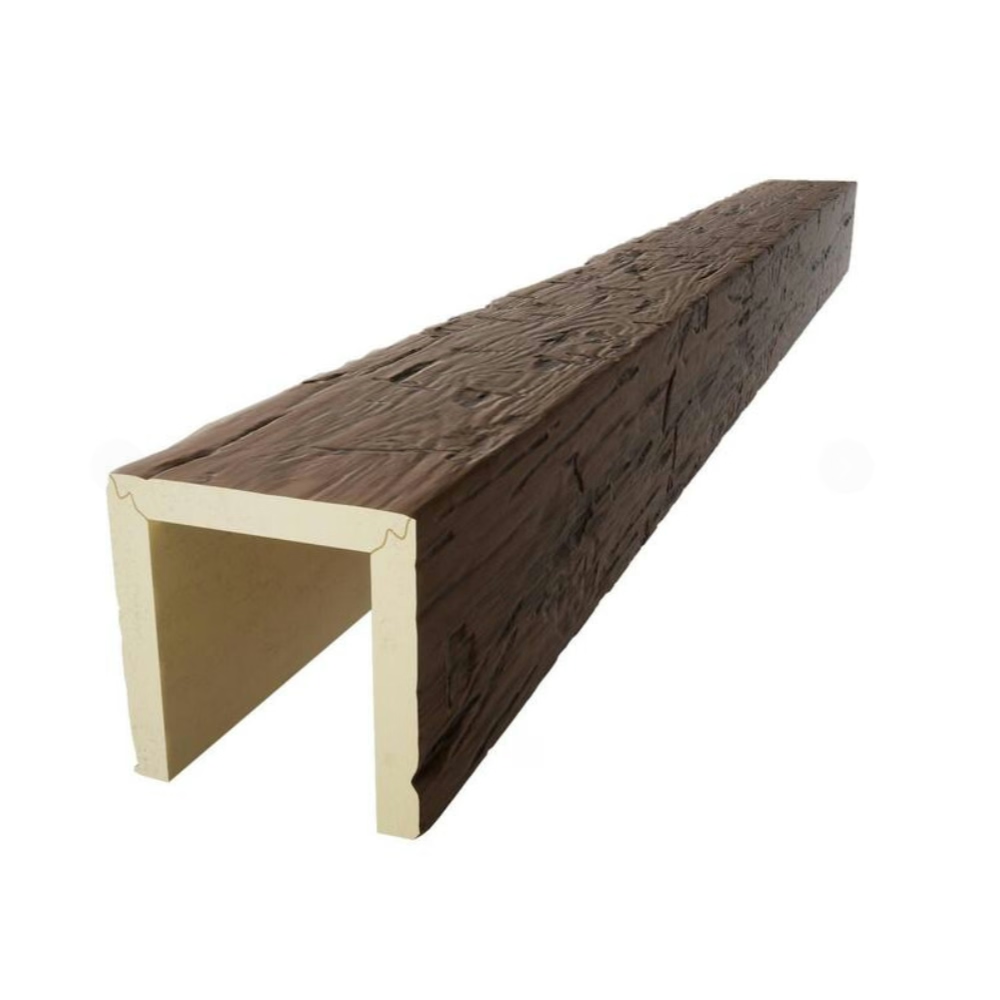
The conversation about building materials has shifted considerably over the past two decades. Where once the primary considerations were initial cost and aesthetic appeal, the conversation now routinely includes service life, maintenance requirements, and total cost of ownership. This broader perspective is warranted: the true cost of a building material is not captured in its purchase price alone but in the cumulative cost of maintaining, repairing, and eventually replacing it over the life of the installation. By this measure, hollow shell faux timber ceiling beams offer one of the most compelling value propositions available in contemporary ceiling treatments.
The service life of quality hollow shell faux beams is typically rated at 20 to 25 years for the structural foam core and 10 to 15 years for surface coatings under normal interior conditions, with many manufacturers offering warranties that reflect this durability. These figures compare favorably with interior-grade natural timber beams, which may require refinishing or repair within 5 to 10 years depending on exposure conditions, and which remain vulnerable to moisture damage, insect activity, and structural degradation throughout their service life.
Material Science of Long-Service Faux Beams
The longevity of hollow shell faux beams derives from the inherent material properties of high-density polyurethane and the engineering of the hollow-shell construction. Polyurethane polymers, when properly formulated and cured, are chemically stable across a wide range of environmental conditions. The material does not rot, does not corrode, and does not support biological growth. It absorbs minimal moisture and maintains its dimensional stability across normal temperature and humidity ranges without the expansion and contraction that causes natural wood to check, split, and deform over time.
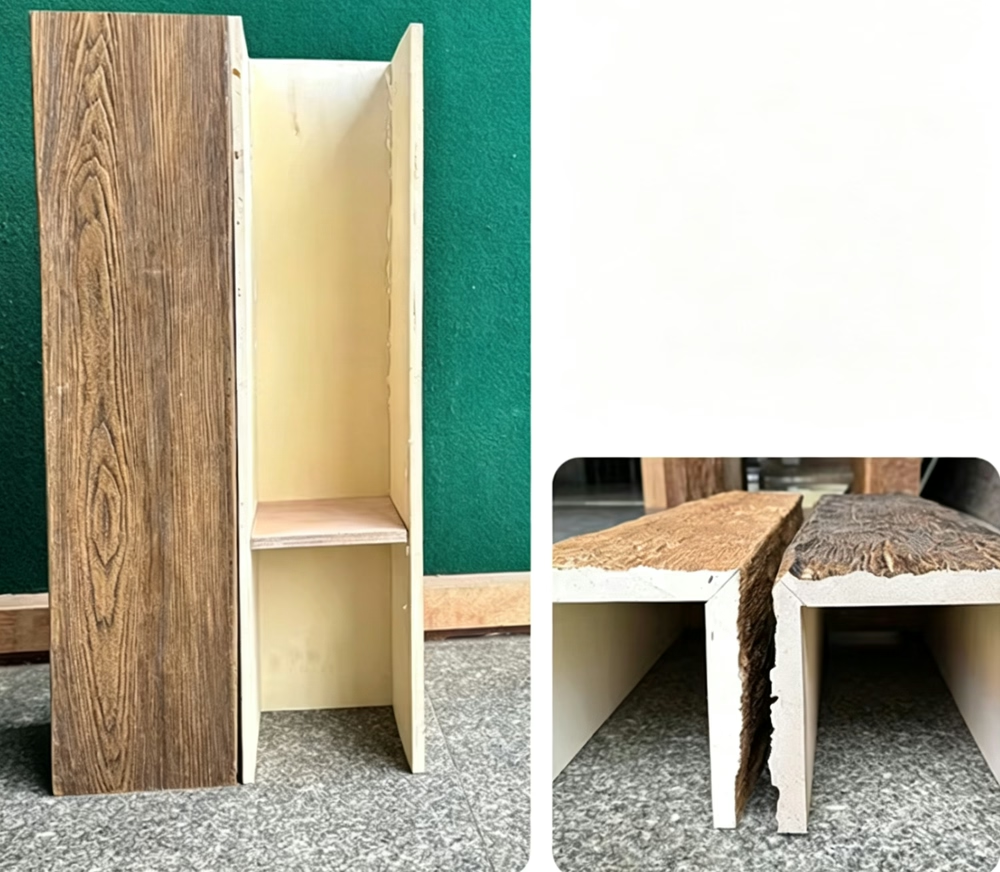
The hollow shell construction contributes to longevity by reducing the internal stresses that lead to material degradation. Solid materials experience differential thermal expansion between surface and core, which creates internal stresses that accumulate over thermal cycles and eventually cause cracking or delamination. The hollow interior of faux beams provides space for any minor thermal expansion to occur without generating significant internal stress, because the walls are thin enough to expand and contract uniformly rather than developing temperature gradients between surface and core.
Surface coatings applied to quality faux beams are specifically formulated for long-term adhesion and UV resistance. Interior applications are generally exposed to minimal UV radiation, so coating degradation in interior settings is primarily a function of surface abrasion, chemical exposure, and natural aging of the binder resin. Premium coatings use UV-stable pigment systems and durable binder chemistries that resist these degradation mechanisms, maintaining color fidelity and surface integrity for the rated service life of the coating.
Environmental Resistance and Performance Stability
Hollow shell faux beams perform consistently across the full range of environmental conditions encountered in interior building applications. In dry climates such as the American Southwest or interior Australia, where relative humidity may drop below 20 percent during winter months, natural timber beams shrink, check, and develop surface cracks that compromise both appearance and structural integrity. Faux beams are unaffected by these conditions; the closed-cell foam structure maintains its dimensions and surface appearance regardless of ambient humidity.
In humid climates, from tropical Southeast Asia to coastal Florida, the moisture resistance of polyurethane provides similar advantages. Natural timber in humid environments absorbs moisture, swells, and becomes vulnerable to mold growth and rot. Polyurethane beams resist moisture absorption entirely, maintaining stable dimensions and clean, mold-free surfaces throughout the humid season. The surface coatings applied to quality beams include mildewcide additives that provide additional protection against surface biological growth in high-humidity environments.
Thermal cycling, the repeated expansion and contraction of materials in response to temperature changes, is a primary driver of aging in building materials. In regions with significant seasonal temperature variation, exterior building materials may experience hundreds of thermal cycles per year, each cycle causing microscopic damage that accumulates into visible cracking, warping, and surface degradation over decades. Interior faux beams experience more moderate thermal cycling since interior temperatures are typically controlled, but the material's low thermal expansion coefficient means that any cycles that do occur generate minimal stress.

Maintenance Requirements Across the Service Life
The maintenance profile of hollow shell faux beams over their service life is remarkably simple. Interior beams in residential applications typically require only occasional dusting or cleaning with a damp cloth to maintain their appearance. There is no need for periodic refinishing, sealing, or repair of surface damage. There is no risk of insect damage that would require treatment. There is no moisture damage to monitor or address. The beams, once installed, simply persist in their original condition with minimal intervention.
Commercial installations may require slightly more attention due to higher traffic, more frequent cleaning, and greater exposure to airborne contaminants. Restaurant kitchens, for example, accumulate grease vapors that settle on ceiling surfaces and require periodic cleaning with appropriate degreasing solutions. Hospitality venues with high occupancy experience more rapid dust accumulation. Retail spaces with HVAC systems that introduce fresh air may expose beams to higher concentrations of atmospheric pollutants. In all these cases, routine cleaning with appropriate products is sufficient to maintain appearance; no specialized maintenance procedures or periodic refinishing are required.
The structural components of the installation — mounting hardware, support brackets, and attachment points — do require periodic inspection in both residential and commercial settings. Fasteners can loosen over time due to vibration, thermal cycling of the building structure, or settling. Inspecting mounting points annually and re-tightening any loose fasteners maintains the security of the installation throughout the beam's service life. This inspection requirement is minimal compared to the ongoing maintenance demands of natural timber, which require regular attention to the timber itself as well as its mounting hardware.
The Lifecycle Cost Advantage
Calculating the total lifecycle cost of hollow shell faux beams versus natural timber reveals the economic logic of the choice. A natural timber beam installation might cost 60 percent less initially than an equivalent faux beam installation, creating a strong temptation to choose the natural material. However, when maintenance costs are factored in over a 20-year service life, the picture changes dramatically. Natural timber requires refinishing at intervals of 5 to 8 years, with costs that may range from 30 to 50 percent of the original installation cost each cycle. Insect inspection and treatment, if applicable, adds additional annual cost. Any repair of damaged sections requires matching the original material and finish, which becomes more difficult and expensive as the beam ages.
Faux beams require no refinishing, no insect treatment, and no repair of aging-related damage. The only maintenance cost is occasional cleaning, which is negligible. The total lifecycle cost of the faux beam installation over 20 years is often 30 to 50 percent lower than the natural timber alternative when all costs are included. This lifecycle cost advantage, combined with the lower installation cost (for most species at most sizes), the dramatically simpler installation process, and the consistent quality of manufactured products, makes faux beams the economically rational choice for most ceiling beam applications.
For foreign trade buyers and commercial project specifiers who evaluate materials on lifecycle cost rather than initial price, hollow shell faux beams represent a specification that delivers superior value across every dimension of the analysis: initial cost, installation cost, maintenance cost, replacement cost, and environmental impact. This comprehensive value proposition is driving the rapid market share growth that faux beams have experienced across all major construction markets globally.
Technical References
ASTM standards cited in every specification
Test Data
Lab results from internal testing program
Updated 2026
Reviewed against current product specs


